Forex Leverage Limits in Canada (2026): Caps by Asset Class
If you’ve traded with an offshore broker offering 500:1 leverage and then opened a Canadian account, the lower caps can be a surprise. Here’s exactly what Canada allows, by asset class, and the logic behind it.
How we make money & how we research
We may earn a commission if you open an account through some links on this page, at no cost to you. We do not test brokers with live-funded accounts; our ratings are built from regulatory records (CIRO, CIPF, provincial regulators), public disclosures, and documented broker terms. See our methodology and affiliate disclosure. Trading forex and CFDs carries a high risk of loss.
Canadian leverage caps by asset class
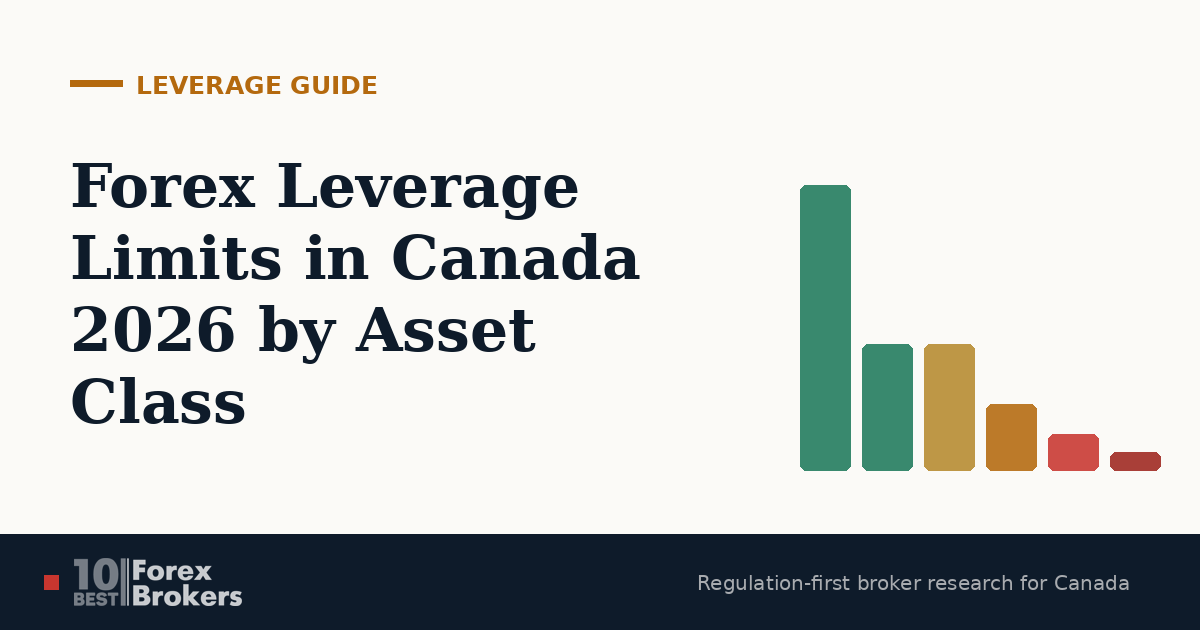
Caps depend on how volatile and risky the asset is — the riskier it is, the less leverage you’re allowed:
| Asset class | Typical max leverage | Approx. margin required |
|---|---|---|
| Major forex pairs (e.g. USD/CAD, EUR/USD) | ~50:1 | 2% |
| Minor / exotic forex pairs | ~20:1 or lower | 5%+ |
| Major indices | ~20:1 | 5% |
| Commodities | ~10:1 | 10% |
| Individual stocks | ~5:1 | 20% |
| Cryptocurrencies | ~2:1 to 3:1 | 33–50% |
What leverage actually does
Leverage lets you control a larger position than your cash alone would allow. At 50:1, $1,000 of your money can control a $50,000 position. That cuts both ways: a move that would be a small gain or loss on $1,000 becomes 50 times larger. Leverage doesn’t improve your odds — it amplifies the outcome, in both directions.
Why the cap is a good thing
Most retail traders lose money trading leveraged CFDs. High leverage is a major reason — it turns normal market noise into account-ending losses. Canada’s caps exist precisely to slow that down. If a broker offers Canadians far more than 50:1, that’s a sign it isn’t operating under CIRO rules. See how to check a broker is safe.
How to size positions within the caps
Leverage sets the maximum position you can take; it shouldn’t set the position you should take. Decide your risk per trade first, then size accordingly — our position size calculator does the math. For the full regulatory background, see the Canada forex regulation guide.
Frequently asked questions
What is the maximum forex leverage in Canada?
Retail leverage on major forex pairs is generally capped at about 50:1 (2% margin). Minor and exotic pairs, indices, commodities, stocks and crypto are capped progressively lower. These are CIRO-aligned limits designed to protect retail traders.
Why is Canadian leverage so much lower than offshore brokers?
Offshore brokers can advertise 500:1 or more because they aren’t bound by Canadian rules. CIRO caps leverage deliberately, because high leverage lets retail traders lose money extremely fast. Lower leverage is a protection, even though it feels like a restriction.