
Affiliate disclosure: We may earn a commission if you open an account through some links on this page, at no extra cost to you. That never changes a regulatory verdict here — a broker that is not licensed for Canadians gets said so, commission or not. See our full affiliate disclosure.
Risk warning: Forex and CFD trading is leveraged and carries a high risk of loss. Most retail accounts lose money. Nothing on this page is investment, legal or tax advice. Regulation reduces the risk that a firm mishandles your money — it does not reduce the risk of the trades themselves. Verify a broker’s current status on the regulator’s own records before you fund an account.
Written & researched by Mark Prosz — trading since 2015 · Licensed Alberta Realtor · Financial content creator & broker reviewer
Last reviewed: November 8, 2026
- The short answer: what a Canadian forex licence actually is
- How CIRO licensing works
- How to verify a broker’s licence, step by step
- CIPF protection: what it covers and what it doesn’t
- Province regulators and their roles
- The rules that come with a CIRO licence: leverage, segregation and complaints
- What offshore regulation does and doesn’t mean for Canadians
- Red flags of an unlicensed broker
- Investment fraud in Canada: what the 2025-2026 data show
- The verified CIRO-regulated brokers
- Forex taxes and registered accounts, in brief
- Frequently asked questions
- How we research this page
The short answer: what a Canadian forex licence actually is
“Forex brokers license” is the most common regulation search Canadians make about this market — and the answer is more specific than most broker websites admit. There is no single piece of paper called a “forex licence” in Canada. A broker is licensed to serve Canadian retail clients when both of these are true:
- The Canadian legal entity behind the brand is a dealer member of the Canadian Investment Regulatory Organization (CIRO), listed in CIRO’s public “Dealers We Regulate” directory in the Investment Dealer category; and
- That same entity is registered under provincial securities law in the provinces it serves, which you can confirm on the Canadian Securities Administrators’ (CSA) National Registration Search — or, for Quebec, through the Autorité des marchés financiers (AMF).
Both halves attach to the legal entity, not the brand. “OANDA” is a brand; OANDA (Canada) Corporation ULC is the licensed entity. “AvaTrade” is a brand; in Canada the licensed entity is Friedberg Mercantile Group Ltd., and the brand reaches you through its Friedberg Direct division. A licence held by a sister company in London, Sydney or Seychelles is a real licence — for that country. It gives the firm no authority to open leveraged forex accounts for Canadians, and it gives you none of the Canadian protections this page describes.
That two-part test is why the Canadian list is short: behind every brand a Canadian can legally use sit just eight CIRO dealer members (nine brands), and one of the eight is currently barred from opening new accounts. Every regulated forex broker in Canada ranked on this site passes both halves of the test. The rest of this page is the machinery behind the test — how CIRO licensing works, how to run the verification yourself in a few minutes, what CIPF protection actually covers, what your province adds, and what an offshore licence does and doesn’t mean. For the plain-language legal summary, start with Is Forex Trading Legal in Canada? — this page is the full reference it points to.
How CIRO licensing works
CIRO is Canada’s national self-regulatory organization for the investment industry. It was formed on June 1, 2023 by merging the Investment Industry Regulatory Organization of Canada (IIROC) and the Mutual Fund Dealers Association of Canada (MFDA). If you see a broker — or an old review — described as “IIROC-regulated,” that is not a different or extra licence: IIROC no longer exists, and the firm means CIRO. Marketing that still leads with IIROC branding years after the merger is a small but telling sign that nobody has checked the details recently.
CIRO is a self-regulatory organization, not a government department: it writes and enforces dealer rules under recognition and oversight from the provincial and territorial securities regulators, which remain the statutory authorities (see the province section below). For a forex or CFD broker, “getting licensed” means being approved as a CIRO dealer member, and membership is not a one-time grant. A dealer must continuously meet requirements on:
- Capital adequacy — minimum risk-adjusted capital, monitored on an ongoing basis, so the firm can absorb losses without reaching for client money.
- Client-money segregation — client funds held separately from the firm’s own money, under CIRO’s segregation rules.
- Proficiency and supervision — registered individuals who meet proficiency standards, supervised under a compliance system CIRO can inspect.
- Conduct and disclosure — prescribed risk disclosure for leveraged products, suitability and conflicts rules, audited financial reporting, and complaint-handling obligations.
- Enforcement exposure — CIRO can investigate, hold hearings, fine firms and individuals, impose terms and conditions on a dealer’s membership or compliance, suspend or terminate membership. Its “Dealers We Regulate” page publicly lists the dealers currently under such terms — a check worth running on any firm you are considering, because a listing there is information the firm’s own website will not volunteer.
CIRO has also been active on new fronts in 2026: it authorized two dealers to offer event contracts, consolidated Quebec oversight, and pushed its trading-increment amendments to November 2027.
Two consequences follow. First, the directory is the licence: if the Canadian entity is not in CIRO’s “Dealers We Regulate” list as an Investment Dealer, there is no CIRO licence, whatever the broker’s homepage says. Second, membership can change — dealers merge, get acquired, or have conditions imposed — which is why this page carries a review date and why the verification below is worth repeating even for a broker you already use. The live example on today’s list is Fortrade Canada Limited: a genuine CIRO dealer member that has been barred from opening new client accounts under a temporary order since November 2022. It holds a licence and still cannot take your account — exactly the kind of nuance a directory check plus a terms-and-conditions check catches, and a logo on a homepage doesn’t.
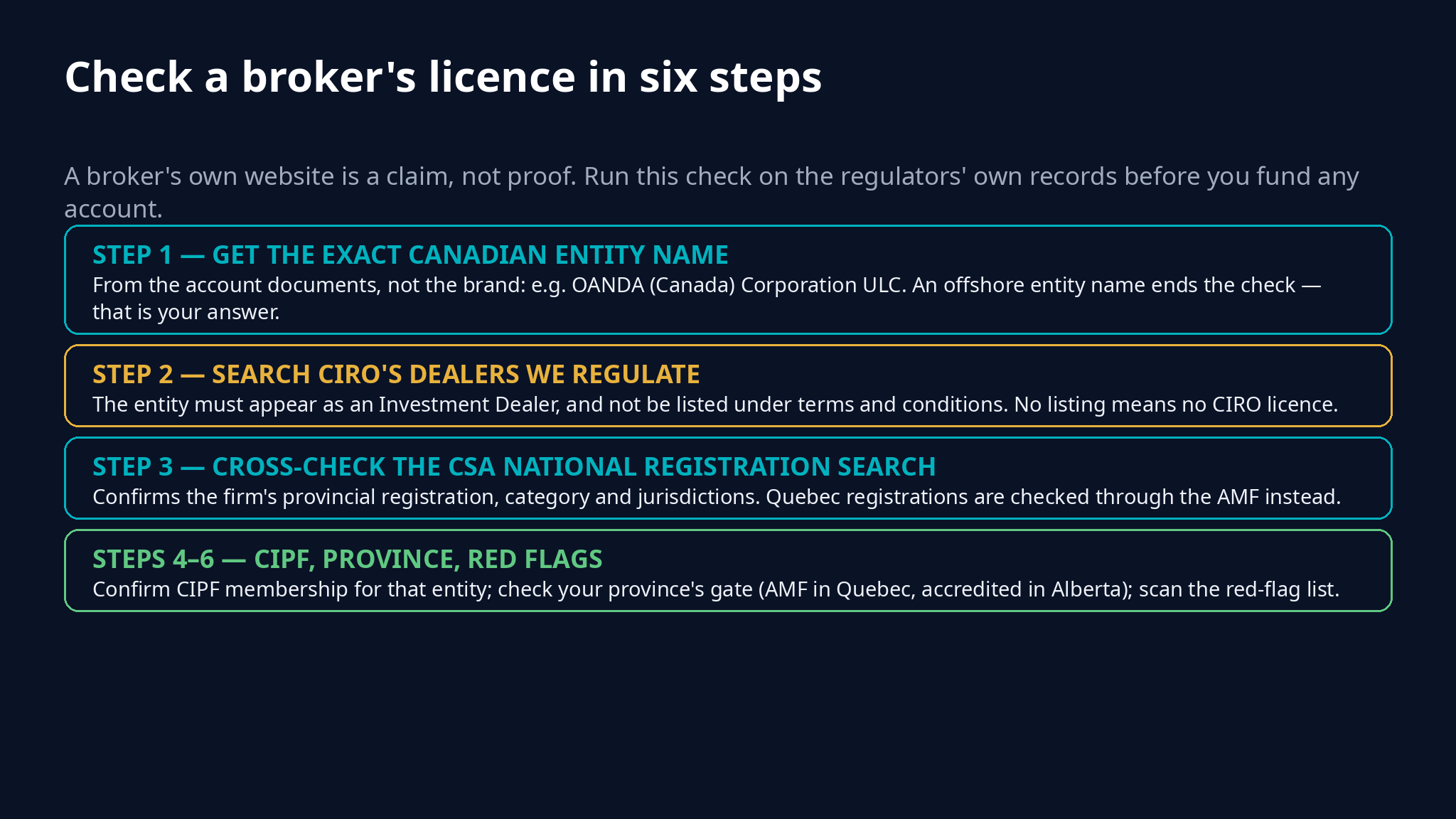
How to verify a broker’s licence, step by step
A broker’s own website is a claim, not proof. Run this check on the regulators’ records before you fund any account — it takes a few minutes, it is free, and it is the same check we run for every broker covered on this site.
Step 1 — Get the exact Canadian legal entity name. Find it in the account-opening documents or the legal footer of the broker’s Canadian site: OANDA (Canada) Corporation ULC, CMC Markets Canada Inc., GAIN Capital — FOREX.com Canada Ltd., Friedberg Mercantile Group Ltd. If the documents name an entity in Seychelles, Vanuatu, Mauritius, St. Vincent or any other offshore jurisdiction, stop there — you already have your answer, and the remaining steps will only confirm it.
Step 2 — Search CIRO’s “Dealers We Regulate” directory. Go to ciro.ca and open the directory. Search the legal entity name from Step 1. The firm must appear, in the Investment Dealer category. Read the entry closely: it confirms the dealer’s name and category, and CIRO’s directory pages flag dealers subject to membership or compliance terms and conditions. No entry means no CIRO licence — full stop.
Step 3 — Cross-check the CSA National Registration Search. Open the National Registration Search (linked from the CSA’s aretheyregistered.ca and from CIRO’s own directory page) and search the same legal entity. The result should show the firm’s registration, its category, and the provinces and territories where it is registered — the provincial half of the licence test. The search carries current and historical status back to 2003, so a firm that was registered and no longer is will show that too. One exception: the National Registration Search does not cover Quebec registrations — for Quebec, check the firm’s status through the AMF’s own registers, and for leveraged derivatives specifically, the AMF qualified-persons position described in the province section below.
Step 4 — Confirm CIPF membership for that entity. CIPF membership attaches to the dealer member, and every CIRO forex dealer in the verified table below is a CIPF member. Check the entity against CIPF’s member list anyway — this is the step that connects the licence to the insolvency protection in the next section.
Step 5 — Check your province on top of the national licence. CIRO membership is national; eligibility is not. Quebec adds the AMF qualification gate and Alberta carries an accredited-investor gate at three dealers (both detailed below). A broker can pass Steps 2–4 and still be unable to take your account.
Step 6 — Run the red-flag pass. Before funding, scan the full red flags list below — offshore licence presented as a Canadian one, IIROC branding used as if current, pressure to fund first, deposits demanded in crypto only. Any one of them outweighs a clean-looking homepage.
Two tools on this site do parts of this for you: our CIRO Broker Checker runs the Canadian registration check, and our broker safety analyzer works through the wider safety picture — ownership, regulation, complaint routes. Neither replaces reading your own account documents: the entity named there is the entity Steps 1–4 must match.
CIPF protection: what it covers and what it doesn’t
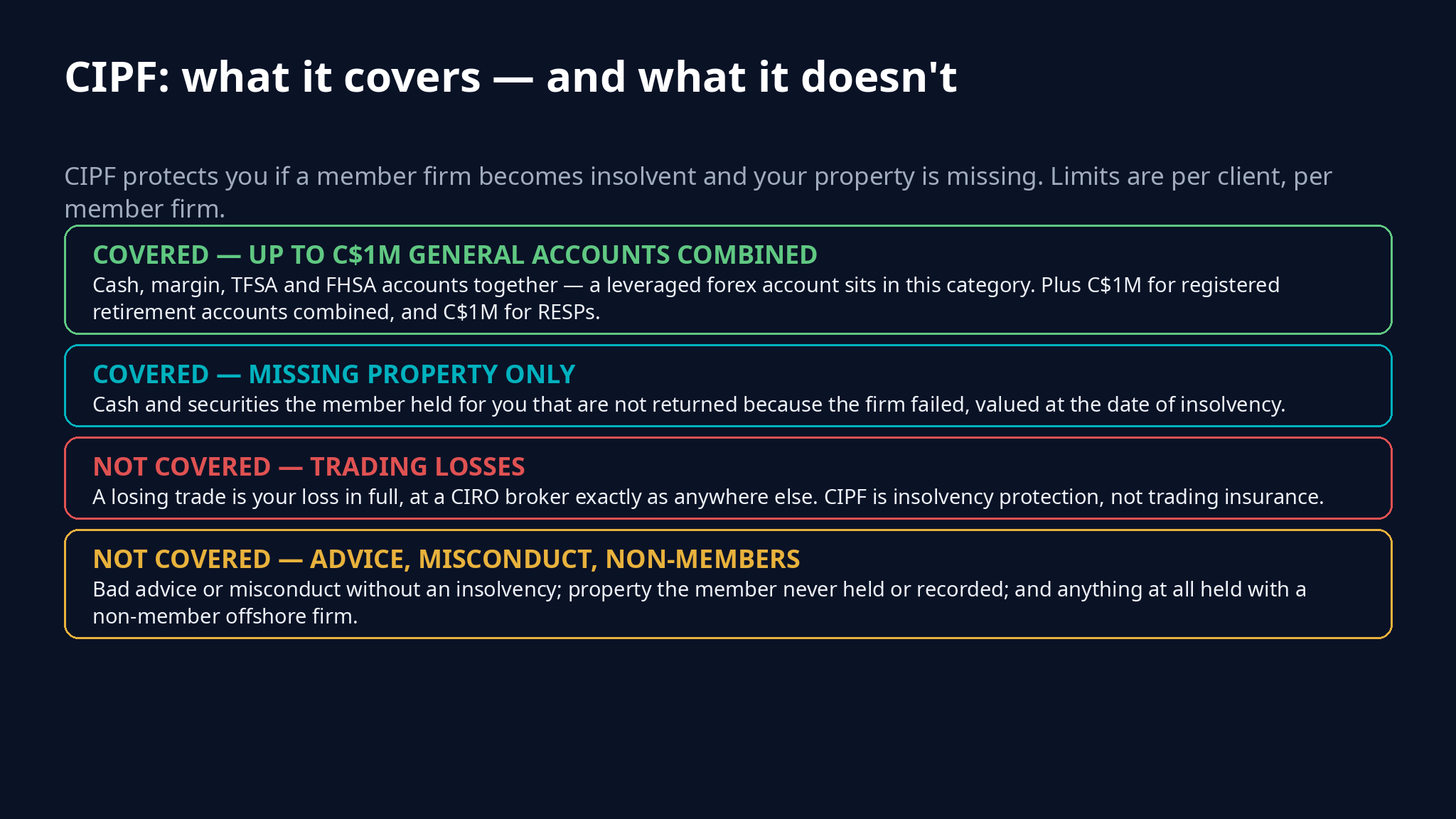
Every CIRO dealer member is a member of the Canadian Investor Protection Fund (CIPF), and that membership is the second half of why the licence matters. CIPF is a not-for-profit protection fund, funded by its member firms — not a government program and not deposit insurance. Its job is narrow and specific: if a member firm becomes insolvent and property it was holding for you is missing, CIPF works to return that property, up to its limits.
The limits, for an individual client at one member firm, are:
- C$1 million for all general accounts combined — cash accounts, margin accounts, TFSAs and FHSAs together; a leveraged forex account sits in this category.
- Plus C$1 million for all registered retirement accounts combined — RRSPs, RRIFs, LIRAs and LIFs together.
- Plus C$1 million for RESPs combined where you are the plan subscriber.
What CIPF does cover: cash and securities (and other eligible property) held by the member for you that are not returned because the firm failed. In practice the trustee in the insolvency returns most client property directly, and CIPF responds to the shortfall, valued at the date of insolvency, within the limits above.
What CIPF does not cover — and this list matters more, because it is where the marketing usually blurs:
- Trading losses. A position that goes against you is your loss, in full, at a CIRO broker exactly as anywhere else. CIPF is insolvency protection, not trading insurance.
- Bad advice or an unsuitable recommendation that doesn’t involve the firm’s insolvency.
- Dealer misconduct on its own — losses must result from the member’s insolvency and missing property to engage CIPF.
- Property the member never held or never recorded in your account — one more reason the account documents in Step 1 matter.
- Anything at a non-member firm. An offshore account has no CIPF protection of any amount — not reduced protection, none.
So the honest summary is: CIPF does not make trading safer trade-by-trade. It makes the firm safer to hold money with — it is the backstop for the one failure you cannot diversify away yourself, the broker itself disappearing with client property. That backstop exists only inside the CIRO system.
Province regulators and their roles
Securities regulation in Canada is provincial and territorial in law. There is no single federal securities regulator; instead, thirteen provincial and territorial regulators coordinate through the Canadian Securities Administrators (CSA) — an umbrella council that harmonizes rules (the National Registration Search above is a CSA tool) but does not itself license your broker. CIRO operates nationally as the recognized self-regulatory organization for dealers, under those regulators’ oversight. In practice, for a forex trader, the layers divide like this:
- CIRO (national SRO): dealer membership, dealer rules, supervision, enforcement against dealers and their registered individuals.
- Your province’s regulator: the statutory authority that recognizes CIRO, grants the provincial registration the National Registration Search shows, runs investor alerts and warning lists, and enforces provincial securities law.
- CSA: coordination, shared tools (National Registration Search, disciplined-persons lists), and national instruments like NI 31-103 (registration requirements) and NI 45-106 (prospectus exemptions, including the accredited-investor definition).
For the rules in your province, see our guides for British Columbia, Manitoba, Saskatchewan, Nova Scotia, New Brunswick and Newfoundland and Labrador.
The four provincial regulators a forex trader is most likely to meet:
- Ontario — Ontario Securities Commission (OSC). The largest market and an active enforcement and investor-alert publisher. Ontario is also the province offshore brokers most often exclude on their own restricted lists.
- Quebec — Autorité des marchés financiers (AMF). Quebec adds a gate no other province has in this form: under Quebec’s derivatives regime, a firm that creates or markets derivatives to the public must be a qualified person with the AMF. On the current CIRO list, CMC Markets, Friedberg (AvaTrade and FXCM), GAIN (FOREX.com), Interactive Brokers, OANDA and Questrade are qualified; Plus500CA and Fortrade do not serve Quebec. French-language service and documentation requirements also apply. The full picture is in our Quebec forex guide.
- Alberta — Alberta Securities Commission (ASC). Alberta’s distinctive feature is not the regulator but the dealers’ response to it: CMC Markets, FOREX.com and Plus500CA accept Alberta residents only as accredited investors under NI 45-106 (broadly, $200,000 of income alone or $300,000 with a spouse in each of the last two years, $1 million in financial assets, or $5 million in net assets), and OANDA accepts no Alberta residents at all. Interactive Brokers, Questrade and the Friedberg brands show no Alberta retail restriction in their published terms. Our Alberta vs Ontario comparison works through the mechanics.
- British Columbia — British Columbia Securities Commission (BCSC). A standard CIRO-aligned position: CIRO dealers operate normally, and the BCSC’s InvestRight program is one of the more active investor-education and alert operations. The remaining provinces and territories (among them Saskatchewan’s FCAA, the Manitoba Securities Commission, New Brunswick’s FCNB and the Nova Scotia Securities Commission) follow the same pattern: CIRO membership plus provincial registration, with no additional retail-forex gate beyond the two described above.
The practical takeaway: when a broker says “regulated in Canada,” ask which layer, which entity, and which provinces — the directory, the registration search and the AMF position answer all three.
The rules that come with a CIRO licence: leverage, segregation and complaints
The licence is also a set of ongoing constraints on how the dealer can treat you, and three of them are worth knowing by name:
- Margin and leverage caps. CIRO’s margin framework holds retail leverage on major currency pairs to typically around 50:1 (a 2% margin requirement), with lower leverage — often 20:1 or less — on minor and exotic pairs, and lower still on other CFD underlyings. An offer of 500:1 to a Canadian resident is therefore not a competitive feature; it is evidence the firm is not operating under CIRO rules.
- Segregation and statements. Client money is held segregated from the firm’s own funds, positions and balances are reported on regulated statements, and the leveraged-product risk disclosure you sign is prescribed, not marketing copy.
- A real complaint route. A CIRO dealer must operate a complaint process, and unresolved complaints can escalate to the Ombudsman for Banking Services and Investments (OBSI), the external ombudsman for participating firms — free to the client, with the power to recommend compensation. Offshore accounts have no equivalent: the complaint route ends at the firm’s own support desk and, beyond it, a foreign regulator with no mandate over your Canadian account.
None of this makes a CIRO broker cheap, fast or good — those are separate questions, answered in our flagship ranking and the broker reviews. It makes the broker accountable inside Canada, which is the part you cannot substitute with a nicer platform.
What offshore regulation does and doesn’t mean for Canadians
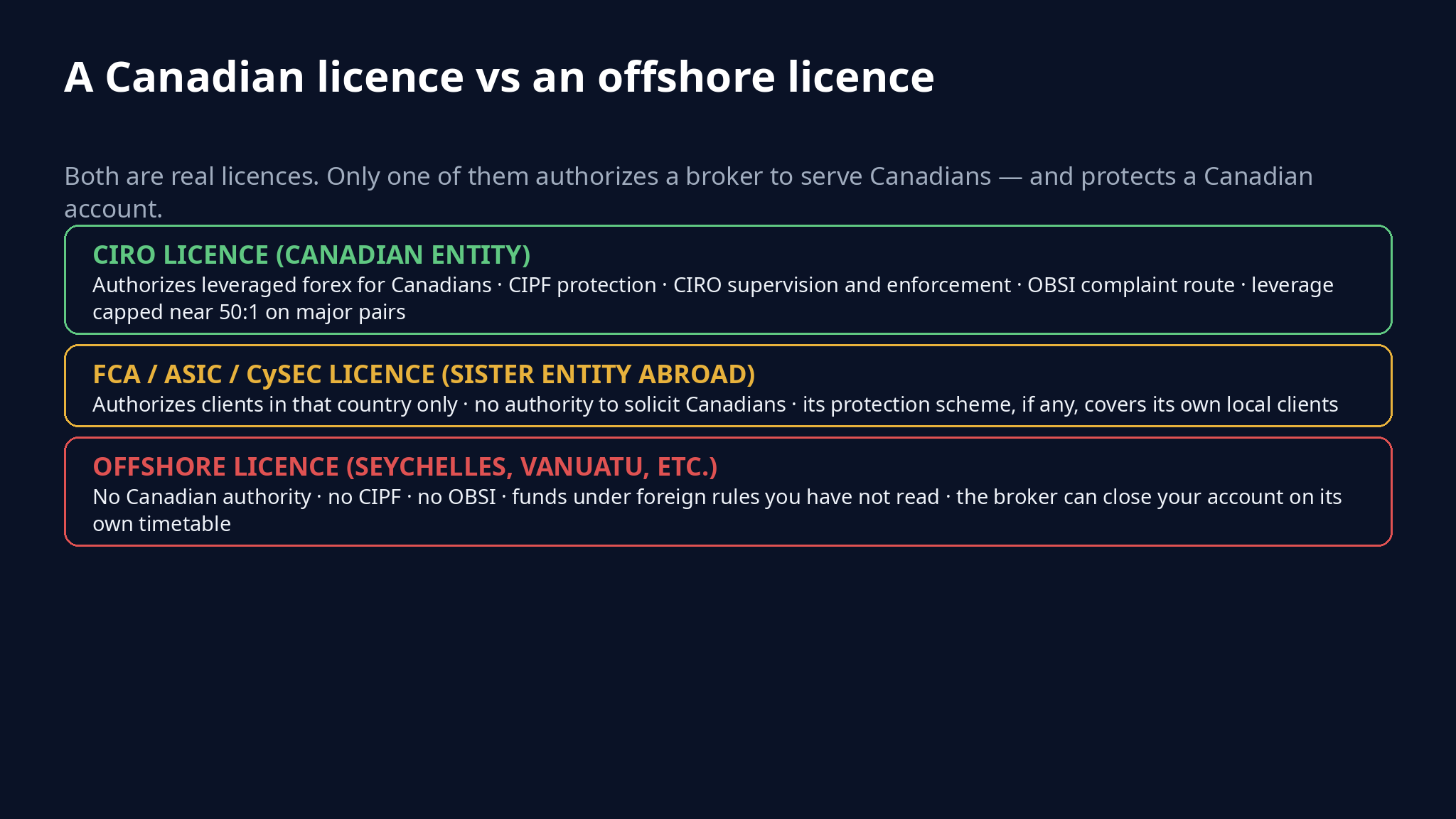
Most big offshore brands are genuinely regulated — somewhere. Pepperstone holds an Australian ASIC licence; various groups hold FCA (UK), CySEC (Cyprus), FSCA (South Africa), FSA (Seychelles), VFSC (Vanuatu) or MISA (Comoros) licences. A licence like that means something real in its own jurisdiction: local capital rules, a local regulator, a local complaint process for local clients. What it does not do is extend to you:
For a single-broker worked example of the offshore pattern, see Is Vantage legal in Canada? — a broker with genuine ASIC and FCA entities that still has no Canadian licence and refuses Canadian residents outright.
- No authority in Canada. None of those regulators can license a firm to solicit Canadian residents for leveraged forex. A firm doing so without CIRO membership is operating outside the Canadian framework regardless of how many licence numbers its footer carries.
- No CIPF. Protection attaches to the Canadian member entity. An account booked with a Seychelles or Vanuatu entity of a famous group has no CIPF coverage — the group’s regulated entity elsewhere is a different legal person from your counterparty.
- No CIRO supervision and no OBSI. Your complaint route is the firm’s internal process and the offshore regulator, in that order.
- Different product rules. The high leverage, bonuses and account perks offshore marketing leads with are generally the features CIRO rules restrict — which is precisely why they are available offshore.
- Exit risk is real. When an offshore broker decides a province is no longer worth serving, accounts close on the broker’s timetable — as Alberta clients of one offshore broker learned in late 2026, with weeks to move. A CIRO dealer exit is supervised; an offshore exit is an email.
None of that makes every offshore firm a scam — several are substantial, honestly run businesses in their home markets. It makes the account a different legal product from the one the brand name suggests, held in a jurisdiction you didn’t choose, under rules you haven’t read. Our offshore leverage warning covers the leverage side of that trade in detail.
Red flags of an unlicensed broker
Treat any one of these as a stop sign, and several together as a certainty:
- No Canadian legal entity in the account documents — or an entity name that returns nothing in CIRO’s directory or the National Registration Search.
- An offshore licence presented as a Canadian one — “regulated” with only Seychelles, Vanuatu, Mauritius, St. Vincent or Belize named, or a famous parent group’s FCA/ASIC licence implied to cover your account.
- “IIROC-regulated” as a current claim. IIROC merged into CIRO in June 2023. A broker still leading with IIROC is either not checking its own compliance or not operating in Canada at all.
- Guaranteed returns, bonuses on deposits, or a personal “account manager” who will trade for you or urges larger deposits — none of this survives contact with CIRO conduct rules.
- Pressure and payment rails: fund today or lose the “offer”; deposits by crypto or wire only; withdrawals that need a “release fee,” a tax payment, or a bigger deposit first. Withdrawal obstruction is the single most common fact pattern in regulator warnings about unregistered firms.
- Leverage pitched at Canadians far above CIRO levels — 500:1 is a confession, not a feature.
- Lookalike and clone branding — sites imitating a registered firm’s name or licence number with a slightly different domain. This is why Step 1 starts from the documents and the directory, never from a search ad.
- A name on a regulator warning list. The CSA members and CIRO publish investor alerts about unregistered firms soliciting Canadians; check the name there as part of the Step 6 pass.
If you have already funded a firm that fails the check, stop adding money, document everything (documents, statements, correspondence), and contact your provincial regulator — the alert and complaint channels exist for exactly this situation.
Investment fraud in Canada: what the 2025-2026 data show
- Fraud-site takedowns: about 23 a day. Between June 5 and November 23, 2025, the CSA and CIRO deactivated more than 3,900 fake investment platforms and crypto scam websites, spanning over 6,900 URLs.
- Formal enforcement has contracted. Complaints were flat, 4,104 in FY2023 to 4,127 in FY2025; investigations were broadly flat, 187 to 176; completed proceedings fell 47 percent, 108 to 57; and total fines fell 59 percent, $25,140,343 to $10,313,381. Fines are lumpy, and Ontario became the seventh province to grant CIRO its full enforcement toolkit in 2025.
- Investment fraud is about half of all reported fraud losses. The Canadian Anti-Fraud Centre recorded $704 million in reported fraud losses in 2025, the worst year on record, with cumulative losses since 2022 above $2.4 billion. Investment fraud alone was $351 million, up from $310 million in 2024.
- Most fraud is never reported. The Canadian Anti-Fraud Centre estimates only 5 to 10 percent of fraud is ever reported. Applied to investment fraud, the implied real figure is $3.5 billion to $7 billion a year. That is an inference from the regulator’s own multiplier, not a measurement.
- The verification gap. The CSA’s 2024 Investor Index found 46 percent of Canadians have seen investment opportunities promoted on social media and 23 percent have been approached with a possibly fraudulent investment, up five points since 2020. Only 8 percent would report investment fraud to their securities regulator; 34 percent would go to the police instead. Incidence is trending up among Canadians aged 55 and under, including people new to investing.
- Impersonation. CIRO has warned about firms impersonating CIRO itself, including One FX Group / One FX Trading, which used CIRO and IIROC logos on fake letters purporting to guarantee deposits. A claim of CIRO regulation is not evidence of it. Logos can be copied; registration entries cannot. Verify on the regulator’s own site, never on the broker’s.
Regulation only protects you if the firm is inside the Canadian system. The sites taken down sit outside it, almost by definition. Sources: CSA and CIRO, December 2025; CIRO Enforcement Reports FY2023 and FY2025; Canadian Anti-Fraud Centre, Fraud Prevention Month 2026; CSA Investor Index 2024; CIRO investor alerts.
The verified CIRO-regulated brokers
Below are the dealer members behind the brands Canadians can use today, verified against CIRO’s directory and the dealers’ own Canadian disclosures in November 2026. Province availability varies — confirm your own province before applying, and re-run the verification steps above on the entity you actually open with.
| Broker brand | Canadian dealer (legal entity) | CIRO | CIPF | Province notes |
|---|---|---|---|---|
| OANDA | OANDA (Canada) Corporation ULC | Yes | Yes | Does not accept Alberta residents |
| CMC Markets | CMC Markets Canada Inc. | Yes | Yes | Alberta: accredited investors only |
| FOREX.com | GAIN Capital — FOREX.com Canada Ltd. | Yes | Yes | Alberta: accredited investors only |
| Interactive Brokers | Interactive Brokers Canada Inc. | Yes | Yes | No published province exclusion — confirm at application |
| Plus500 | Plus500CA Ltd. | Yes | Yes | No Quebec; Alberta accredited only |
| Questrade | Questrade Inc. | Yes | Yes | Canadian-headquartered; broad provincial availability |
| AvaTrade / FXCM | Friedberg Mercantile Group Ltd. (Friedberg Direct) | Yes | Yes | Your dealer is Friedberg, not the global brand |
| Fortrade | Fortrade Canada Limited | Yes | Yes | Barred from opening new accounts under a temporary order — not available |
For the ranked version of this list — pricing, platforms and who each broker suits — see the best forex brokers in Canada comparison and the Best Forex Brokers in Canada 2027 flagship. Individual reviews: OANDA, CMC Markets, FOREX.com, Interactive Brokers, Plus500, Questrade, AvaTrade.
Forex taxes and registered accounts, in brief
Regulation decides who can take your account; two adjacent rules decide how you can hold and report the activity. Forex profits are taxable in Canada — as capital gains or as business income depending on how you trade — and the record-keeping and filing rules are covered in our forex taxes in Canada guide and the year-end tax checklist. Leveraged forex and CFDs cannot be held in a TFSA or RRSP: registered accounts are restricted to qualified investments, and leveraged margin forex is not one. Spot currency conversion inside a registered account (for example at Questrade) is a different product — exchanging currency you hold, not leveraged trading. If a firm offers leveraged CFD trading “inside a TFSA,” that claim alone tells you it is not operating under Canadian rules.
Frequently asked questions
What licence does a forex broker need to operate in Canada?
Two things, attached to the same Canadian legal entity: membership of CIRO as an Investment Dealer (listed in CIRO’s “Dealers We Regulate” directory) and registration under provincial securities law, visible in the CSA National Registration Search — plus, to offer leveraged derivatives in Quebec, qualification with the AMF. A licence from the FCA, ASIC, CySEC or any offshore regulator is not a substitute for any part of that.
How do I check a forex broker’s licence in Canada?
Get the exact Canadian legal entity name from the account documents, search it in CIRO’s “Dealers We Regulate” directory (it must appear as an Investment Dealer), cross-check it in the CSA National Registration Search for its provincial registration and category, confirm CIPF membership, and then check your province’s gate (AMF qualification in Quebec, the accredited-investor gate in Alberta). The step-by-step section above walks through each stage, and our CIRO Broker Checker runs the registration check for you.
Is IIROC the same as CIRO?
Effectively, yes — IIROC merged with the MFDA to form CIRO on June 1, 2023, so an “IIROC-regulated” broker is now a CIRO-regulated broker. But a firm still marketing itself as IIROC-regulated today is using a regulator that has not existed for years, which tells you how recently anyone there reviewed the Canadian details.
Does an FCA or ASIC licence let a broker serve Canadians?
No. Those licences authorize the firm in the UK or Australia. Serving Canadian retail clients with leveraged forex requires CIRO membership through a Canadian entity, and accounts held offshore carry no CIPF protection and no access to the Canadian complaint route through OBSI.
What does CIPF actually cover?
CIPF covers eligible client property — cash, securities and other property the member held for you — that is missing because the member firm became insolvent, up to C$1 million for all general accounts combined, plus C$1 million for registered retirement accounts combined and C$1 million for RESPs. It never covers trading losses, bad advice, or losses at a firm that isn’t a CIPF member.
Is it illegal for a Canadian to trade with an offshore broker?
The legal breach sits with the firm: a broker without CIRO membership is not permitted to solicit Canadian residents for leveraged forex. Canadians who hold offshore accounts are not committing an offence by trading — but the account sits outside the Canadian framework, with no CIPF protection, no CIRO supervision and no OBSI complaint route, and the firm can close it on its own timetable. That is the risk you accept, stated plainly.
How we research this page
We do not test brokers with live-funded accounts, and we say so on every page. The regulatory positions above are built from the regulators’ own records — CIRO’s dealer directory, the CSA National Registration Search, CIPF’s coverage materials and member list, and the provincial regulators’ publications — checked against the dealers’ Canadian disclosures, and re-verified for the November 8, 2026 review stamp at the top of this page. See our methodology for the full process. Regulatory status changes: if you find a position here that a primary source contradicts, tell us and we will correct it and note the change.