Forex Trading Taxes in Canada (2026): Capital Gains vs Business Income
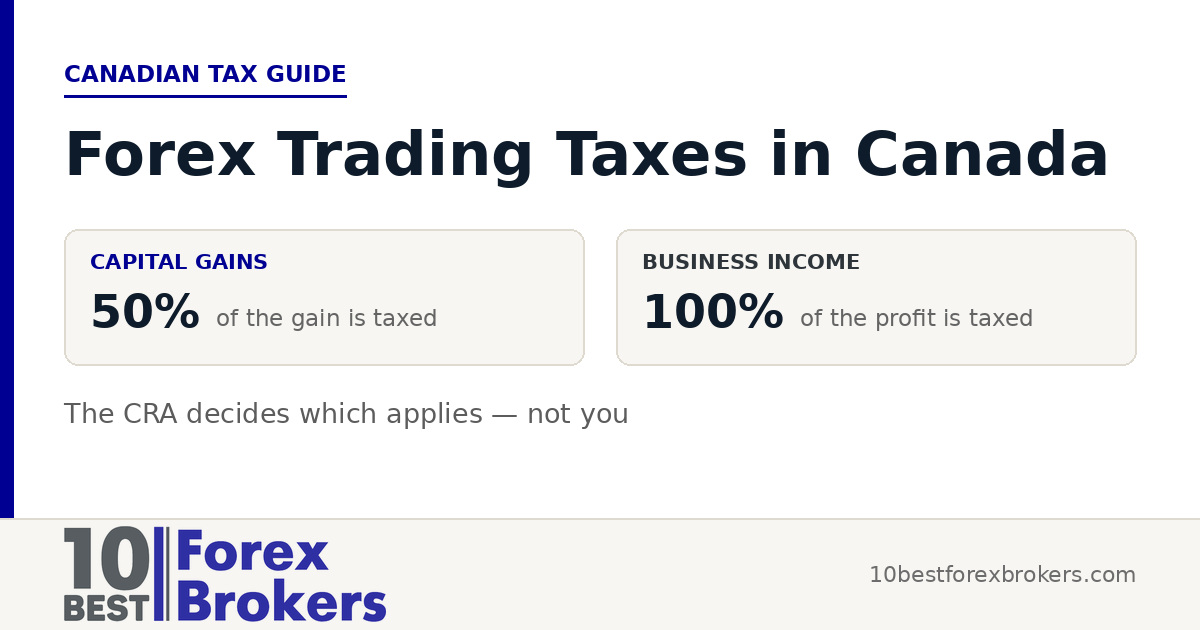
Forex profits are taxable in Canada — that part is not in dispute. What trips people up is that two completely different tax treatments exist, the difference between them can double your bill, and you do not get to choose which one applies to you. The CRA decides, based on the character of your trading, and it can reassess a return years later if it disagrees with the position you took.
This is general information, not tax advice
We are not accountants and this page is not tax advice. Tax treatment depends on your specific circumstances, and the CRA decides your classification based on the full picture of your activity — you do not get to pick. Before you file, speak to a CPA or tax professional who has seen your actual trading records. Where we cite rules we link to the primary source so you can verify them yourself.
The two tax treatments
Canadian tax law does not have a special regime for forex. Profits fall under the general provisions of the Income Tax Act, and they land in one of two buckets.
Capital gains treatment. Under the standard inclusion rate, half of your net capital gain is included in taxable income and taxed at your marginal rate. On a $20,000 net gain, $10,000 is included. This is the treatment that applies to investors — people whose trading is occasional, whose positions are held for meaningful periods, and for whom trading is not a livelihood.
Business income treatment. The entire profit is included in income at your full marginal rate. On that same $20,000, all $20,000 is included. In exchange, you can deduct legitimate business expenses and apply losses against your other income — which, as we will get to, is not a trivial offset.
The practical gap is large. A trader in a 40% combined marginal bracket with $50,000 in net profit pays roughly $10,000 under capital gains treatment and roughly $20,000 under business income treatment, before considering deductions. That is the difference this page exists to explain.
How the CRA decides which applies
There is no single decisive factor and no form you file to elect a treatment. The CRA looks at the whole pattern of your activity. The factors that consistently appear in its assessments and in the case law include:
- Frequency of transactions. A handful of trades a year looks different from several hundred.
- Duration of holdings. Positions held for months point toward investment; positions held for minutes point toward business.
- Time devoted. Someone spending most of their working day on markets is running something that resembles a business.
- Knowledge and experience. Specialised expertise in the market weighs toward business treatment.
- Relationship to your other work. Trading that is connected to your profession, or that has become your primary income, points strongly toward business.
- Use of leverage and financing. Heavily margined activity is more characteristic of a trading business than of investing.
- Intention at the time of the trade. Buying with the intent to resell quickly for profit is business-like; buying to hold is not.
For most people who trade forex actively — and particularly for anyone using leverage on short-term positions, which describes the majority of retail forex — the honest answer is that business income treatment is the likely characterisation. Retail forex trading is structurally short-term and leveraged. It does not look much like investing.
Consistency matters, and the CRA notices
You cannot report profitable years as capital gains and unprofitable years as business losses. Reporting must be consistent from year to year, and switching treatment to suit the outcome is exactly the pattern that draws scrutiny. If the CRA reassesses and reclassifies several years at once, you face back taxes plus interest and potentially penalties.
Capital gains vs business income, side by side
| Capital gains | Business income | |
|---|---|---|
| Amount included in income | 50% of the net gain | 100% of the net profit |
| Reporting form | Schedule 3 → line 12700 | Form T2125 |
| Expense deductions | Very limited | Broad range of business expenses |
| Loss treatment | Only against capital gains (back 3 years, forward indefinitely) | Against any source of income |
| $200 FX exemption | Available on currency dispositions | Not available |
| Typical profile | Occasional, longer-held, secondary activity | Frequent, short-term, time-intensive |
| Tax on $50,000 profit at a 40% marginal rate | Roughly $10,000 | Roughly $20,000, before deductions |
Read the loss row carefully before assuming capital gains treatment is simply better. A trader who loses $30,000 in a year gets substantially more relief under business treatment, because that loss can offset employment income. Under capital treatment it sits idle until there is a capital gain to absorb it.
The $200 foreign exchange exemption
Subsection 39(1.1) of the Income Tax Act exempts an individual’s first $200 of net capital gains from dispositions of foreign currency in a taxation year. Introduced in the 1971 budget, its stated purpose was to spare taxpayers from tracking the adjusted cost base of currency used in ordinary personal transactions — leftover holiday euros, essentially.
Three limits are worth understanding. It applies to net gains, so foreign exchange losses in the same year reduce the amount first. It applies to dispositions of currency itself, not to gains on securities that happen to be denominated in a foreign currency. And it is only relevant under capital treatment — if your trading is business income, the exemption does not apply at all.
For anyone trading forex at any real volume, this exemption is a rounding error. It is worth knowing about mainly so you do not mistake it for a meaningful shelter.
Which forms you file
- Schedule 3 — capital gains and losses. The taxable half flows through to line 12700 of your T1.
- Form T2125 — Statement of Business or Professional Activities, for business income treatment. This is also where you claim deductions.
- Form T1135 — Foreign Income Verification Statement, generally required when specified foreign property exceeds CAD $100,000 in total cost at any time in the year.
- T1 General — your return itself, where the amounts from the above ultimately land.
The form you file is a statement about your classification. Filing a T2125 asserts that you are carrying on a trading business; filing Schedule 3 asserts that you are not. Pick deliberately, document why, and keep the reasoning with your records.
Converting to Canadian dollars
Everything must be reported in Canadian dollars. Each transaction is converted using the exchange rate in effect on the date of that transaction. Where circumstances make it appropriate — a steady stream of similar transactions through the year, for example — the CRA will generally accept the Bank of Canada annual average rate instead.
This creates a second layer of gain or loss that traders often overlook. If you fund a USD account when the Canadian dollar is strong and withdraw when it is weak, the currency movement itself has a tax consequence separate from your trading results. A broker offering a native CAD account sidesteps a good deal of this bookkeeping — see our comparison of Canadian brokers.
How losses are treated
Under capital treatment, allowable capital losses offset taxable capital gains. Unused net capital losses can be carried back three years or forward indefinitely, but they cannot touch employment or other ordinary income. A salaried trader with a bad year gets no immediate relief.
Under business treatment, a non-capital loss can generally be applied against other income in the year, carried back three years, or carried forward up to twenty. For a trader with a day job and a losing trading year, this is a materially better outcome — which is precisely why the CRA scrutinises taxpayers who claim business losses in poor years after reporting capital gains in good ones.
TFSAs, RRSPs and registered accounts
The idea of trading forex tax-free inside a TFSA comes up constantly and deserves a direct answer: it is generally not workable, and attempting it carries real risk.
Registered accounts may only hold qualified investments, and leveraged forex and CFD positions generally do not qualify. Beyond that, the CRA has taken the position that a TFSA carrying on a business — which active, frequent trading can constitute — makes the account’s income taxable, and it has assessed accounts on exactly that basis. The tax-free wrapper does not survive contact with business-like trading activity.
Most CIRO-regulated forex offerings are structured as margin accounts and are not available in registered form for this reason. If a broker claims otherwise, read the account documentation very carefully and get professional advice first.
Offshore brokers and T1135
If you hold funds with a broker outside Canada, two separate issues arise.
The tax issue is Form T1135. Where the total cost of your specified foreign property exceeds CAD $100,000 at any point in the year, the form is generally required, and the penalties for failing to file it are meaningful — they accrue per month and are not proportionate to the tax at stake.
The prior issue is regulatory. Offshore brokers are not registered with CIRO and are not permitted to solicit Canadian residents. Money held with them carries no CIPF protection, and your practical recourse in a dispute is close to nil. We cover this in detail in how to check whether your broker is safe, and you can verify registration directly with our CIRO broker checker.
Records to keep
Keep everything for six years from the end of the tax year it relates to:
- Complete trade history and account statements from your broker, downloaded rather than left on the platform — access can disappear when an account closes.
- Every deposit and withdrawal, with dates and amounts in both currencies.
- The exchange rate used for each conversion, and a note of the source.
- Records supporting any expenses claimed under business treatment.
- Your own running record. Broker statements are a starting point; the obligation to report accurately is yours, not theirs.
Once you know what a trade actually netted, our profit and loss calculator is useful for reconciling individual positions against your statements before those figures reach a tax form.
Four worked scenarios
Abstract rules are hard to apply to your own situation. Here are four profiles that sit at different points on the spectrum, with the reasoning that would likely apply to each. These are illustrations, not rulings — your own facts will differ.
Scenario 1 — the occasional position trader. A salaried engineer opens four or five currency positions a year, holds them for two to six months, uses little or no leverage, and spends perhaps an hour a week on markets. Trading is plainly secondary to employment income. This profile sits firmly at the investment end: low frequency, long holding periods, minimal time devoted, no leverage. Capital gains treatment is the defensible position.
Scenario 2 — the evening swing trader. A teacher trades most weeknights, holds positions for two to ten days, uses moderate leverage, and makes perhaps 150 trades a year. Trading supplements a salary but is not the primary income. This one is genuinely ambiguous. The frequency and leverage point toward business; the holding periods and the secondary role point toward capital. This is exactly the profile that needs a CPA to look at the actual records rather than a rule of thumb.
Scenario 3 — the full-time day trader. Someone left a job to trade, is at the screen through the London and New York sessions, closes almost everything intraday, uses leverage on every position, and trading is the household’s main income. Every factor points the same direction. Business income treatment is the realistic characterisation, and arguing capital treatment here would be difficult to sustain.
Scenario 4 — the consistent loser. An active trader has lost money three years running while working full-time elsewhere. Many people in this position instinctively want capital treatment because that is what they assume applies. But capital losses cannot touch employment income — they sit unused until there is a capital gain. If the facts genuinely support business treatment, those losses may be applicable against salary, which is a materially different outcome. The point is not to pick the treatment that helps; it is that people often misjudge which one their facts actually support, and it does not always cut the way they expect.
The pattern worth noticing
In three of these four scenarios, the taxpayer’s instinct about which treatment applies is either wrong or unsupported. That is why this determination is worth paying a professional to get right once, rather than guessing annually and hoping the question never comes up.
Does your province change anything?
The classification rules are federal and identical everywhere in Canada. What differs by province is the rate applied once your income is determined — combined federal and provincial marginal rates vary meaningfully across the country, so the same trading profit produces a different bill in Alberta than in Quebec.
Quebec residents have one additional obligation: a separate provincial return filed with Revenu Québec alongside the federal return. Trading income must be reported on both, and the classification you take should be consistent across them.
The regulatory picture also varies somewhat by province, which is separate from tax but worth understanding — see our guide to forex regulation in Canada and the provincial pages linked from it.
When gains become taxable
Gains are generally taxable when they are realised — when a position is closed — not when you withdraw money from the account. This surprises people regularly. A trader who closed $40,000 of winning trades during the year and left every dollar in the account to keep trading still has $40,000 of realised gains to report, even if nothing reached a bank account.
The corollary is that an open position showing a large unrealised gain at December 31 generally has no immediate tax consequence under capital treatment. Whether that remains true under business treatment can depend on the accounting method used, which is another reason the classification question flows through into everything else.
This timing mismatch creates a real risk worth planning around: it is entirely possible to owe tax on gains realised early in the year and then give those profits back to the market before the filing deadline. The tax liability does not disappear when the account balance does. Traders who set aside an estimated tax reserve as gains are realised avoid a genuinely painful situation.
Frequently asked questions
Do I have to pay tax on forex trading in Canada?
Yes. Profits from forex trading are taxable in Canada. The question is not whether you owe tax but which of two treatments applies: capital gains, where only half your net gain is included in income, or business income, where the full amount is included at your marginal rate. The CRA makes that determination based on the character of your activity, not on your preference.
Is forex taxed as capital gains or business income in Canada?
It depends on how the CRA characterises your trading. Occasional, longer-held, non-primary activity tends toward capital gains treatment. Frequent, short-term, time-intensive trading that functions as a source of livelihood tends toward business income. There is no bright-line test and no election you can file — the CRA weighs the whole picture and can reassess a return it disagrees with.
What is the $200 exemption on foreign exchange gains?
Subsection 39(1.1) of the Income Tax Act gives individuals a de minimis exemption on the first $200 of net capital gains from dispositions of foreign currency in a year. It was introduced to spare people from tracking the adjusted cost base of holiday spending money. It applies to currency itself, not to gains on securities denominated in a foreign currency, and it does not apply if your trading is business income.
Which forms do I use to report forex trading?
Capital gains are reported on Schedule 3 and flow to line 12700 of the T1. Business income is reported on Form T2125, Statement of Business or Professional Activities. Using the wrong form is one of the more common triggers for CRA questions, because the form you file signals the classification you are claiming.
Can I claim forex losses against my other income?
Only if your trading is business income. Business losses can generally be applied against other sources of income. Capital losses can only be applied against capital gains — carried back three years or forward indefinitely — not against employment income. This asymmetry is a real consideration for consistently unprofitable traders and one reason classification is not always a matter of wanting the lower rate.
Can I trade forex inside a TFSA or RRSP?
In practice this is rarely available and carries real risk. Registered accounts are restricted to qualified investments, and margin forex and CFD trading generally does not fit within a TFSA’s permitted activity. The CRA has also taken the position that carrying on a business inside a TFSA makes the account’s income taxable, and it has assessed active traders on that basis. Speak to a tax professional before attempting anything of this kind.
Do I need to report a foreign broker account?
Possibly. Form T1135, the Foreign Income Verification Statement, is generally required when the total cost of your specified foreign property exceeds CAD $100,000 at any point in the year. Funds held with a broker outside Canada can count. Separately, offshore brokers are not permitted to solicit Canadian residents in the first place — which is a compliance problem before it is a tax one.
What records should I keep?
Keep complete trade statements, deposit and withdrawal records, and the exchange rates used for each conversion, generally for six years from the end of the tax year. Amounts must be reported in Canadian dollars, converted at the rate in effect on the transaction date, though the CRA will generally accept the Bank of Canada annual average rate in appropriate circumstances. Broker statements are a starting point, not a substitute for your own records.