How to Report Forex Trading on Your Canadian Tax Return (2026)
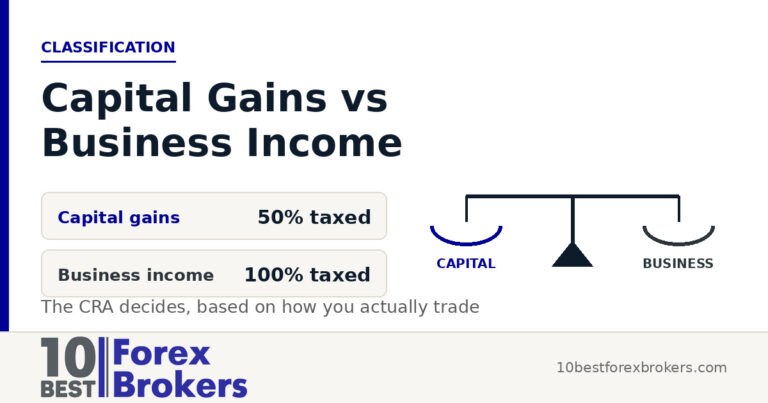
Once you know which treatment applies to you, the mechanics are manageable. This page covers which forms to file, how to convert your figures to Canadian dollars, what a foreign broker account triggers, and the errors that most reliably generate CRA correspondence. If you are not yet sure which treatment applies, start with capital gains vs business income.
This is general information, not tax advice
We are not accountants and this page is not tax advice. Tax treatment depends on your specific circumstances, and the CRA decides your classification based on the full picture of your activity — you do not get to pick. Before you file, speak to a CPA or tax professional who has seen your actual trading records. Where we cite rules we link to the primary source so you can verify them yourself.
Before you start
Assemble these first. Filing without them is where most errors originate:
- Your complete trade history for the tax year, downloaded from the broker as a file you control.
- All deposits and withdrawals, with dates and both currency amounts.
- The exchange rates you will use, and a note of where they came from.
- The previous year’s return, so your treatment stays consistent.
- Receipts for anything you intend to deduct under business treatment.
Reporting as capital gains
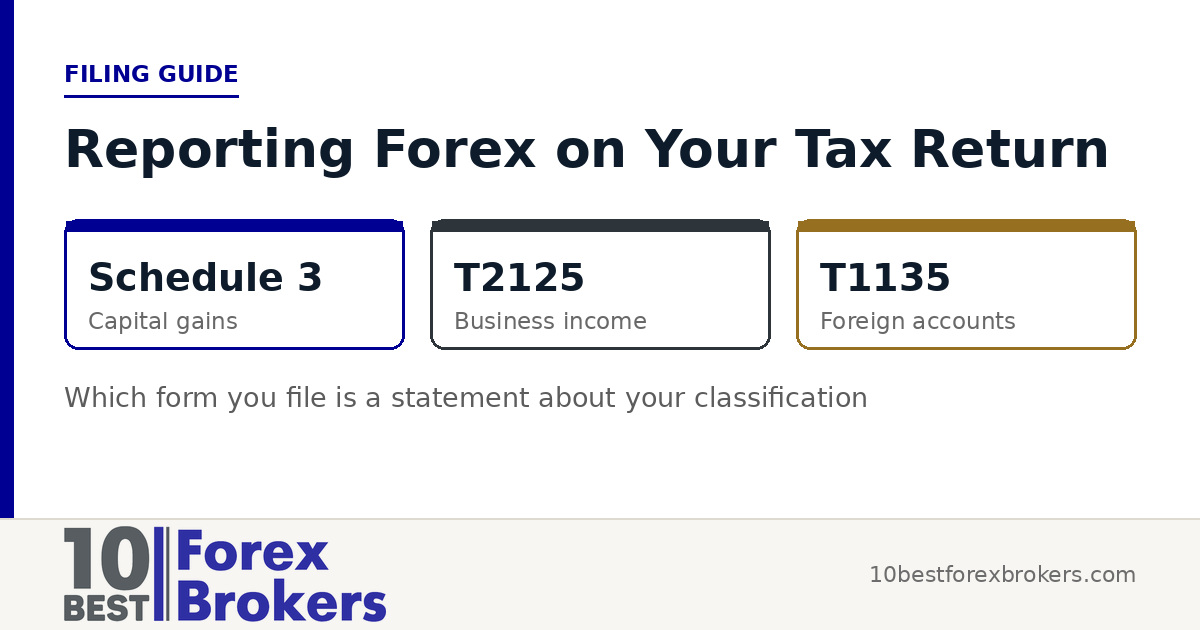
Capital gains are reported on Schedule 3. For each disposition you record the proceeds, the adjusted cost base and any outlays or expenses; the difference is your gain or loss. Where you have hundreds of similar transactions, grouping them by security or currency with supporting detail retained is generally acceptable — but keep the underlying records.
Net the gains and losses for the year. Under the standard inclusion rate, half the net gain is the taxable capital gain, and it flows to line 12700 of your T1. If your net position is a loss, it does not go to line 12700 — it becomes a net capital loss available to carry back three years or forward indefinitely against capital gains.
Remember the $200 de minimis under subsection 39(1.1) if part of your gain comes from dispositions of foreign currency itself. It applies to net gains on currency, not to gains on foreign-denominated securities, and not at all under business treatment.
Reporting as business income
Business income goes on Form T2125, the Statement of Business or Professional Activities. Gross trading revenue goes at the top, deductible expenses below it, and the net figure flows to line 13500 of your T1 where it is taxed in full at your marginal rate.
Filing a T2125 is an assertion that you are carrying on a business. That assertion has consequences beyond the current return: it affects how losses are treated, what you can deduct, and potentially whether you need to consider GST/HST registration and CPP contributions on self-employment earnings. Get advice before the first time you file this way.
Converting to Canadian dollars
Every figure on your return is in Canadian dollars. Convert each transaction at the rate in effect on its date, or use the Bank of Canada annual average rate where circumstances make that appropriate — typically a regular stream of similar transactions through the year.
Two points people miss. First, the currency movement on your account balance is itself a potential source of gain or loss, separate from your trading results: funding a USD account at one rate and withdrawing at another has a tax consequence. Second, whichever method you choose, use it consistently. Mixing spot rates and average rates to improve the outcome is not a defensible position.
Holding a native CAD account with a Canadian broker removes a good deal of this complexity. Our broker comparison shows which CIRO-regulated firms offer them.
Form T1135 and foreign accounts
Where the total cost of your specified foreign property exceeds CAD $100,000 at any point in the year, Form T1135 is generally required. Funds held with a broker outside Canada can count toward that threshold.
The penalties for failing to file are worth taking seriously because they are not proportionate to the tax involved — they accrue on a per-month basis and can substantially exceed any tax that was actually at stake. If you are near the threshold, get advice rather than guessing.
There is also a prior question. Offshore brokers are not registered with CIRO and are not permitted to solicit Canadian residents; funds held with them have no CIPF protection. The tax reporting is the smaller of the two problems. See how to check any broker.
Deductible expenses under business treatment
Business treatment allows deduction of reasonable expenses incurred to earn the income. Commonly claimed items include:
- Commissions, financing and platform fees
- Market data and charting subscriptions
- A reasonable proportion of home office costs, subject to the specific rules that apply to workspace-in-home claims
- A reasonable proportion of internet and computer costs used for the business
- Professional fees for accounting and tax preparation
- Trading education directly related to the business, though this one attracts scrutiny
Two caveats. Every claim needs documentation that would survive review, and the home office and education claims in particular have conditions that are easy to get wrong. Have a CPA look at your intended claims before you file rather than after you are asked about them.
A step-by-step walkthrough
Working in this order tends to prevent the errors that follow:
- Export the full year from your broker as a file you control, before you need it. Include closed positions, financing charges, commissions and every cash movement.
- Convert each figure to Canadian dollars using your chosen method, applied consistently. Record the rate source in the same file.
- Net the results for the year. Total gains, total losses, and the net figure. Do not report gross gains and omit losses.
- Confirm your classification against last year’s filing. If it has changed, document why before you file, not after you are asked.
- Complete the correct form — Schedule 3 or T2125 — and carry the figure to the right line of the T1.
- Check the T1135 threshold against the peak total cost of foreign property during the year, not the year-end balance.
- File, then archive everything together: statements, rate sources, working file and the return itself.
If you live in Quebec
Quebec residents file a separate provincial return with Revenu Québec in addition to the federal return. Trading income appears on both, and the classification you take must be consistent across them — reporting business income federally and capital gains provincially is not a position that survives review.
The federal forms have provincial counterparts, and the combined marginal rates differ from other provinces. If you trade at any volume and live in Quebec, the case for professional preparation is stronger simply because there are two filings to keep aligned.
Tax instalments
This catches out newly profitable traders. If you owe more than a threshold amount of tax in a year — and in the prior year or the one before that — the CRA may require you to pay by quarterly instalments rather than in a lump sum at filing. Interest applies to instalments that are missed or underpaid.
Someone whose trading income arrives entirely outside payroll withholding can find themselves in instalment territory without realising it, and the first indication is often a notice from the CRA. If your trading became meaningfully profitable this year, ask a CPA whether instalments will apply next year before the requirement arrives on its own.
The practical habit worth building is setting aside an estimated tax reserve as gains are realised rather than at year end. Trading profits can reverse; the tax on gains already realised does not.
Common mistakes
- Assuming capital gains treatment because it is the better rate, when the activity looks like a business.
- Switching treatment between years to suit the result — the clearest signal you can send.
- Reporting only withdrawals. Gains are generally taxable when realised, whether or not the money leaves the account.
- Ignoring the currency layer on account funding and withdrawal.
- Relying entirely on broker statements instead of maintaining independent records.
- Missing T1135 when foreign holdings cross the threshold.
- Losing access to records when an account closes. Download everything while you still can.
Frequently asked questions
Where do I report forex gains on my Canadian tax return?
Capital gains go on Schedule 3, and the taxable portion flows to line 12700 of the T1. Business income goes on Form T2125, and the net figure flows to line 13500. Which one you use is determined by your classification, not by preference.
Do Canadian brokers issue tax slips for forex trading?
Not in the way employers issue T4s. Brokers and financial institutions generally report securities dispositions to the CRA and provide clients with statements, but forex and CFD activity does not always produce a conventional slip. You are responsible for compiling your own figures regardless of what arrives in the mail.
What exchange rate do I use?
The rate in effect on the transaction date. Where you have a steady stream of similar transactions through the year, the CRA will generally accept the Bank of Canada annual average rate instead. Whichever you use, apply it consistently and record your source.
How long do I need to keep trading records?
Generally six years from the end of the tax year the records relate to. Download statements rather than relying on platform access, because that access can disappear when an account is closed or a broker ceases operating.
What expenses can I deduct as a trading business?
Under business treatment, reasonable expenses incurred to earn the income may be deductible — data and platform subscriptions, commissions and financing costs, a proportionate share of home office expenses, and professional fees among them. Documentation is essential, and the home office claim in particular has specific rules. Have a CPA review what you intend to claim.
What happens if I do not report forex income?
Unreported income can result in reassessment with interest, and penalties where the failure is repeated or the CRA considers it grossly negligent. Coming forward voluntarily before the CRA raises the issue generally produces a much better outcome than being found.