Capital Gains vs Business Income: How the CRA Classifies Forex Trading
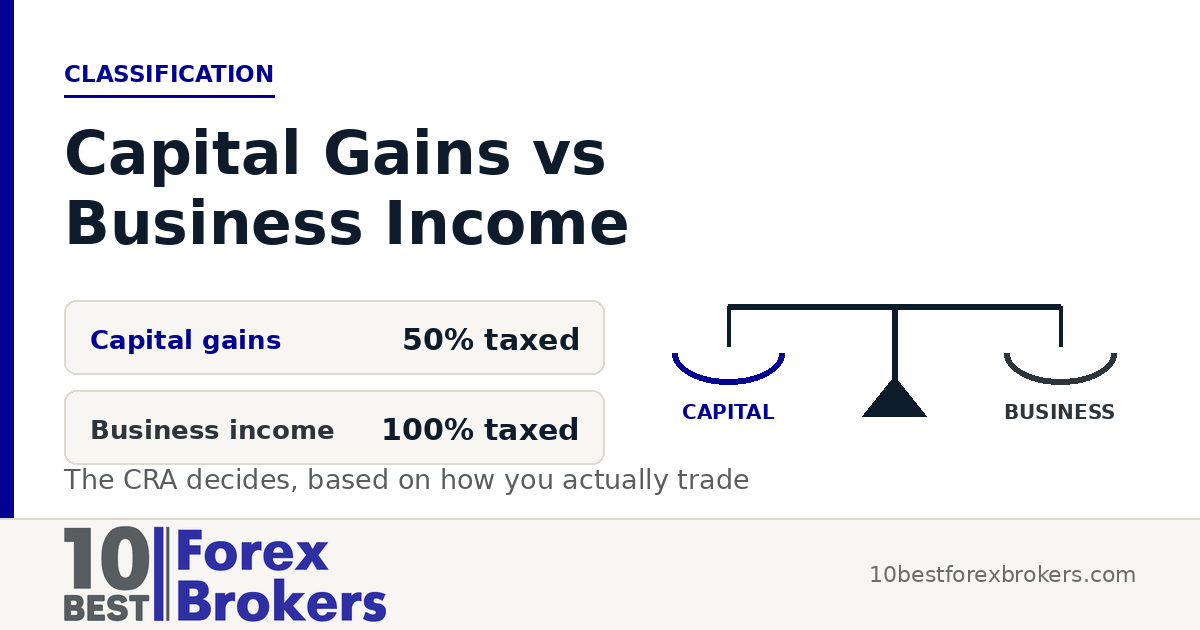
This is the single most consequential question in Canadian trading tax, and the most widely misunderstood. The difference between the two treatments can double your tax bill or, in a losing year, determine whether your losses are useful at all. Here is how the determination actually gets made.
This is general information, not tax advice
We are not accountants and this page is not tax advice. Tax treatment depends on your specific circumstances, and the CRA decides your classification based on the full picture of your activity — you do not get to pick. Before you file, speak to a CPA or tax professional who has seen your actual trading records. Where we cite rules we link to the primary source so you can verify them yourself.
You do not get to choose
Start here, because a great deal of bad advice circulates on this point. There is no election. There is no form. You cannot decide that your trading is capital in nature because the rate is better. The classification follows from the facts of your activity, and the CRA assesses those facts independently of the position you took on your return.
What you do control is the accuracy and consistency of your reporting, and the quality of the records supporting it. If your facts genuinely point toward capital treatment, document why. If they point toward business treatment, filing that way from the outset is far cheaper than being reassessed for several years at once with interest running.
The factors the CRA weighs
No single factor decides it. These are the considerations that recur in CRA guidance and in the case law, roughly in order of the weight they tend to carry:
| Factor | Points to capital gains | Points to business income |
|---|---|---|
| Frequency | A modest number of trades | High, sustained volume |
| Holding period | Months or longer | Days, hours or minutes |
| Time devoted | Occasional attention | A substantial part of your working day |
| Intention | Acquired to hold | Acquired to resell for profit |
| Leverage & financing | Little or none | Significant margin use |
| Expertise | General knowledge | Specialised market knowledge or related professional background |
| Role in your finances | Secondary to other income | A primary source of livelihood |
Where retail forex usually lands
It is worth being blunt about this. Retail forex trading is, structurally, short-term and leveraged. The typical retail forex account holds positions for hours or days, uses margin as a matter of course, and turns over frequently. Measured against the factors above, that profile sits much closer to the business end of the spectrum than to the investment end.
Many retail traders assume capital gains treatment because it is the more favourable rate and because it is what applies to the stocks in their brokerage account. That assumption is often wrong, and the consequences arrive years later when a reassessment covers multiple tax years at once, with interest.
This does not mean business treatment is always worse. In a losing year — and a large majority of retail forex accounts lose money — business treatment allows those losses to offset employment income, which capital treatment does not. Traders sometimes discover they have been leaving real relief unclaimed.
The asymmetry cuts both ways
Capital treatment is better when you win. Business treatment is better when you lose. This is exactly why the CRA does not let you pick, and why switching treatments between years is one of the clearest audit signals you can send.
Why consistency matters
The CRA expects your reporting to be consistent from year to year. Profits filed as business income cannot be recharacterised as capital gains in a later year simply because the rate suits you better, and the reverse is equally true.
A pattern of claiming business losses in bad years and capital gains in good ones is close to a worked example of what draws attention. If your circumstances genuinely change — you leave a job to trade full-time, or you wind down to occasional activity — that can support a change in treatment, but document the change and get advice before you file it.
What the courts have actually said
The factors above are not invented by the CRA in isolation — they come out of decades of Canadian tax jurisprudence on the distinction between an adventure in the nature of trade and an investment. A few principles recur consistently and are worth knowing:
- Intention at acquisition governs. The question is what you meant to do with the position when you opened it. Buying something with a view to reselling it at a profit is trading; buying it to hold for yield or long-term appreciation is investing. Later events do not retroactively change the original intent, though they can be evidence of it.
- A secondary intention counts. Even where the primary purpose was to hold, if the possibility of a quick resale was an operating motivation at the time of purchase, that can be enough to characterise the transaction as trading.
- The whole course of conduct is examined. No single transaction is assessed in isolation. A pattern across years carries more weight than the facts of any one trade.
- The nature of the asset matters. Assets that produce no income and are held purely for price movement are harder to characterise as investments than assets that yield interest or dividends. Spot forex produces no yield.
- Labels do not decide it. Calling yourself an investor, or naming an account an investment account, carries no weight against the actual pattern of activity.
That fourth point deserves attention from forex traders specifically. A dividend-paying stock held for years has an obvious investment rationale independent of price movement. A leveraged currency position does not — the only way it produces a return is through price change, and financing costs mean holding it indefinitely is expensive. That structural fact makes the investment characterisation harder to sustain for forex than it is for equities.
Does the instrument change the answer?
Traders sometimes hear that spot forex, forex futures and CFDs are taxed differently as a matter of course. The reality is more nuanced.
The classification analysis is the same regardless of instrument — the CRA is assessing your activity, not the product. What differs is how the underlying facts tend to line up. Spot currency dispositions can engage the subsection 39(1.1) treatment and the $200 de minimis where capital treatment applies. Derivatives held for speculative gain, including CFDs, sit less comfortably in the capital category because there is no acquisition of an underlying asset to hold in the first place.
There is also a point specific to Canadian retail traders worth flagging: much of what is marketed as forex trading in Canada is a CFD or margin product rather than the purchase of currency itself. If you are unsure which you are actually trading, the account documentation will say, and it is worth knowing before tax time.
If you have been filing the wrong way
This is common and it is fixable, but the timing matters enormously.
The CRA operates a Voluntary Disclosures Program that may provide relief from penalties and partial relief from interest for taxpayers who correct their filings before the CRA raises the issue. Once an audit, enquiry or enforcement action has begun, that relief is generally no longer available. The window closes on its own schedule, not yours.
The right move is to take your actual trading records to a CPA who handles trader files, get an assessment of which treatment your facts support, and act on it. This is not a situation where waiting improves anything.
Frequently asked questions
Can I choose whether my forex trading is capital gains or business income?
No. The CRA determines the classification from the character of your activity. There is no election, no form, and no box to tick. You take a position when you file, but the CRA can reassess and reclassify it, and it does.
How many trades make me a business?
There is no threshold. Frequency is one factor among several, and a high count on its own is not decisive any more than a low count guarantees capital treatment. A person making thirty large, heavily leveraged, same-day trades looks more business-like than someone making eighty small ones across a year. The CRA weighs the whole picture.
Does trading full-time automatically mean business income?
It weighs heavily toward it. Time devoted to the activity is one of the strongest single factors, and if trading is your primary source of livelihood, business treatment is the likely result. It is not literally automatic, but arguing capital treatment in that situation is a difficult position to defend.
What if I have been reporting the wrong way for years?
Speak to a CPA promptly. The CRA’s Voluntary Disclosures Program may offer relief from penalties and partial interest relief for taxpayers who come forward before the CRA contacts them about the issue — but the relief generally evaporates once an audit or enquiry has begun. Waiting makes the outcome worse, not better.
Is day trading treated differently from swing trading?
Not as separate legal categories, but the underlying facts differ in ways that matter. Day trading involves short holding periods and high frequency, both of which point toward business income. Swing trading over weeks or months sits closer to the investment end of the spectrum. The label you use for your style is irrelevant; the pattern of activity is what gets assessed.