Forex Trading in Quebec 2026: Rules, Regulator & Best Brokers
Quebec is the one province where forex regulation looks and feels genuinely different. Instead of a securities commission, you deal with the Autorité des marchés financiers (AMF) — an integrated regulator covering securities, derivatives, insurance and deposit institutions in one body. You also have language rights other Canadians don’t: firms doing business in Quebec must be able to serve you in French, and the AMF publishes its registers, alerts and investor education in both languages.
Whether you trade from Montreal, Quebec City, Gatineau or the regions, here is what actually differs — the regulator, the tax filing, dispute resolution — and which brokers serve the province.
The AMF: an integrated regulator, not just a securities commission
The AMF administers Quebec’s Derivatives Act, under which retail forex falls. Dealers must be registered with the AMF and hold CIRO membership for day-to-day supervision. Two AMF features are worth knowing. First, its public registers let you confirm a firm’s Quebec registration directly. Second, the AMF operates its own complaint examination and mediation services — so a Quebec trader with a dispute has an avenue in addition to OBSI, something no other province offers.
Check both lists: the AMF register for Quebec registration, and the AMF’s warnings and alerts, where unregistered forex platforms targeting Quebecers appear regularly. Our CIRO Broker Checker covers the national side.
French-language service is a right, not a courtesy
Under Quebec’s language framework (including the Charter of the French Language as amended by Bill 96), businesses serving Quebec consumers must be able to do so in French — contracts, disclosures and support included. In practice, the large CIRO dealers serving Quebec offer French platforms and support; offshore brokers almost never do, which is one more practical tell that a firm was never built to serve you lawfully.
Leverage caps: identical to the rest of Canada
The AMF does not set separate leverage rules — CIRO’s national margin requirements apply to every registered dealer serving Quebec.
Trading hours on Montreal time
Quebec shares Eastern Time with Ontario, which is the sweet spot for forex: the London–New York overlap runs about 8 h to 12 h Montreal time, and the Tokyo session opens in the evening around 19 h–20 h for anyone trading yen pairs after work.
Brokers that accept Quebec residents
All seven CIRO-regulated brokers we review serve Quebec: OANDA, FOREX.com, CMC Markets, AvaTrade, Interactive Brokers, Questrade and Plus500. If French-language support quality matters to you, weigh that in our side-by-side comparison or take the broker quiz.
Taxes: the two-return province
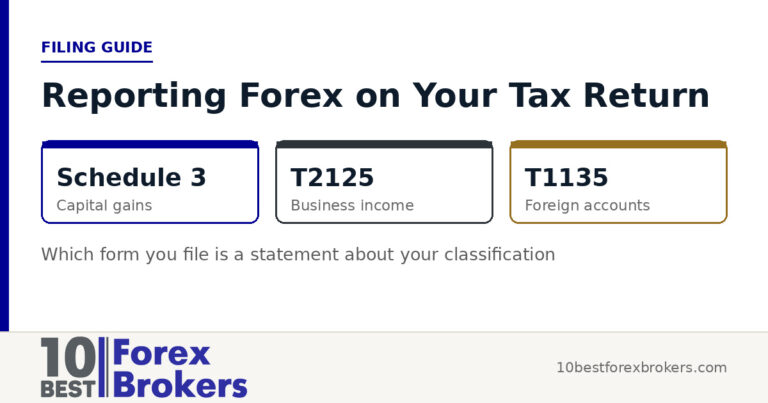
Quebec is the only province where you file a separate provincial return with Revenu Québec in addition to the federal CRA return — your forex results get reported twice, and the capital-gains-versus-business-income question applies on both. Frequent leveraged day trading leans toward business income (fully taxable); occasional longer-term positions lean toward capital gains (generally half taxable). Keep CAD-converted records for both filings. This is general information, not tax advice — Quebec’s combined top marginal rates are among the highest in the country, so professional advice pays for itself quickly.
Verifying a broker from Quebec: three steps
- Search the firm in the AMF register — the legal entity, not the marketing name.
- Confirm CIRO membership on CIRO’s dealer list for CIPF protection.
- Scan AMF alerts and the CSA national alert list.
Free tools for Quebec traders
- CIRO Broker Checker — verify any broker’s Canadian registration in seconds
- Broker match quiz — answer 6 questions, get a shortlist
- Side-by-side comparison — spreads, platforms and protection
- Pip value calculator (CAD) and position size calculator
Frequently asked questions
Is forex trading legal in Quebec?
Yes, entirely legal for residents. Firms offering leveraged forex to Quebecers must be registered with the AMF and be CIRO members. The AMF actively lists unregistered platforms on its alerts page — trading with one costs you CIPF coverage, AMF mediation and French-language rights.
Do brokers have to serve me in French?
Firms doing business in Quebec must be able to serve consumers in French under the province’s language laws. CIRO dealers serving Quebec provide French platforms, documents and support; offshore brokers generally don’t — a practical red flag.
What is the AMF’s dispute service?
The AMF examines complaints and offers mediation between consumers and registered firms — an extra avenue on top of OBSI that only Quebec residents have. It applies to registered firms, which is another reason to stay inside the regulated system.
How are forex profits taxed in Quebec?
You report on two returns — CRA federally and Revenu Québec provincially. Either way, the key issue is capital gains (about half taxable) versus business income (fully taxable), decided by how you actually trade. Keep CAD records for both filings; consult an accountant for your situation.
Can I get 500:1 leverage in Quebec?
Not from any registered broker — CIRO caps major pairs around 50:1 nationwide. Anyone offering 500:1 to a Quebec resident is unregistered by definition, and likely already on an alert list.