Forex Trading in Manitoba 2026: Rules, Regulator & Best Brokers
Manitoba traders sit in the geographic middle of the country and, conveniently, close to the middle of the forex clock. From Winnipeg, Brandon or Steinbach, your provincial watchdog is the Manitoba Securities Commission (MSC), which operates as part of the Manitoba Financial Services Agency — a smaller regulator than Ontario’s or Quebec’s, but one plugged into the same national machinery: CSA registration, CIRO supervision and CIPF protection all apply identically here.
The MSC and Manitoba’s place in the national system
The MSC administers Manitoba’s Securities Act and Commodity Futures Act, and retail forex dealers serving Manitobans must be registered and be CIRO members. Manitoba participates in the CSA passport system, so a dealer registered through its principal regulator elsewhere can serve Manitoba clients without friction — which is why every major forex broker in Canada is available here despite the province’s smaller market.
Smaller regulator does not mean fewer tools for you: registration checks run through the same CSA National Registration Search, and the MSC publishes its own investor alerts alongside the CSA’s national list.
Verify first: CSA registration search, CIRO member list, MSC alerts — or run all three checks through our free CIRO Broker Checker.
Leverage limits in Manitoba
Trading hours on Winnipeg time
Central Time is arguably Canada’s most balanced forex clock. The London–New York overlap runs roughly 7:00 a.m. to 11:00 a.m. CT — early but civilized — and the New York close lands at 4:00 p.m. CT. Tokyo opens around 6:00–7:00 p.m. CT, so evening yen trading fits neatly after supper. Unlike neighbouring Saskatchewan, Manitoba does observe daylight saving time, so these local times hold year-round relative to New York.
Brokers that accept Manitoba residents
All seven CIRO-regulated brokers we review accept Manitobans: OANDA, FOREX.com, CMC Markets, AvaTrade, Interactive Brokers, Questrade and Plus500. None run Winnipeg offices — support is remote for everyone — so weigh platform and support quality in our comparison or take the broker quiz.
Taxes for Manitoba traders
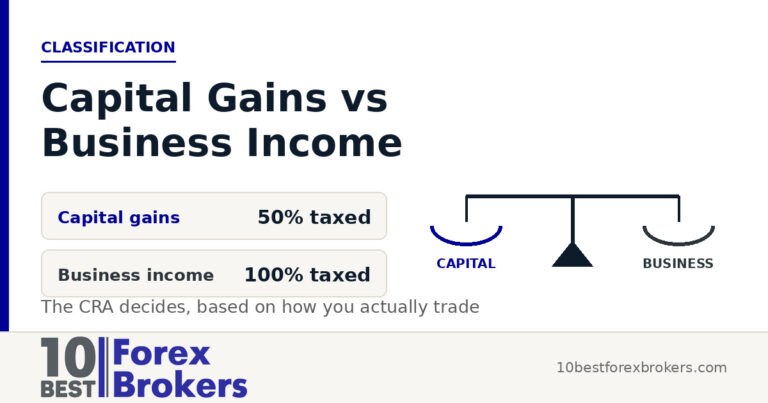
Manitoba provincial tax stacks on the federal rate through a single CRA return. The classification question rules everything: frequent, leveraged, short-term trading points to business income (fully taxable); occasional position trading points to capital gains (generally half taxable). Manitoba’s brackets bite at comparatively modest incomes, so a profitable trader hits the top provincial rate sooner than in Alberta or BC — one more reason to get classification right early. Not tax advice; keep CAD records and talk to an accountant. Our beginner’s guide covers the paperwork habit.
Three-step broker check for Manitobans
- Confirm registration via the CSA National Registration Search.
- Confirm the firm on CIRO’s dealer list.
- Scan MSC and CSA investor alerts for the name.
Free tools for Manitoba traders
- CIRO Broker Checker — verify any broker’s Canadian registration in seconds
- Broker match quiz — answer 6 questions, get a shortlist
- Side-by-side comparison — spreads, platforms and protection
- Pip value calculator (CAD) and position size calculator
Frequently asked questions
Is forex trading legal in Manitoba?
Yes. Residents can trade freely; the legal duty sits with dealers, who must be registered and CIRO members to offer leveraged forex in Manitoba. Offshore platforms soliciting Manitobans are operating unlawfully and give you no CIPF or OBSI protection.
Does Manitoba have its own leverage rules?
No — CIRO’s national margin requirements apply. Major pairs cap around 50:1 at every registered broker in every province.
What are the best trading hours from Winnipeg?
The London–New York overlap, roughly 7–11 a.m. CT, has the tightest spreads. Tokyo opens around 6–7 p.m. CT for evening traders.
Is my money protected with a Manitoba account?
At a CIRO member, CIPF covers client assets up to $1 million per account category if the firm becomes insolvent — identical protection to every other province. Trading losses are never covered.
Why don’t any brokers have Manitoba offices?
Market size — dealers concentrate offices in Toronto and sometimes Montreal or Vancouver. It has no regulatory effect: registration, CIPF and OBSI apply to your account regardless of where the broker’s desks sit.