How to Start Forex Trading in Canada: A Beginner’s Guide (2026)
New to forex and based in Canada? This guide walks you through starting safely — which mostly means starting with a broker that’s actually legal for you, and understanding risk before you risk anything. We’ll keep it practical and honest, including the uncomfortable parts.
How we make money & how we research
We may earn a commission if you open an account through some links on this page, at no cost to you. We do not test brokers with live-funded accounts; our ratings are built from regulatory records (CIRO, CIPF, provincial regulators), public disclosures, and documented broker terms. See our methodology and affiliate disclosure. Trading forex and CFDs carries a high risk of loss.
The honest starting point
Most retail forex traders lose money. That’s not a reason never to trade, but it is a reason to start small, learn properly, risk only what you can afford to lose, and ignore anyone promising fast riches.
Step 1: Choose a CIRO-regulated broker
In Canada, your first decision is regulation, not spreads. Use a broker registered with CIRO through a Canadian entity and covered by CIPF (protection up to CAD $1M on insolvency). Start with our best forex brokers in Canada shortlist, and confirm the broker accepts your province — availability varies, as our province guide explains.
Step 2: Understand Canada’s leverage caps
Canadian accounts cap leverage at around 50:1 on major pairs, with lower caps on other assets. This is lower than offshore brokers — and that’s protection, not a limitation. Read the leverage caps explainer so the numbers don’t surprise you.
Step 3: Practise on a demo account
Before risking real money, use a free demo to learn the platform, order types, and how positions behave. Treat the demo seriously — trade it the way you’d trade real money, not recklessly.
Step 4: Learn position sizing and risk
This is what separates traders who last from those who blow up. Decide in advance how much you’ll risk per trade (many keep it to 1–2% of the account), and size every position to that. Our position size calculator does the math for you.
Step 5: Keep records for taxes
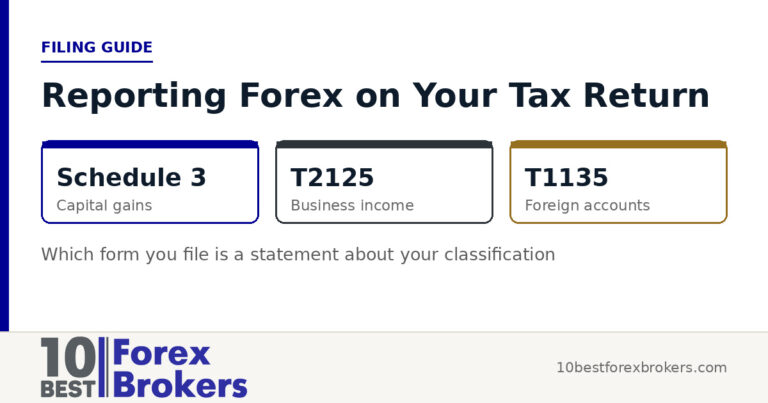
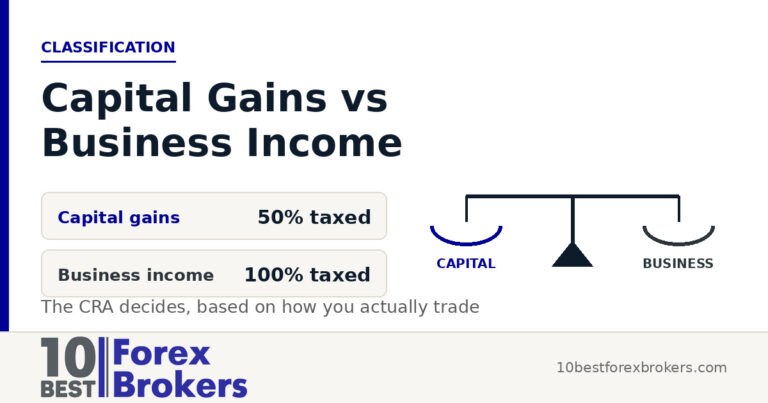
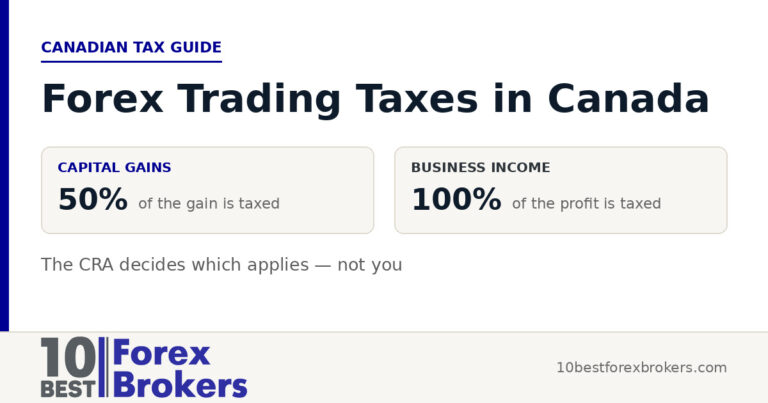
Forex profits are taxable in Canada as capital gains or business income depending on how you trade. From day one, keep a journal: dates, pairs, entry/exit, and fees. It makes tax time far easier and helps you improve. Confirm your specific situation with a qualified accountant.
What to avoid as a beginner
- Offshore brokers offering huge leverage and bonuses — you give up CIPF protection and legal recourse.
- “Signal sellers” and guaranteed-profit schemes — if it were that easy, they wouldn’t be selling it.
- Risking money you can’t afford to lose, or trading to recover losses (revenge trading).
- Over-leveraging because the platform lets you — the cap is a maximum, not a target.
When you’re ready, compare regulated options on our Canada brokers page and verify any broker with our safety checklist.
Frequently asked questions
How much money do I need to start forex trading in Canada?
You can start with very little — some CIRO-regulated brokers like OANDA have no minimum deposit, and you can trade micro or smaller lots. A few hundred dollars is a practical starting point, but what matters far more than the amount is risk management and only using money you can afford to lose.
Is forex trading taxed in Canada?
Yes. Forex profits are taxable, treated as either capital gains or business income depending on how actively you trade. Keep a detailed trading journal and confirm your situation with a qualified accountant.
Should beginners use a demo account first?
Yes. A demo account lets you learn the platform and test a strategy with no money at risk. Most CIRO-regulated brokers offer free demos. Spend real time there before funding a live account.