Forex Trading in Saskatchewan 2026: Rules, Regulator & Best Brokers
Saskatchewan has one genuinely unique quirk for forex traders that almost nobody writes about: the province doesn’t observe daylight saving time. Because forex sessions are anchored to London and New York — which do shift their clocks — a Saskatoon or Regina trader’s session times move twice a year even though the local clock never changes. We’ll map that out below, along with the province’s regulator, the Financial and Consumer Affairs Authority of Saskatchewan (FCAA).
The FCAA: Saskatchewan’s integrated regulator
Securities oversight in Saskatchewan sits inside the FCAA’s Securities Division — an integrated consumer-and-financial regulator, structurally closer to New Brunswick’s FCNB than to a stand-alone commission like the OSC. The rules for forex are the national ones: dealers serving Saskatchewan residents must be registered and hold CIRO membership, bringing national margin caps, audits and CIPF coverage. Saskatchewan participates in the CSA passport system, so every major Canadian forex broker is available here.
Check before funding: the CSA National Registration Search, CIRO’s dealer list and the FCAA’s investor alerts. Our CIRO Broker Checker bundles the process.
Leverage caps apply here like everywhere
The no-DST effect: your session times move twice a year
Saskatchewan stays on Central Standard Time year-round. New York doesn’t — so the market’s anchor points slide against your wall clock:
- Winter (New York on standard time): the London–New York overlap runs about 7:00–11:00 a.m. Saskatchewan time; New York closes at 4:00 p.m.
- Summer (New York on daylight time): everything shifts an hour earlier — overlap roughly 6:00–10:00 a.m., New York close at 3:00 p.m.
If you set alarms, alerts or session-based strategies, recheck them every March and November. It’s a small thing that quietly breaks a lot of Saskatchewan traders’ routines.
Brokers that accept Saskatchewan residents
All seven CIRO-regulated brokers we review serve the province: OANDA, FOREX.com, CMC Markets, AvaTrade, Interactive Brokers, Questrade and Plus500. Compare them on our comparison page or take the 60-second quiz.
Taxes for Saskatchewan traders
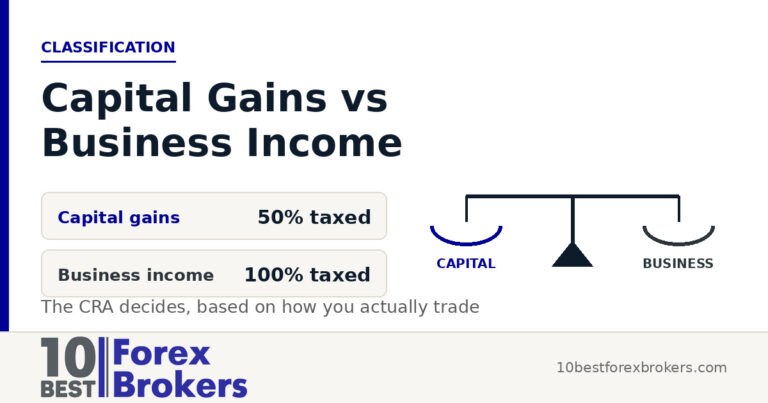
One CRA return covers federal plus Saskatchewan provincial tax. The recurring Canadian question decides your bill: business income (fully taxable — likely for frequent leveraged trading) versus capital gains (generally half taxable). Agricultural producers who already use currency futures for hedging should keep hedging and speculative activity clearly separated in their records — mixing them muddies both the tax picture and the CRA conversation. General information, not tax advice; see record-keeping basics in our beginner’s guide.
Three-step verification for Saskatchewan
- CSA National Registration Search — legal entity, Saskatchewan listed.
- CIRO membership — the CIPF trigger.
- CSA and FCAA investor alerts — confirm the name is clean.
Free tools for Saskatchewan traders
- CIRO Broker Checker — verify any broker’s Canadian registration in seconds
- Broker match quiz — answer 6 questions, get a shortlist
- Side-by-side comparison — spreads, platforms and protection
- Pip value calculator (CAD) and position size calculator
Frequently asked questions
Is forex trading legal in Saskatchewan?
Yes — fully legal for residents. Dealers offering leveraged forex here must be registered and CIRO members; unregistered offshore platforms give you no CIPF, no OBSI and no practical recourse.
Why do my trading hours change if Saskatchewan has no daylight saving?
Because the market’s anchors — London and New York — do change their clocks. Relative to a fixed Saskatchewan clock, sessions shift an hour earlier each spring and back each fall: the London–NY overlap is roughly 7–11 a.m. in winter and 6–10 a.m. in summer.
Who regulates forex in Saskatchewan?
The FCAA’s Securities Division provincially, with CIRO handling dealer supervision nationally and CIPF protecting client assets at member firms up to $1 million per account category.
Can I hedge farm income and speculate in the same account?
You can, but you shouldn’t — at least not without clean records separating the two. Hedging and speculation can attract different tax treatment, and blending them invites CRA scrutiny. Many producers keep separate accounts entirely.
What leverage can Saskatchewan traders get?
The national CIRO caps: about 50:1 on major pairs, stepping down through minors, indices, commodities, stocks and crypto. No registered broker can offer more, anywhere in Canada.