Forex Trading in Nova Scotia 2026: Rules, Regulator & Best Brokers
Halifax traders get something the rest of the country envies without realizing it: Atlantic Time turns the London–New York overlap into a mid-morning event rather than a pre-dawn one. From Halifax, Sydney or Truro, your provincial regulator is the Nova Scotia Securities Commission (NSSC) — a small commission by national standards, but wired into the same CSA, CIRO and CIPF machinery that governs a Toronto account.
The NSSC and how a small regulator protects you
The NSSC administers Nova Scotia’s Securities Act; leveraged retail forex dealers serving NS residents must be registered and hold CIRO membership. Nova Scotia participates in the CSA passport system, which is precisely why a province of about a million people has access to every major forex broker in Canada — registration and supervision are pooled nationally, and CIPF’s $1-million-per-account-category insolvency protection applies identically here.
The NSSC also publishes investor alerts and runs local investor-education outreach; for verification, the national tools do the heavy lifting.
Verify in a minute: the CSA National Registration Search, CIRO’s dealer list, then CSA alerts — or use our CIRO Broker Checker, which chains all three.
Leverage: national caps, Nova Scotia included
Trading hours on Halifax time
Atlantic Time puts the London–New York overlap at roughly 9:00 a.m. to 1:00 p.m. AT — the most humane liquidity window in Canada, fully inside a normal workday morning. London itself opens around 4:00 a.m. AT for the truly committed, and New York closes at 6:00 p.m. AT, meaning the entire North American session fits before supper. The trade-off: Asian sessions run deep into the Atlantic night, so yen-pair night owls have it harder here than out west.
Brokers that accept Nova Scotia residents
All seven CIRO-regulated brokers we review accept NS residents: OANDA, FOREX.com, CMC Markets, AvaTrade, Interactive Brokers, Questrade and Plus500. Support is remote for everyone in Atlantic Canada, so weigh support responsiveness in our side-by-side comparison or start with the broker quiz.
Taxes for Nova Scotia traders
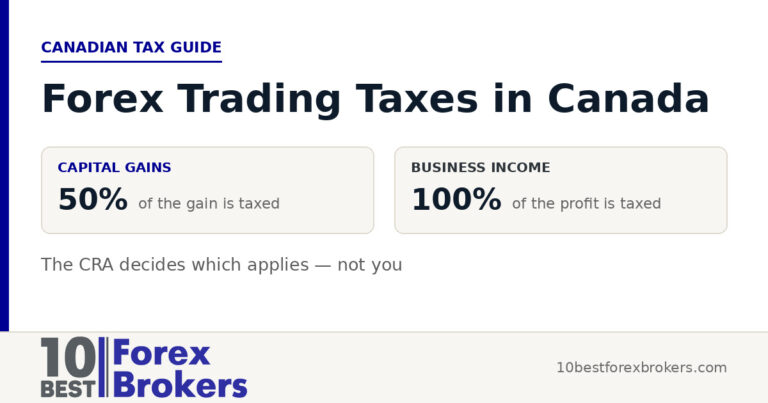
Nova Scotia’s provincial income tax stacks on federal through one CRA return, and NS has long carried some of the highest combined marginal rates in the country — which raises the stakes on the classification question. Business income (frequent, leveraged, short-term trading) is fully taxable; capital gains (occasional, longer-hold trading) are generally half taxable. Get the classification right early, keep CAD records, and treat this as general information rather than tax advice. Basics in our beginner’s guide.
Three checks before you fund an account
- Legal entity registered in Nova Scotia — CSA registration search.
- CIRO member — dealer list (this is the CIPF trigger).
- Clean on CSA and NSSC alerts.
Free tools for Nova Scotia traders
- CIRO Broker Checker — verify any broker’s Canadian registration in seconds
- Broker match quiz — answer 6 questions, get a shortlist
- Side-by-side comparison — spreads, platforms and protection
- Pip value calculator (CAD) and position size calculator
Frequently asked questions
Is forex trading legal in Nova Scotia?
Yes — residents trade freely. The obligation sits with dealers, who must be registered and CIRO members to offer leveraged forex in the province. Offshore platforms give you no CIPF, no OBSI and no realistic recourse.
Does a small regulator mean weaker protection?
No — the protections that matter to a retail forex trader (registration, CIRO supervision, CIPF, OBSI) are national. The NSSC plugs into that system through the CSA passport rather than duplicating it.
What are the best trading hours from Halifax?
Roughly 9 a.m. to 1 p.m. Atlantic Time — the London–New York overlap — which is the most convenient liquidity window in any Canadian province. New York closes at 6 p.m. AT.
Which brokers have Halifax offices?
None — Canadian forex dealers concentrate offices in Toronto. It has no bearing on your protections: registration, CIPF and OBSI apply to your account wherever the broker’s staff sit.
How are forex profits taxed in Nova Scotia?
Federally plus NS provincial rates on one CRA return. Whether profits count as fully taxable business income or half-taxable capital gains depends on how you trade — frequency, holding period, leverage. NS’s high combined rates make the distinction especially valuable to get right.