
Forex Taxes in Canada: The Year-End Checklist
Affiliate disclosure: We may earn a commission if you open an account through some links on this page, at no extra cost to you. See our full affiliate disclosure.
This is general information, not tax advice. We are not accountants. How your trading is taxed depends on your facts, and the CRA — not you — decides whether it is capital gains or business income. Before you file, have a CPA or tax professional look at your actual records.
The short answer
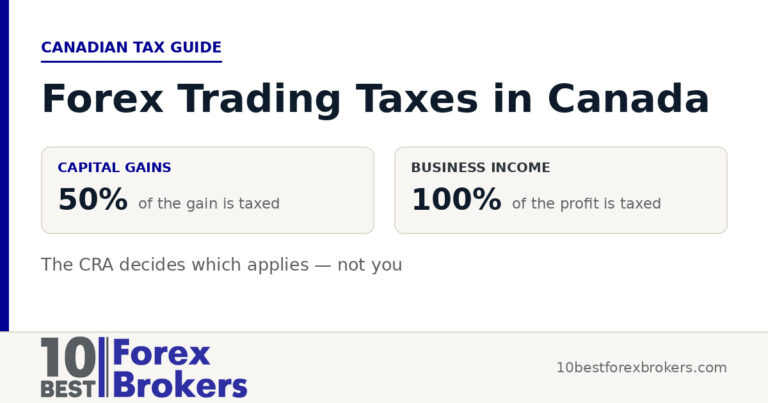
Three things decide how painful forex tax season is in Canada: the rate (still 50% inclusion for capital gains — the much-publicised increase was cancelled before it ever applied), your classification (capital gains vs business income, which the CRA determines from your activity, not your preference), and your paperwork (records, deadlines and instalments). The first two are covered in depth in our main guide to forex trading taxes in Canada. This page is the follow-up most traders actually need in the autumn: what to do before December 31, which deadlines apply to you, and the two costs — tax instalments and CPP — that catch profitable traders out.
The rate increase that never happened
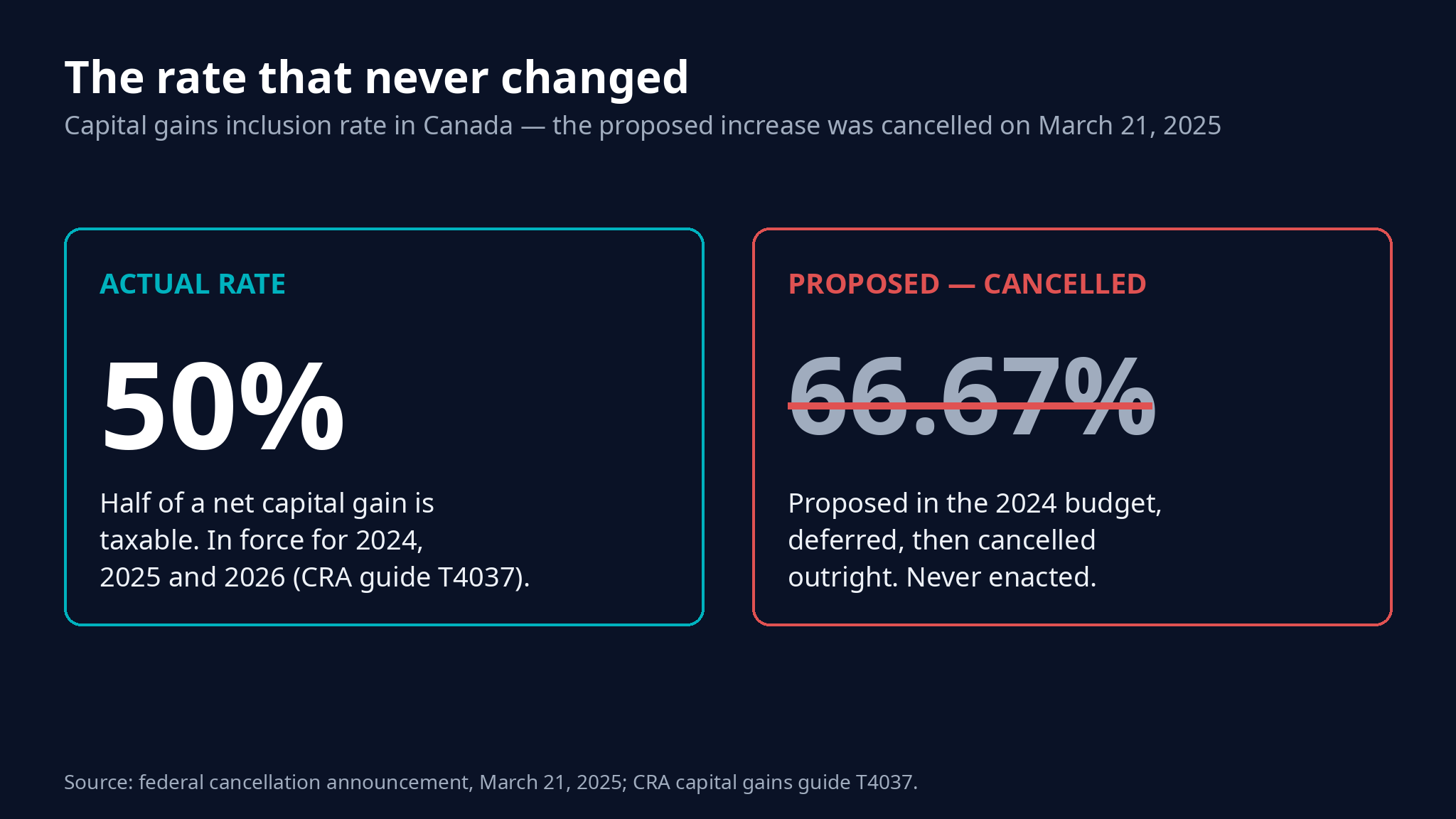
If you read anything in 2024 or 2025 about Canadian capital gains being taxed at two-thirds, you can put it aside. Here is the timeline:
- The 2024 federal budget proposed raising the capital gains inclusion rate from 50% to 66.67% for individuals on gains above $250,000 a year, and for all gains in corporations and trusts.
- The start date was deferred, and on March 21, 2025 the federal government cancelled the increase outright. It was never enacted.
- The CRA administers the long-standing 50% inclusion rate — the rate stated in its current capital gains guide (T4037). Half of a net capital gain is taxable. That is the rate that applied in 2024, applies in 2025, and applies in 2026.
Why this matters for forex traders specifically: if part of your trading is genuinely on capital account, your taxable amount did not jump by a third. And if you find a website, a forum post or even a tax article still telling you the two-thirds rate is in force, treat everything else on that page with suspicion — it is working from a proposal that died in March 2025.
One warning in the other direction: the 50% rate only helps you if capital treatment genuinely applies to your activity. Most active, leveraged retail forex trading points toward business income, where 100% of net profit is taxable and the inclusion rate is irrelevant. Our explainer on how the CRA classifies forex trading — capital gains vs business income walks through the factors. Do not build a year-end plan on a classification your facts don’t support.
Before December 31: five moves
Year-end is when a Canadian forex trader can still change their tax outcome. After it, you can only report what already happened.
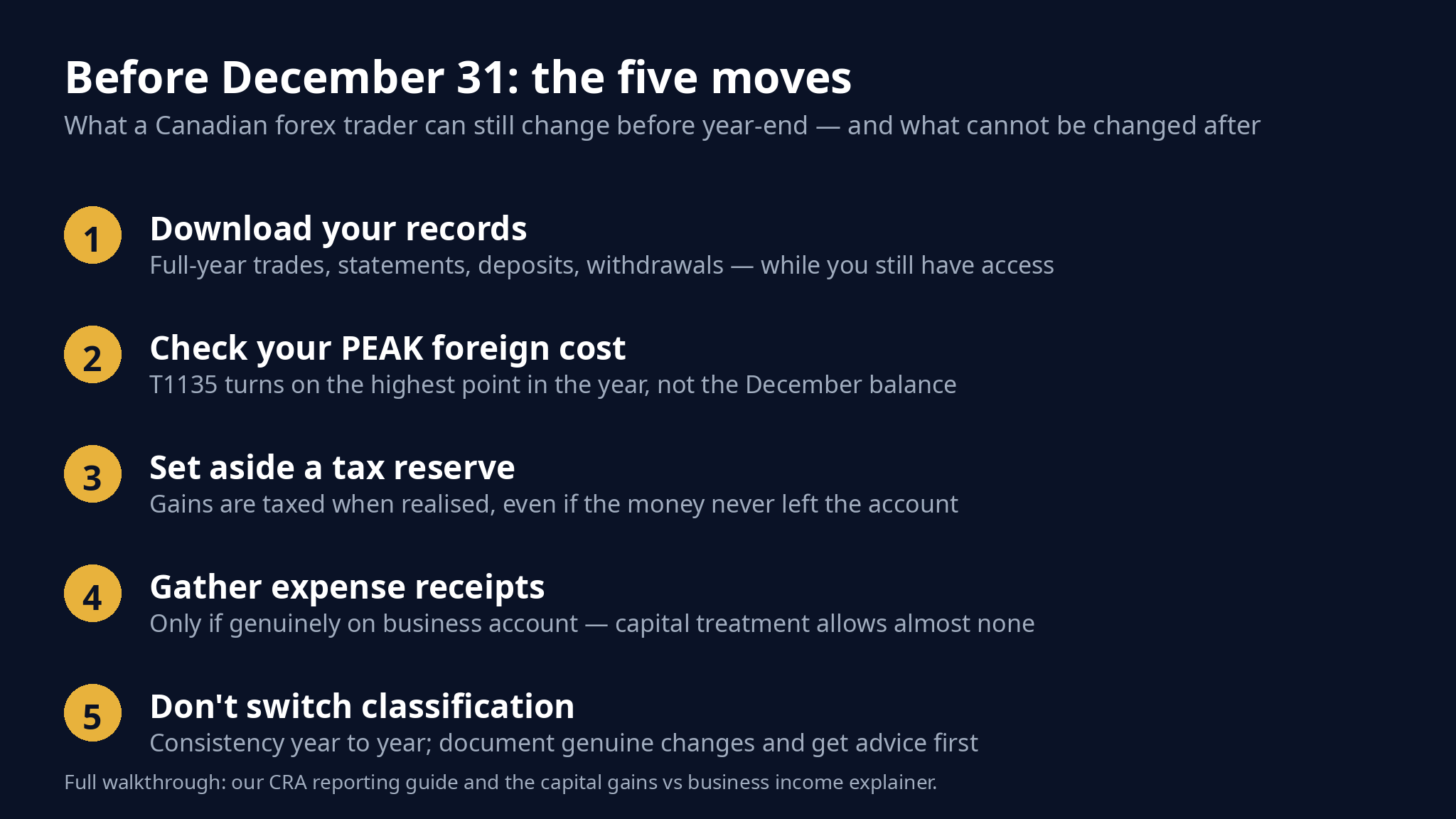
1. Download your complete records now. Export the full year’s trade history, statements, deposits and withdrawals from every broker while you still have platform access. Access disappears when accounts close, and reconstructing a year of trades in April from a broker’s support desk is miserable. Keep the exchange-rate source you will use for conversions in the same folder. Our step-by-step guide to reporting forex trading to the CRA lists exactly what to assemble.
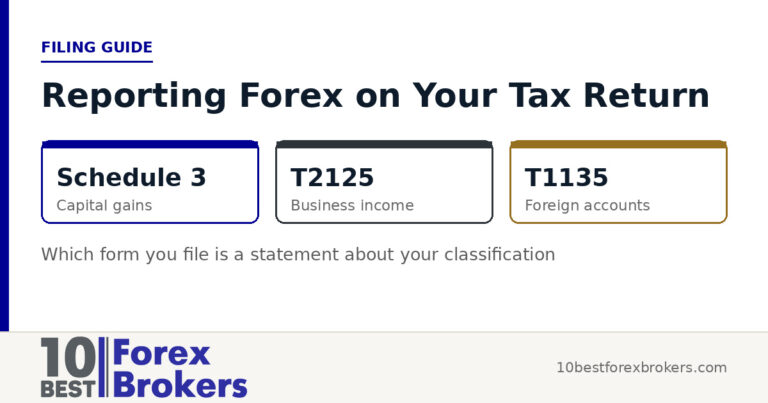
2. Check your peak foreign-property cost, not your year-end balance. Form T1135 is generally required when the total cost of your specified foreign property exceeded CAD $100,000 at any point in the year — including funds held with a broker outside Canada. A balance that spiked in June and shrank by December still counts. Note the peak now, while the statements are in front of you.
3. Put a tax reserve aside on gains already realised. Gains are taxable when a position closes, not when money reaches your bank account. A trader who realised $40,000 of gains by October and left it all in the account still has $40,000 to report. If that profit later reverses, the tax on the realised portion does not. Moving an estimated reserve out of the trading account before year-end is the simplest protection against spending your tax bill.
4. Gather expense receipts — if you are genuinely on business account. Business treatment allows deductions for reasonable expenses incurred to earn the income: commissions and financing charges, data and platform subscriptions, professional fees, a proportionate share of home office and internet costs. Capital treatment allows almost none of this. Collect the documentation now; do not reconstruct it in April.
5. Do not “fix” your classification in December. Reporting must be consistent year to year. Switching from capital gains in profitable years to business losses in losing years is the single clearest audit signal a trader can send. If your circumstances genuinely changed — you left a job to trade full-time, or wound down to occasional trades — document the change and get advice before you file, not after you are asked.
The deadline calendar
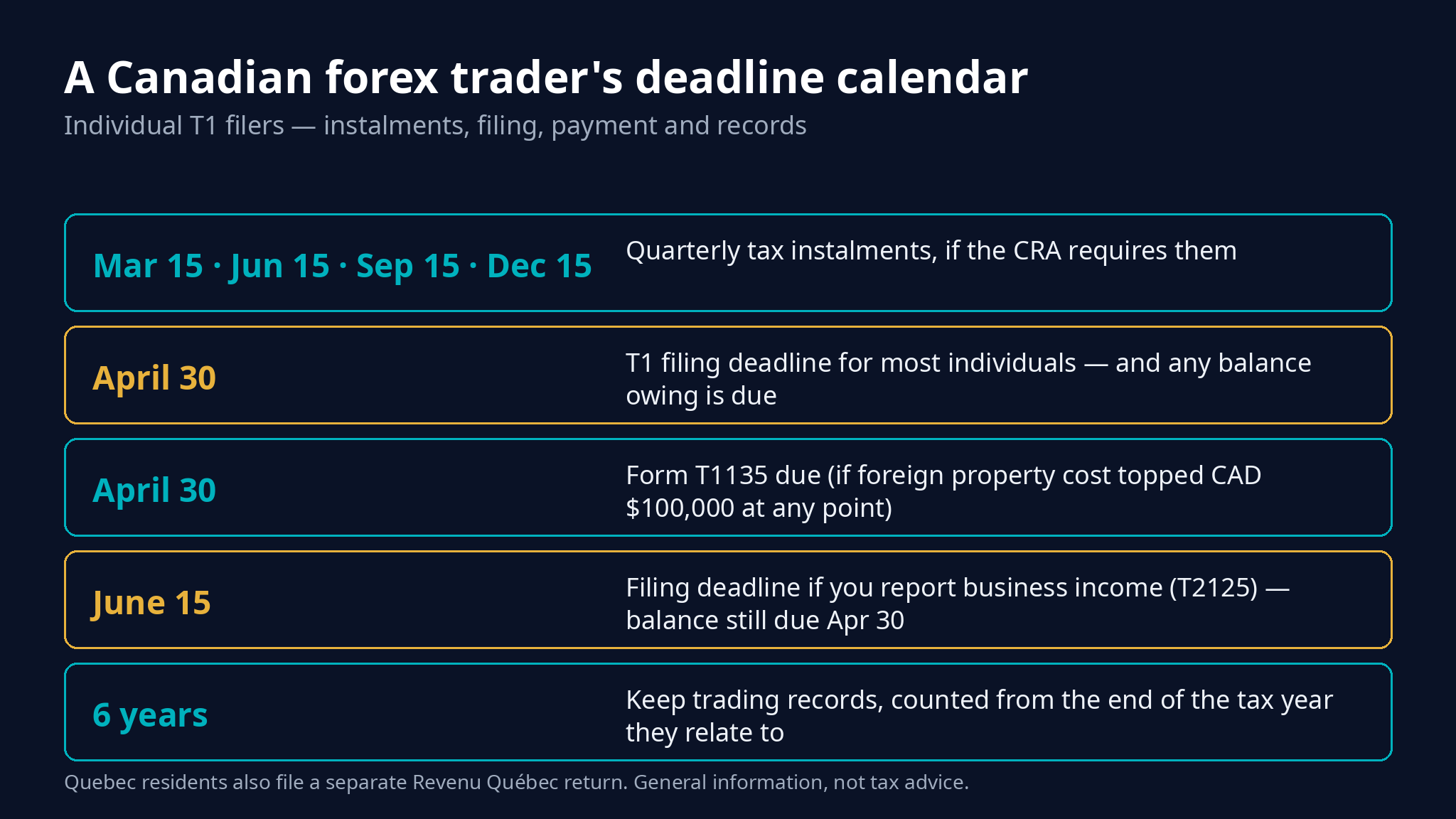
These are the dates that apply to individual traders filing a T1. Put the ones that apply to you in your calendar today:
- March 15, June 15, September 15, December 15 — quarterly tax instalment due dates, if the CRA requires you to pay by instalments (see below).
- April 30 — T1 filing deadline for most individuals, and the deadline to pay any balance owing. Form T1135 is due by your filing deadline.
- June 15 — T1 filing deadline if you (or your spouse or common-law partner) carried on a business — which includes traders reporting business income on Form T2125. Note the trap: even with the June 15 filing deadline, any balance owing is still due April 30, and interest runs from then.
- Six years — how long to keep your trading records, counted from the end of the tax year they relate to.
Quebec residents file a separate provincial return with Revenu Québec alongside the federal return, and the classification must be consistent across both.
The instalment trap
This is the surprise that hits traders in their first profitable year. If your net tax owing exceeds the CRA’s threshold in the current year and in either of the two previous years, the CRA can require you to pay your tax quarterly by instalments instead of in one lump sum at filing. Interest applies to instalments that are late or short.
Trading income is especially exposed because none of it arrives through payroll withholding. A salaried employee’s tax is largely prepaid; a profitable trader’s is not. The first sign is often a CRA instalment reminder arriving after a good year — by which time the first payment may already be due. If this was your first meaningfully profitable year, ask a CPA whether instalments will apply to you next year, and build the quarterly amounts into your cash flow now rather than discovering them in March.
CPP: the cost business traders forget
If your forex trading is business income, the net profit reported on Form T2125 is also self-employment income for CPP purposes. That means Canada Pension Plan contributions are calculated on it — and a self-employed person pays both the employee and the employer share. Capital gains attract no CPP at all.
This widens the real gap between the two treatments beyond the headline rates. On $50,000 of net profit at a 40% combined marginal rate, capital treatment costs roughly $10,000 of income tax; business treatment costs roughly $20,000 before deductions — and then CPP contributions on the self-employment income come on top. It does not make business treatment “wrong” — in a losing year, business losses can offset employment income, which capital losses cannot — but it does mean the true cost of the business classification is higher than the income-tax comparison alone suggests. Our main forex taxes in Canada guide shows the full side-by-side, including loss treatment.
Year-end losses: what they can and cannot do
A losing position you are still holding has no tax effect until it is realised. What a realised loss is worth depends entirely on your classification:
- On capital account, an allowable capital loss can only offset capital gains — in the same year, carried back three years, or carried forward indefinitely. It cannot touch employment or business income. Be careful about realising a capital loss and immediately re-entering the same position: the superficial-loss rules can deny or defer a loss where you or your spouse reacquires the same or identical property within 30 days before or after the sale. Whether and how that analysis applies to a currency position is fact-specific — take advice before assuming a December loss is usable.
- On business account, a non-capital loss can generally be applied against other income in the year, carried back three years or carried forward up to twenty. For an employed trader with a losing year, that is real, immediate relief — one of the few situations where business treatment is unambiguously better.
Neither point is a reason to choose a classification — the CRA decides that from your facts. They are reasons to understand, before December 31, which side of the line your existing classification puts this year’s losses on.
Frequently asked questions
Did the capital gains inclusion rate change?
No. The proposed increase to 66.67% was cancelled on March 21, 2025, before it ever took effect. The inclusion rate is 50% — half of a net capital gain is included in taxable income — for 2024, 2025 and 2026.
Do I have to pay tax instalments on forex income?
Possibly. If your net tax owing passes the CRA’s threshold in the current year and in either of the two prior years, the CRA can require quarterly instalments (March 15, June 15, September 15, December 15). Because no tax is withheld from trading income, profitable traders reach instalment territory faster than they expect.
When is Form T1135 due, and who files it?
Generally, by your tax filing deadline (April 30, or June 15 if you have the self-employed filing extension), if the total cost of your specified foreign property — which can include funds held with a foreign broker — exceeded CAD $100,000 at any time in the year. The penalties for missing it accrue monthly and are not proportionate to the tax at stake.
Do I pay CPP on forex trading profits?
Only under business treatment. Net business income from trading is self-employment income, so CPP contributions apply at the combined employee-plus-employer rate. Capital gains are not subject to CPP.
Can I trade forex inside a TFSA to avoid all of this?
Generally, no. Leveraged forex and CFD positions are not qualified investments for registered accounts, most CIRO dealers do not offer them in registered form, and the CRA has assessed TFSAs it considered to be carrying on a trading business. See why in our guide to whether forex trading is legal in Canada and the registered-accounts section of our main tax guide.
Bottom line
The rate never changed: 50% inclusion, as it has been for decades. What actually determines your bill is whether the CRA sees a business or an investment — covered in our classification explainer — and whether your records, deadlines and instalments are handled before they become penalties, covered step by step in our CRA reporting walkthrough. Do the five year-end moves above while December is still ahead of you, and take your records to a CPA before you file. If you are still choosing where to trade, start with the dealers that are actually legal and protected here — our Best Forex Brokers in Canada ranking — and the forex regulation in Canada framework behind it.