
Forex Trading in Alberta vs Ontario: Why Your Province Changes Your Broker Choice
Affiliate disclosure: We may earn a commission if you open an account through some links on this page, at no extra cost to you. See our full affiliate disclosure.
Risk warning: Forex and CFD trading is leveraged and carries a high risk of loss. Most retail accounts lose money. Nothing on this page is legal, investment or tax advice. Verify a broker’s current CIRO status and your own province eligibility before you fund an account.
- The short answer
- Alberta vs Ontario at a glance
- Why two provinces run two different rulebooks
- Alberta: the accredited-investor gate
- Ontario: the full-choice market
- What is identical in both provinces
- Moving provinces? Your account may not move with you
- How to check your own eligibility in five minutes
- Frequently asked questions
- Bottom line
The short answer
Two Canadians can read the same national “best forex brokers” ranking and face completely different choice sets — and the clearest example is Alberta versus Ontario.
- Ontario is the full-choice market. Every CIRO-regulated forex brand that can open an account today serves Ontario retail traders. If you live in Ontario, the national ranking is your ranking: pick on price, platform and fit.
- Alberta is the restricted market. One major dealer refuses Alberta residents outright, and three more — plus a fourth that is currently closed to all new clients — take Albertans only if they qualify as accredited investors, a high-income, high-asset status most retail traders do not meet. An Alberta retail trader’s realistic shortlist is materially shorter than the national one.
Everything else — the CIRO-only rule, CIPF protection, margin and leverage, the ban on leveraged forex in registered accounts — is national and identical in both provinces. This page explains where the difference comes from, dealer by dealer, and what to do about it depending on which side of it you live on. The dedicated province guides go deeper: forex trading in Alberta and forex trading in Ontario.
Alberta vs Ontario at a glance
| Alberta | Ontario | |
|---|---|---|
| Provincial regulator | Alberta Securities Commission (ASC) | Ontario Securities Commission (OSC) |
| Retail access to CIRO forex dealers | Restricted — see the dealer table below | Full — all open brands serve Ontario retail |
| Accredited-investor gate | Yes, at several major dealers | No |
| Dealers refusing the province | OANDA refuses Alberta entirely | None of the ranked dealers refuse Ontario |
| Registration quirk | Passport-system province | Long the only province outside the passport system; committed to join in July 2026 |
| London–New York overlap (best liquidity) | ~6–10 a.m. Mountain Time | ~8 a.m.–12 p.m. Eastern Time |
| Investor-protection hub | CheckFirst.ca (ASC) | OSC investor alerts and warnings list |
Why two provinces run two different rulebooks
Canada has no single national securities regulator. Securities and derivatives law is provincial: each province has its own regulator — the ASC in Alberta, the OSC in Ontario — and a dealer must be registered under the law of the province whose residents it serves. The Canadian Securities Administrators (CSA) coordinates the 13 provincial and territorial regulators, and CIRO, the national self-regulatory organization, supervises investment dealers day to day: capital, audits, business conduct and margin rules.
That structure produces a two-layer market. The top layer is genuinely national: in every province, leveraged forex may only be sold to retail clients by a CIRO dealer member, with CIPF protection up to C$1 million for all general accounts combined if the firm fails. Our guide to whether forex trading is legal in Canada and the complete guide to forex regulation in Canada cover that layer in full.
The bottom layer is provincial — and it is where Alberta and Ontario diverge. A dealer’s national CIRO membership does not guarantee it can, or will, serve retail clients in your province. Each firm applies provincial distribution rules and its own registration position province by province, which is why eligibility — not spreads, not platforms — is the first question a Canadian trader should ask.
Alberta: the accredited-investor gate
The Alberta Securities Commission treats forex as a high-risk product whose distribution must comply with Alberta’s prospectus and registration requirements or an exemption from them. In the ASC’s own framing, only accredited investors are eligible to invest in forex in Alberta under that distribution framework — and several major dealers have built exactly that gate into their Alberta account rules.
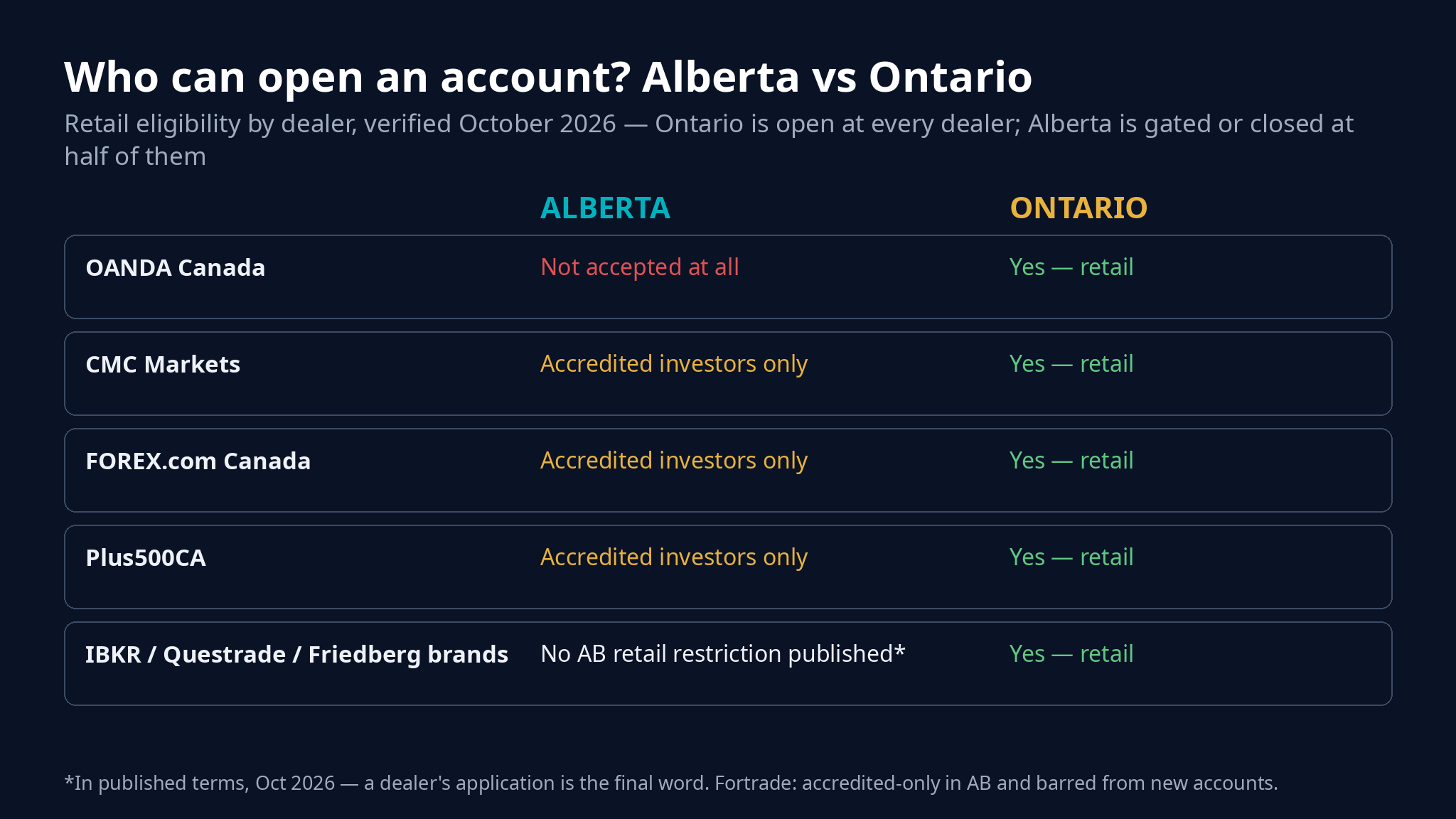
The practical result, verified against the dealers’ own Canadian disclosures in October 2026:
| Dealer (brand) | Alberta retail? | Ontario retail? |
|---|---|---|
| OANDA (Canada) Corporation ULC | No — Alberta residents not accepted at all | Yes |
| CMC Markets Canada Inc. | Accredited investors only | Yes |
| FOREX.com Canada (GAIN Capital) | Accredited investors only | Yes |
| Plus500CA Ltd. | Accredited investors only | Yes |
| Fortrade Canada Limited | Accredited investors only — and currently barred from opening new accounts at all | Same bar on new accounts |
| Interactive Brokers Canada Inc. | No Alberta retail restriction in its published terms* | Yes |
| Questrade Inc. | No Alberta retail restriction in its published terms* | Yes |
| AvaTrade / FXCM via Friedberg Direct | No Alberta retail restriction in its published terms* | Yes |
*As published in October 2026. A dealer’s application is always the final word — confirm your eligibility when you apply, because province policies change.
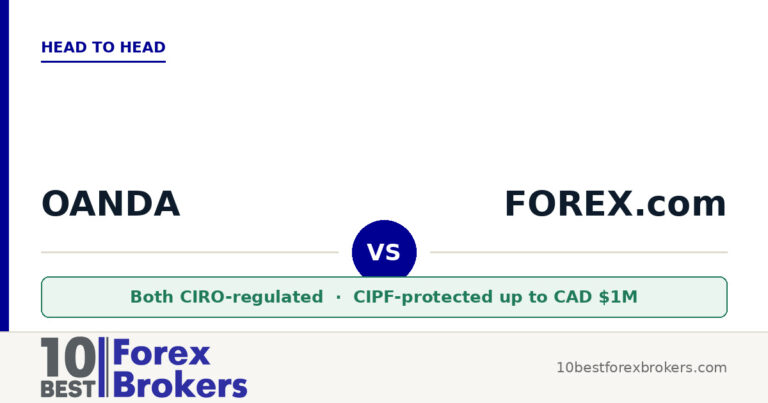
CMC Markets’ Canadian Terms of Business state the gate in plain contractual language: an Alberta resident must warrant that they are an “accredited investor” as defined in National Instrument 45-106. OANDA goes further and does not accept Alberta residents in any category. We compared those two dealers head to head in Plus500 vs OANDA — a comparison Alberta retail traders, notably, cannot act on with either firm on standard terms.
What “accredited investor” actually means
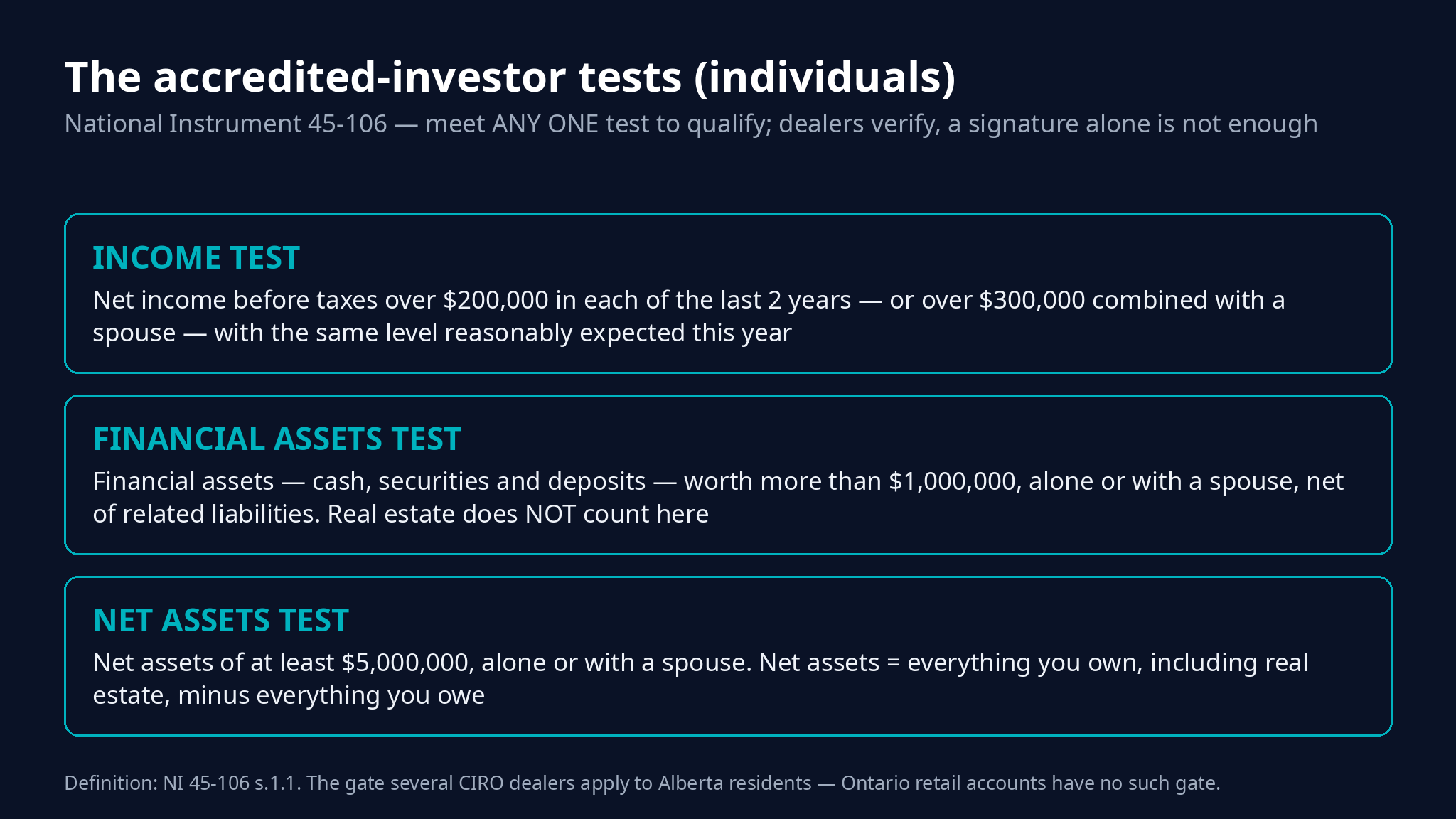
It is a defined legal status, not a compliment a broker pays you. For an individual, National Instrument 45-106 sets income and asset tests — you must meet any one of them:
- Income test: net income before taxes over $200,000 in each of the two most recent calendar years — or over $300,000 combined with a spouse — with a reasonable expectation of exceeding that level this year; or
- Financial-assets test: financial assets (cash, securities and deposits — your house does not count here) worth more than $1,000,000, alone or with a spouse, net of related liabilities; or
- Net-assets test: net assets of at least $5,000,000, alone or with a spouse. Net assets means everything you own, including real estate, minus everything you owe.
Read those thresholds again and the Alberta picture snaps into focus: the typical retail trader does not clear any of them, which is precisely why several national dealers are effectively closed to ordinary Alberta accounts. If you do qualify, expect the dealer to verify it — a signature on a form is not the end of the process.
Two Alberta specifics soften the picture slightly. The ASC runs CheckFirst.ca, one of the strongest investor-protection resources in the country, with registration checks and scam alerts that regularly name offshore platforms soliciting Albertans — use it before you trust any firm our table does not cover. And Alberta’s energy economy gives its traders a home-field pair: oil is priced in U.S. dollars, so USD/CAD drivers are part of daily working life in Calgary and Edmonton in a way they simply are not in Ontario.
Ontario: the full-choice market
Ontario is the centre of gravity of Canadian finance. The Ontario Securities Commission is the country’s largest securities regulator, Bay Street hosts the head offices or Canadian offices of most CIRO forex dealers, and — the point that matters to a retail trader — every one of the eight CIRO brands that can open an account today serves Ontario residents on retail terms. No accredited gate, no provincial refusal among the ranked dealers. An Ontario trader works through the same shortlist as our national Best Forex Brokers in Canada ranking and chooses on the merits: pricing model, platform, minimum deposit and fit.
Ontario does have one famous regulatory quirk, and it is worth understanding precisely because it so rarely touches a retail account. Ontario is the only CSA jurisdiction that never joined the passport system (Multilateral Instrument 11-102, in force since 2008), under which a firm deals mainly with its home-province regulator and that regulator’s decision is recognised across the other participating provinces. Dealers serving Ontario register with the OSC directly instead — which every major forex dealer does — so in practice the quirk affects smaller niche firms, not the names on a retail shortlist. The story is also moving: in July 2026 Ontario committed to join the passport system, a harmonisation step that, once implemented, would retire the last big structural difference between Ontario and the rest of the CSA. It changes nothing about which broker an Ontarian can use today.
Ontario’s other practical edge is the clock. On Eastern Time, the London–New York overlap — the deepest liquidity and tightest spreads of the trading day — runs roughly 8 a.m. to noon, squarely inside a normal morning. Alberta traders get the same window at 6–10 a.m. Mountain Time: workable for early risers, gone before a Calgary lunch break.
What is identical in both provinces
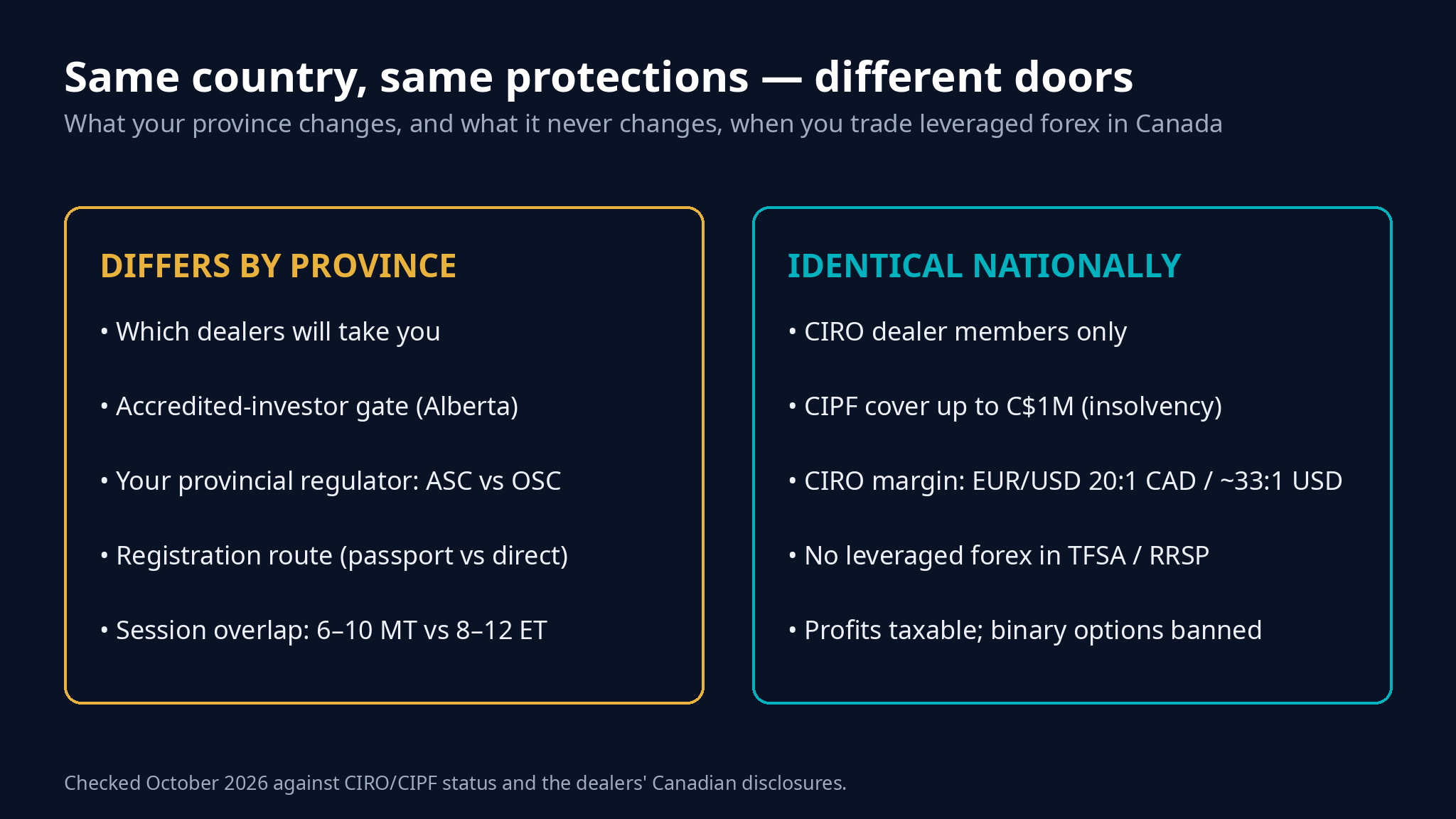
Do not let the Alberta gate obscure how much of this market is national. In Alberta and Ontario alike:
- CIRO-only, CIPF-backed. Leveraged forex for retail clients runs through CIRO dealer members only, with CIPF cover up to C$1 million for general accounts combined against a firm’s insolvency — never against trading losses. Offshore brokers offer neither protection in either province.
- Same margin, same leverage. CIRO sets margin by currency pair and account base currency, nationally: EUR/USD is 5% margin in a CAD account (20:1) and 3% in a USD account (about 33:1), with USD/CAD reaching the 50:1 ceiling. No province can offer you more, and anyone advertising 1:500 is offshore by definition. The full tables are in our guide to forex leverage limits in Canada.
- No registered accounts. Leveraged forex and CFDs cannot be held in a TFSA, RRSP or FHSA in any province.
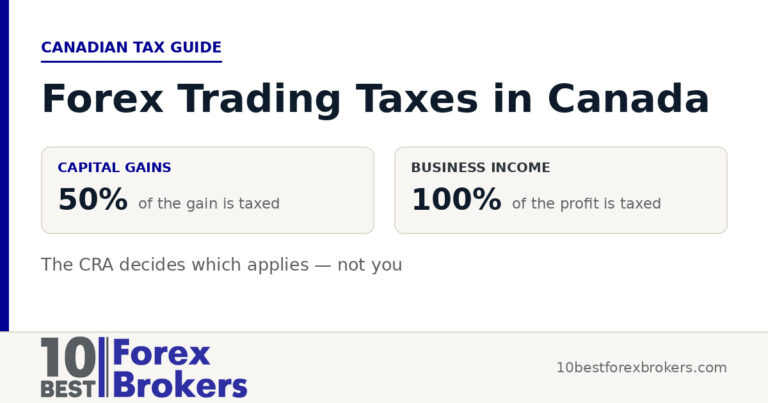
- Same tax framework. Profits are taxable under the same federal rules — capital gains or business income depending on how you trade. Your province changes the provincial rate layered on top, not the classification test, and Alberta’s generally lower provincial burden and lack of a provincial sales tax do not change what the CRA asks of you. Keep CAD records from day one in both provinces.
- Binary options are banned for individuals in both provinces (terms under 30 days, under CSA Multilateral Instrument 91-102). Any site pitching them to you is a fraud red flag wherever you live.
Moving provinces? Your account may not move with you
Eligibility follows your residence, not your citizenship, your account’s age or where you opened it. That creates a trap for movers in both directions:
- Ontario → Alberta is the painful direction. An OANDA account that was perfectly ordinary in Toronto cannot simply continue from Calgary or Edmonton — OANDA does not serve Alberta residents. The same move can push a CMC, FOREX.com or Plus500CA account behind the accredited-investor gate. Tell your dealer before you move, and plan the transition while you still have a choice of timing.
- Alberta → Ontario is the liberating direction: the full national choice set opens up, including the dealers that were closed or gated in Alberta.
- Either way, notify your dealer of a change of residential address promptly — account agreements require it, and quietly trading from a province where your dealer cannot serve you risks a frozen or closed account at the worst possible moment.
How to check your own eligibility in five minutes
- Start from your province, not the brand. Use the table above for Alberta and Ontario; for any other province, start with that province’s guide from our legality overview.
- Find the legal entity behind the brand on the broker’s Canadian site — eligibility attaches to the entity, not the marketing name.
- Confirm CIRO membership in CIRO’s “Dealers We Regulate” directory, or run the name through our CIRO Broker Checker.
- Read the dealer’s own province terms for your province specifically — Alberta’s accredited wording sits in the terms of business, not on the homepage.
- Apply with your real provincial address. A compliant dealer screens eligibility at signup and will tell you immediately if it cannot serve you. A broker that never asks which province you live in is telling you something important about itself.
Frequently asked questions
Is forex trading legal in Alberta?
Yes — forex trading itself is legal for Alberta residents. The restriction sits on distribution: dealers must comply with Alberta’s prospectus and registration requirements or an exemption, and several major CIRO dealers serve Alberta only on an accredited-investor basis, while OANDA does not accept Alberta residents at all.
Why can’t Albertans use OANDA?
OANDA (Canada) Corporation ULC does not accept residents of Alberta — its Canadian disclosures exclude the province entirely, in every client category. It serves every other province and territory, including Quebec, where it is registered as a derivatives dealer. Alberta traders need a different dealer from the table above.
What is an accredited investor in Alberta?
An individual status defined in National Instrument 45-106. You qualify by meeting any one test: income over $200,000 (or $300,000 with a spouse) in each of the last two years with the same expected this year; financial assets over $1,000,000 net of related liabilities (real estate does not count as a financial asset); or net assets of at least $5,000,000 including real estate, minus debts.
Is forex trading legal in Ontario?
Yes, and Ontario is the least restricted large market in Canada: every CIRO forex brand that can open an account today serves Ontario retail traders, with no accredited-investor gate. The dealers must be registered with the OSC and be CIRO members — the same national rule as everywhere else.
Does Ontario’s passport-system status affect my broker account?
Almost never at retail level. Ontario stood outside the CSA passport system from 2008, so dealers register directly with the OSC instead of relying on a home-province passport decision — and every major forex dealer does exactly that. Ontario committed in July 2026 to join the passport system; the commitment changes no retail eligibility today.
Is leverage different in Alberta and Ontario?
No. CIRO margin rules are national and identical in both provinces: margin is set per currency pair and account currency (EUR/USD 20:1 in a CAD account, about 33:1 in USD, up to 50:1 on USD/CAD). Your province changes which dealers you can use — never how much leverage a legal dealer can offer you.
Bottom line
Ontario traders: your province is not a constraint. Work the national shortlist, choose on price and platform, and spend your diligence on the broker, not the map. Alberta traders: your province is the first filter, not a footnote. OANDA is closed to you entirely; CMC Markets, FOREX.com and Plus500CA sit behind the accredited-investor tests set out above; and the dealers with no Alberta retail restriction in their published terms are your realistic starting point — confirmed at application, every time. Whichever province you trade from, the protection stack is the same only inside the CIRO system: check the dealer, check your province, then fund the account.
Last reviewed: October 28, 2026. Dealer eligibility re-verified against CIRO/CIPF status, the dealers’ Canadian disclosures and terms of business, and National Instrument 45-106 at review time. Eligibility changes — confirm current terms on the broker’s official Canadian site before funding an account.