
Leverage and Risk Management for Canadian Forex Traders: A Position-Sizing Guide
Affiliate disclosure: We may earn a commission if you open an account through some links on this page, at no extra cost to you. See our full affiliate disclosure.
Risk warning: Forex and CFD trading is leveraged and carries a high risk of loss. Most retail accounts lose money. Leverage amplifies losses exactly as it amplifies gains, and no calculator or rule in this guide makes a losing strategy profitable. Nothing here is investment advice.
- The short answer
- Start with the calculator: sizing a trade in four steps
- What leverage Canada actually allows
- Maximum leverage vs effective leverage: the number that actually hurts you
- Margin is not risk — and a margin closeout is not a safety net
- The 1% rule and the survival math behind it
- The rest of the risk stack
- A pre-trade checklist worth taping to the monitor
- Frequently asked questions
- Bottom line
The short answer
Canada already limits how much leverage a legal broker can offer you — but that limit is a ceiling, not a target, and it was never designed to size your trades for you. The traders who survive are not the ones who find the best entries. They are the ones who decide, before every trade, exactly how much of their account that trade is allowed to cost — and then size the position to fit that number, never the other way round.
Three ideas do almost all of the work in this guide:
- Maximum leverage is what the rules allow; effective leverage is what you actually use. They are wildly different numbers, and only the second one can hurt you.
- Risk is set by your stop distance and your position size — not by your margin. A trade can tie up very little margin and still be sized to destroy your account, or tie up a lot of margin and risk almost nothing.
- Position sizing is arithmetic, not judgement. Risk amount ÷ (stop distance × pip value) gives you the lot size. Our free position size calculator does that arithmetic for you — this guide explains the thinking behind every field in it, so you know what the number it returns actually means.
Start with the calculator: sizing a trade in four steps
Open the forex position size calculator alongside this section. It asks for four things, in the only order that makes sense:
- Your account balance — the money actually in the account, in its base currency.
- Your risk per trade, as a percentage — the share of that balance you accept losing if this trade hits its stop. The calculator defaults to 1%, and the section below on the 1% rule explains why that default is sane.
- Your stop-loss distance, in pips — set by where your trade idea is actually wrong, not by how much you would like to lose. If the chart says the stop belongs 40 pips away, entering 25 because it “feels safer” does not reduce your risk; it just gets you stopped out more often.
- The pip value per standard lot — about 10 units of your account currency per pip for most major pairs, as the calculator notes. If your pair differs — JPY pairs and cross rates often do — work it out first with the pip value calculator.
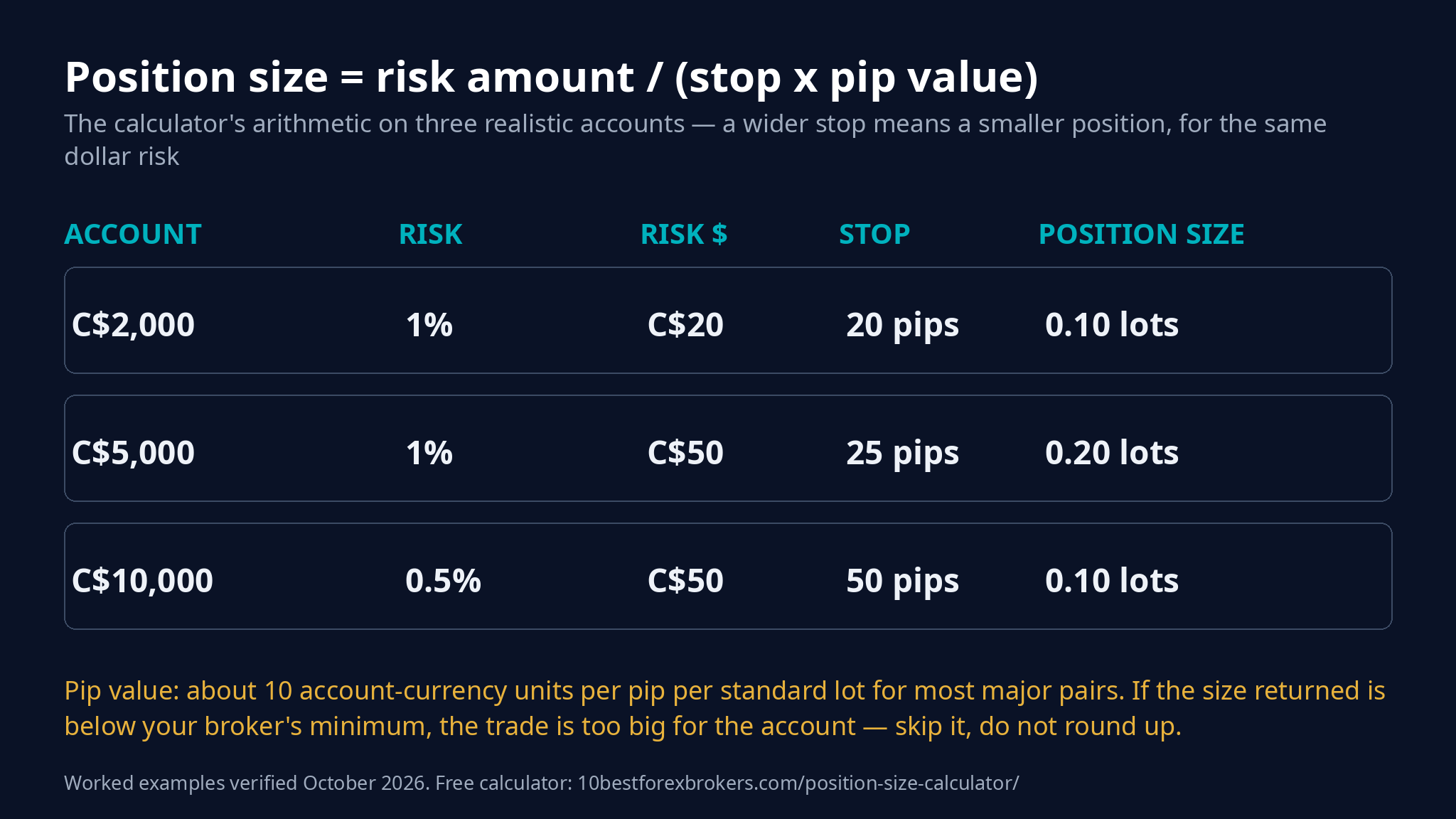
The calculator returns your risk amount in dollars and your position size in lots and units. That is the whole method. Here is what it produces on three realistic Canadian accounts:
| Account | Risk per trade | Risk amount | Stop distance | Position size |
|---|---|---|---|---|
| C$2,000 | 1% | C$20 | 20 pips | 0.10 lots (10,000 units) |
| C$5,000 | 1% | C$50 | 25 pips | 0.20 lots (20,000 units) |
| C$10,000 | 0.5% | C$50 | 50 pips | 0.10 lots (10,000 units) |
Read the last two rows together, because they teach the central lesson: a wider stop means a smaller position, for exactly the same dollar risk. The C$10,000 trader with a 50-pip stop trades half the size of the C$5,000 trader with a 25-pip stop — and both lose the same C$50 if they are wrong. Traders who fix their lot size first and let the loss float to wherever the stop happens to be have the equation backwards, and it is the single most common sizing error we see described in broker education material and trader post-mortems alike.
Two practical notes. First, if the calculator returns a size below your broker’s minimum trade size, the trade is too big for your account at that stop distance — the correct response is to skip it or fund the account properly, not to round up and quietly risk 3% instead of 1%. (This is one place where minimum trade size matters: OANDA Canada allows trades from 1 unit, so its sizing can be exact; standard-lot platforms force rounding.) Second, run the calculation before you enter, every time. A size worked out after entry is not risk management — it is a description of a risk you have already taken.
What leverage Canada actually allows
Leverage and margin are the same number viewed from opposite sides: a 5% margin requirement is 20:1 leverage, a 2% requirement is 50:1. In Canada, the maximum leverage on any instrument is determined by CIRO, and every CIRO dealer member publishes its own margin table within that framework — which is why the honest way to show Canadian leverage is a real dealer’s live table, not a single headline ratio.
This is FOREX.com Canada’s published margin table for forex, checked October 30, 2026 — one of the largest CIRO dealers, shown here because it displays the feature most marketing hides: the same pair carries different leverage depending on your account’s base currency.
| Pair | CAD account margin | CAD account leverage | USD account margin | USD account leverage |
|---|---|---|---|---|
| USD/CAD | 2% | 50:1 | 2% | 50:1 |
| EUR/USD | 5% | 20:1 | 3% | ~33:1 |
| GBP/USD | 5% | 20:1 | 3% | ~33:1 |
| AUD/USD | 5% | 20:1 | 3% | ~33:1 |
| USD/JPY | 5% | 20:1 | 3% | ~33:1 |
| EUR/CAD | 3% | ~33:1 | 5% | 20:1 |
| Most other crosses/minors | 5–6% | ~17–20:1 | 5–6% | ~17–20:1 |
| Exotics (e.g. EUR/TRY, USD/ZAR) | 25–28% | ~3.5–4:1 | 25–28% | ~3.5–4:1 |
FOREX.com Canada margin requirements, October 30, 2026. Other CIRO dealers publish their own tables and rates can differ and change — check your own dealer’s table in its platform. Beyond forex, the same dealer’s table requires 10% margin on the main U.S. index CFDs (10:1), 15% on most other indices, and 30% on stock CFDs (about 3:1).
Three things follow from that table:
- “50:1 in Canada” is a ceiling on one pair, not a general entitlement. It applies to USD/CAD. The workhorse pair most Canadians trade, EUR/USD, is 20:1 in a CAD account. Our dedicated guide to forex leverage limits in Canada breaks the caps down by asset class.
- Your account currency changes your leverage. A Canadian who funds in USD gets roughly 33:1 on EUR/USD where a CAD-funded account gets 20:1 — same broker, same pair, same regulator. Neither is “better”; both are far more than the effective leverage the next section recommends actually using.
- Anyone advertising 500:1 to a Canadian is offshore by definition. No CIRO dealer can offer it, an offshore account carries no CIPF protection, and the pitch itself is the warning — we track how those offers target Canadians in our offshore leverage warning. The full legal picture is in our guide to whether forex trading is legal in Canada.
Maximum leverage vs effective leverage: the number that actually hurts you
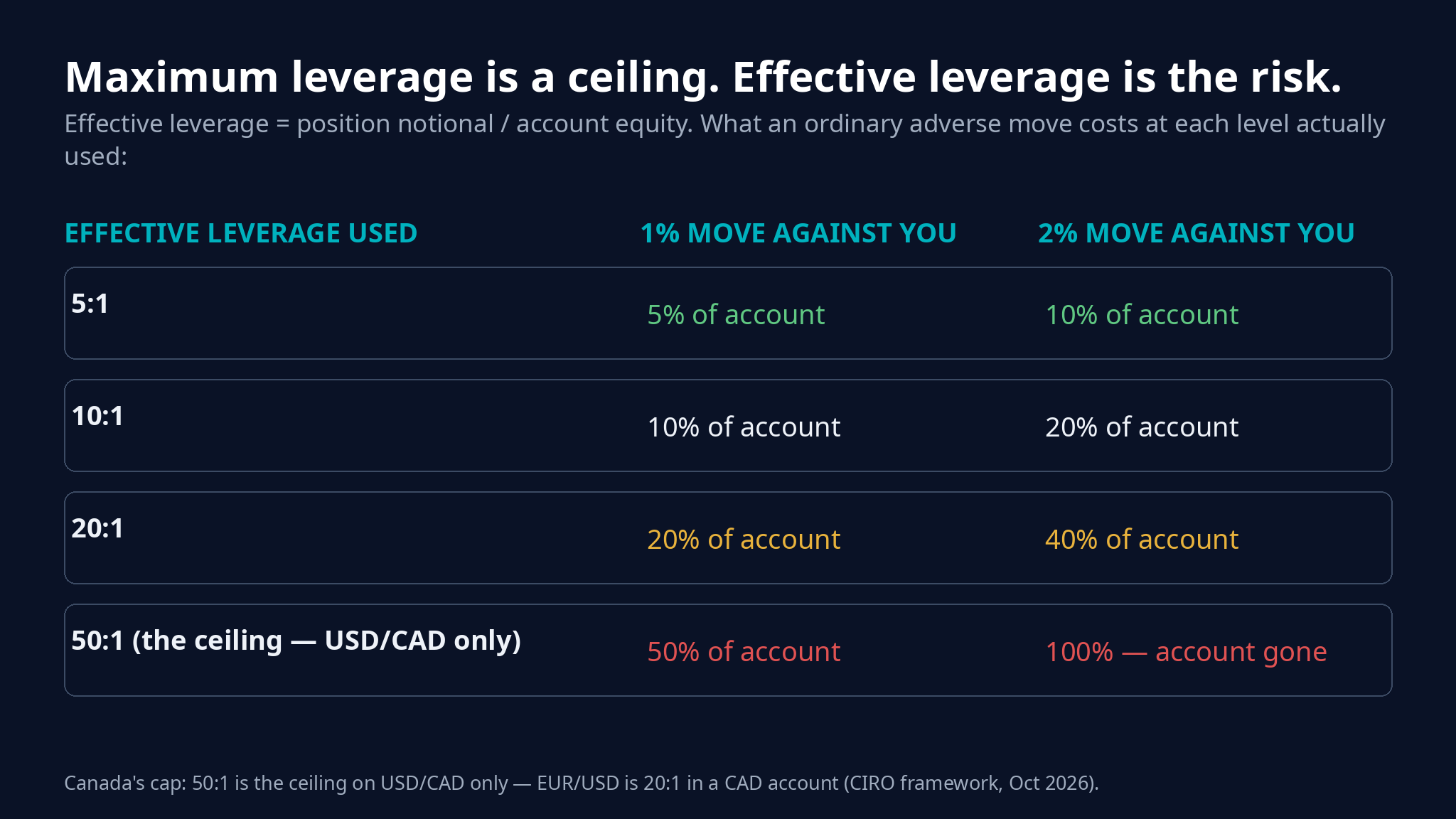
Maximum leverage describes the largest position your margin could open. Effective leverage describes the position you actually hold, divided by your account equity — and it is effective leverage that decides how a normal market move translates into account damage:
| Effective leverage you actually use | A 1% move against you costs | A 2% move against you costs |
|---|---|---|
| 5:1 | 5% of your account | 10% of your account |
| 10:1 | 10% of your account | 20% of your account |
| 20:1 | 20% of your account | 40% of your account |
| 50:1 | 50% of your account | 100% — the account |
Major pairs move 1% in a day without any news at all, and 2% on a central-bank day is unremarkable. So a trader using the full 50:1 available on USD/CAD is not “making the most of their account” — they have arranged for an ordinary bad day to end it. By contrast, look at the calculator examples above: the C$5,000 account trading 0.20 lots is controlling 20,000 units of a currency pair — on the order of C$30,000 of notional value at typical major-pair rates, an effective leverage of roughly 6:1 — while risking exactly 1% to its stop. That gap between the 20:1 or 50:1 on the brochure and the single-digit effective leverage a disciplined trader actually uses is not wasted capacity. It is the entire point. The cap exists to slow down how fast an account can be wiped out; your sizing is what actually prevents it.
A useful self-check before any trade: divide the position’s full notional value by your account balance. If the answer embarrasses you, the position is too big no matter where the stop sits — because stops, as the next section explains, are not guarantees.
Margin is not risk — and a margin closeout is not a safety net
New traders routinely confuse the two numbers on their platform:
- Margin is collateral — the deposit your dealer locks while the position is open. On the C$5,000 example above, 0.20 lots of EUR/USD is 20,000 euros of notional — roughly C$32,000 at an EUR/CAD rate near 1.60 — so at 5% margin the position locks about C$1,600 of collateral.
- Risk is what you lose if the stop is hit: C$50, set by the stop distance and the size, as calculated above.
A small margin figure does not mean a small risk, and tying up most of your account as margin on several positions can leave you unable to withstand a normal fluctuation even if each individual stop looks reasonable. Dealers enforce margin mechanically, and their enforcement is not designed to protect your plan: OANDA Canada states that when an account is under-margined its platform automatically initiates a margin closeout, closing all tradable open positions at current rates; FOREX.com Canada requires positions to be fully margined at all times and liquidates positions — the largest loser first — once the balance falls below 100% of maintenance margin. A closeout crystallises your worst moment at the market’s price, not yours.
And the stop itself has a limit every leveraged trader must internalise: stop-loss orders are not guaranteed. OANDA’s own margin guidance warns that gaps in market pricing can fill a stop at a less advantageous price than intended — over a weekend, a surprise rate decision, or an illiquid hour, the loss can exceed the amount the calculator planned. That is not an argument against stops; it is the argument for sizing so that even a slipped stop is survivable. Some dealers sell certainty separately — Plus500CA, for example, offers guaranteed stops on some instruments for a wider spread — which is a legitimate tool for event risk, priced like the insurance it is. CIPF, for completeness, protects none of this: its C$1 million cover applies if your dealer becomes insolvent, never to trading losses.
The 1% rule and the survival math behind it
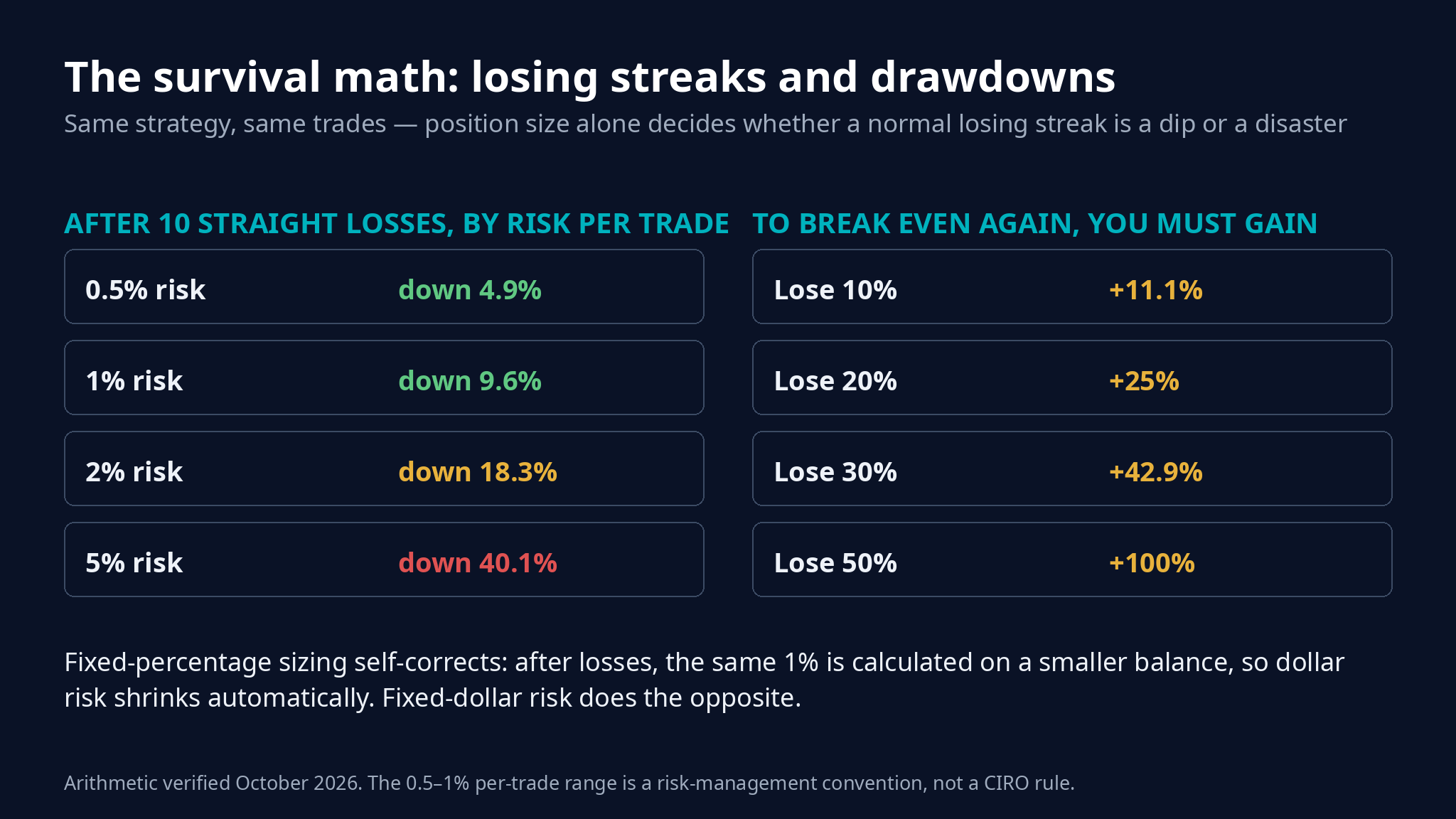
The most durable convention in retail risk management is to risk a small fixed percentage of the account on any single trade — most commonly 0.5% to 1% for learners and active traders alike. It is a convention, not a CIRO rule, and its power is pure arithmetic. Losing streaks are not bad luck; every strategy produces them. What a streak does to you depends entirely on the percentage:
| Risk per trade | After 10 straight losses | After 20 straight losses |
|---|---|---|
| 0.5% | Down 4.9% | Down 9.5% |
| 1% | Down 9.6% | Down 18.2% |
| 2% | Down 18.3% | Down 33.2% |
| 5% | Down 40.1% | Down 64.2% |
At 1% risk, a brutal ten-loss streak costs you less than a tenth of the account and changes nothing about how you trade next. At 5%, the same streak — same strategy, same trades, larger size — takes 40%, and the recovery math turns hostile, because losses and gains are not symmetrical:
| If you lose | You must gain, just to break even |
|---|---|
| 10% | 11.1% |
| 20% | 25% |
| 30% | 42.9% |
| 50% | 100% |
| 75% | 300% |
Fixed-percentage sizing also self-corrects in a way fixed-dollar sizing never does. Risking 1% shrinks your dollar risk automatically as the account falls — after the ten-loss streak above, 1% is calculated on the smaller balance — and grows it only as the account grows. Risking a fixed C$100 a trade does the opposite: after a drawdown, that same C$100 is a growing percentage of what is left, precisely when you can least afford it. Size in percentages, and let the position size calculator turn the percentage into lots on the day, with the day’s balance.
The rest of the risk stack
Per-trade sizing is the foundation, but four positions at 1% each, all betting the same way, is not 1% of risk in any honest sense. Round the method out:
- Cap your total open risk (“portfolio heat”). Add up the loss if every open stop is hit. Many disciplined traders keep that total in the low single digits as a percentage of the account — three trades at 1% with genuinely independent ideas is a very different book from six.
- Treat correlated pairs as one bet. Long EUR/USD and long GBP/USD usually rise and fall together; two 1% risks there behave like one ~2% risk on a single “strong dollar / weak dollar” view. Correlation, not the pair count, is the real exposure.
- Set a daily and weekly walk-away line in advance. A common framework is to stop for the day after losing roughly three trades’ worth of risk, and to cut size after a defined drawdown — for example, halving per-trade risk after a 5–10% peak-to-trough fall, and pausing to audit your journal after 10%. The exact numbers are yours to choose; having them written down before the losses arrive is the non-negotiable part, because no one drafts good rules mid-drawdown.
- Respect event and weekend risk. Spreads widen and prices gap around rate decisions, jobs data and market reopens. If your stop can be jumped, either size for the jump, use a guaranteed stop where your dealer offers one, or be flat. Checking the profit or loss on a planned exit before you enter — our profit and loss calculator does this in CAD — takes ten seconds and regularly kills trades that never made sense at the intended size.
- Keep leveraged forex out of registered accounts — because you must. Leveraged forex and CFDs cannot be held in a TFSA, RRSP or FHSA anywhere in Canada, so this risk is always taken with after-tax dollars in a non-registered account. That is one more reason the sizing stays conservative: there is no tax shelter softening a blow-up, and the dealers ranked in our Best Forex Brokers in Canada guide are the CIRO members whose margin tables and closeout rules this guide is built on.
A pre-trade checklist worth taping to the monitor
- What is my account balance today — not last week?
- What percentage am I risking on this trade, and what is that in dollars?
- Where does the idea become wrong? That price sets the stop distance — not my comfort.
- What lot size does the calculator return for that balance, percentage and stop? Enter that size, not a rounder one.
- What is my total open risk if this trade is added, and is anything already open that is secretly the same bet?
- What is my effective leverage after this trade — notional divided by equity?
- Is there a data release, a rate decision or a weekend inside this trade’s likely holding period? If so, is the size still right?
- If this trade loses, am I still inside my daily and weekly walk-away lines?
If any answer is a shrug, the trade is not ready. Beginners building their first routine can pair this checklist with our step-by-step guide to how to start forex trading in Canada.
Frequently asked questions
What is the maximum forex leverage in Canada?
It depends on the pair and your account’s base currency, under CIRO’s framework. The ceiling is 50:1, reached on USD/CAD (2% margin). EUR/USD — the pair most Canadians actually trade — is 20:1 in a CAD account and about 33:1 in a USD account at a major CIRO dealer (FOREX.com Canada’s table, checked October 2026), and exotics fall to roughly 3.5–4:1. Any offer far above 50:1 is offshore and carries no CIPF protection.
How much should I risk on one forex trade?
The widely used convention is 0.5% to 1% of your account balance per trade. At 1%, ten consecutive losses cost about 9.6% of the account — painful but fully recoverable. At 5% per trade, the same streak costs about 40%, which then requires about a 67% gain on what remains just to break even — the arithmetic in the tables above is why professionals treat size, not entry quality, as the survival variable. This is risk-management convention, not a regulatory requirement.
How do I calculate position size?
Position size in lots = risk amount ÷ (stop distance in pips × pip value per standard lot). The risk amount is your balance multiplied by your chosen risk percentage. Example: C$5,000 × 1% = C$50 risk; with a 25-pip stop and a pip value of C$10 per standard lot, C$50 ÷ (25 × C$10) = 0.20 lots. Our position size calculator performs exactly this calculation.
Does using less leverage than the maximum slow down my profits?
It slows down gains and losses by the same proportion — that symmetry is the product. What it changes is survivability: at ~5:1 effective leverage a 2% adverse move costs about 10% of the account, while at 50:1 it costs everything. A strategy with a genuine edge compounds for years at modest effective leverage; the same edge at maximum leverage usually meets its losing streak first.
Will my stop-loss always protect me at the price I set?
No. Stops execute at the next available price, and gaps — over weekends, data releases or fast markets — can fill you materially worse than your stop level, a risk dealers including OANDA state in their own margin guidance. Size so a slipped stop is survivable, consider guaranteed stops where a dealer offers them (for example Plus500CA on some instruments, for a wider spread), and never treat the calculated risk as a hard guarantee.
What happens if my margin runs out?
Your dealer closes you out, mechanically and without asking. OANDA Canada automatically closes all tradable positions when an account becomes under-margined; FOREX.com Canada liquidates positions, largest loser first, when the balance falls below 100% of maintenance margin. Keeping effective leverage low and total open risk capped is how you stay far away from that machinery.
Bottom line
Canadian rules already cap your leverage — 50:1 at the very top, 20:1 on EUR/USD in a CAD account — but no cap sizes a trade for you. That job belongs to a fixed routine: pick a small percentage of your balance (start at 1% or less), let the chart set the stop distance, and let the position size calculator turn those two decisions into a lot size before you enter. Keep total open risk and correlation in view, know that stops can slip and margin closeouts are automatic, and treat the difference between maximum leverage and the single-digit effective leverage a careful trader actually uses as your margin of survival. Entries decide whether a trade wins. Sizing decides whether you are still trading next year.
Last reviewed: October 30, 2026. Margin figures re-verified against FOREX.com Canada’s published margin requirements and OANDA Canada’s margin guidance at review time; dealers set their own tables within CIRO’s framework and rates change — confirm the current margin for your pair and account currency in your own dealer’s platform before trading.