
CMC Markets vs Interactive Brokers: Which Is Better for Canadian Traders?
Affiliate disclosure: We may earn a commission if you open an account through some links on this page, at no extra cost to you. See our full affiliate disclosure.
Risk warning: Forex and CFD trading is leveraged and carries a high risk of loss. Most retail accounts lose money. Never trade with money you cannot afford to lose.
- The short answer
- Head to head
- The difference most comparisons miss: CFDs vs spot currency
- Regulation and safety: a tie on status, a split on history
- Province rules: Alberta is the fault line
- Pricing: two honest models, closer than the marketing suggests
- Platforms and tools
- What else you can trade — and the registered-account divide
- Who each broker suits
- Frequently asked questions
- The bottom line
The short answer
Both brokers serve Canadians through a direct CIRO dealer member with CIPF protection, so this is not a safety contest. It is a product contest — and the two products are not the same thing:
- CMC Markets sells forex CFDs. You speculate on currency prices with CMC Markets Canada Inc. as your counterparty, inside a purpose-built CFD account with 330+ pairs, spread-only or commission account options, and nothing but derivatives on the menu.
- Interactive Brokers sells spot currency inside a full brokerage. You trade actual currency balances on Interactive Brokers Canada’s multi-asset platform — the same account that holds your stocks, ETFs, options and futures — with interbank-style pricing and a separate transparent commission.
If forex is the main event and you want a platform built only for leveraged trading, CMC is the natural home. If forex is one position among many in a broader portfolio — or you are an Alberta retail trader, where CMC’s door is closed to you — Interactive Brokers wins by default and on merit. The sections below show the working.
Head to head
| CMC Markets | Interactive Brokers | |
|---|---|---|
| Canadian entity | CMC Markets Canada Inc. | Interactive Brokers Canada Inc. |
| CIRO dealer member | Yes | Yes |
| CIPF protection | Yes — up to C$1 million (general accounts combined) | Yes — up to C$1 million (general accounts combined) |
| What you actually trade | Forex CFDs (CMC is your counterparty) | Spot currency (no CFDs in Canada) |
| Currency pairs | 330+ | 100+ |
| Minimum deposit | None | None |
| Pricing model | Standard: spread-only, no FX commission. FX Active: spreads from 0.0 pips on six majors + US$2.50 per US$100,000 per side | No markup on quotes; spreads as narrow as 0.1 pip + commission of 0.20 basis points of trade value (US$2.00 minimum per order) |
| Platforms | CMC web/mobile platform, MT4, MT5, TradingView | Trader Workstation, IBKR Desktop, IBKR Mobile, GlobalTrader, Client Portal, TradingView, API |
| Beyond forex | 11,000+ CFD instruments: indices, shares, commodities, ETFs, bonds — all as CFDs | Real stocks, ETFs, options, futures and bonds on 175 markets, plus registered accounts for securities |
| Guaranteed stops | Available (premium applies; refunded if not triggered) | No |
| Demo account | Yes — $10,000 virtual funds | Yes — paper trading account |
| Alberta | Accredited investors only | No Alberta restriction in its published terms — confirm at application |
| Quebec | Served (Quebec derivatives dealer) | Served (Canadian entity is based in Montreal) |
Pricing figures are each broker’s advertised rates, checked November 2026 — minimums and best cases, not measured averages. Spreads are variable and widen in fast markets.
The difference most comparisons miss: CFDs vs spot currency
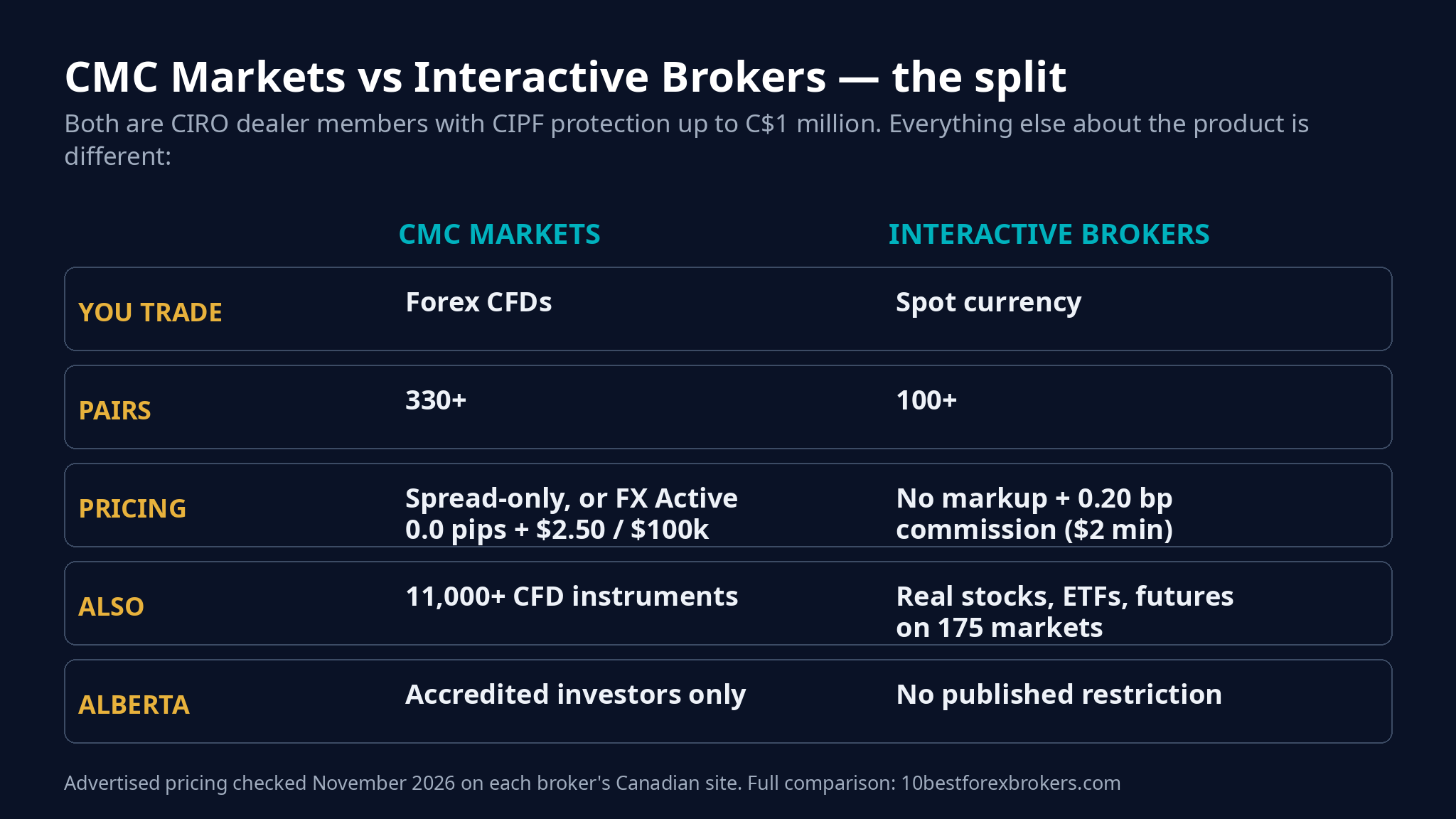
At CMC, a forex trade is a contract for difference. You never own euros or US dollars; you hold a contract with CMC Markets Canada Inc. that tracks the pair, and CMC is the counterparty on the other side of every position. That structure is what makes the rest of CMC’s offer possible: 330+ pairs including exotics, tiny and flexible contract sizes, guaranteed stop-loss orders for a premium, and one account that also trades index, share and commodity CFDs.
At Interactive Brokers Canada, a forex trade is a spot currency transaction. You are buying one currency and selling another, and the position shows up as actual currency balances in your brokerage account — which is why IBKR forex sits naturally next to a US stock portfolio: the same account holds CAD, USD and twenty-some other currencies, and converts between them at near-interbank rates. What IBKR Canada does not offer is forex CFDs — its CFD products are not available to Canadian residents at all.
Neither structure is “safer” in the way that matters most. Both are leveraged, both are margined under the same CIRO framework, and at both firms a fast market can close you out. The practical differences are in the surrounding machinery: CMC’s guaranteed stops and CFD range on one side; IBKR’s real currency balances, multi-currency account and everything-else-a-brokerage-does on the other. If that distinction is new to you, our guide to whether forex trading is legal in Canada covers how both product types sit inside the Canadian rules.
Regulation and safety: a tie on status, a split on history
Each Canadian entity is a CIRO dealer member you can find in CIRO’s public “Dealers We Regulate” directory, and each is a CIPF member, so eligible client property is protected up to C$1 million for all general accounts combined if the firm became insolvent. CMC additionally holds its client money in segregated accounts, and is a registered investment dealer in every province and territory and a derivatives dealer in Quebec. CIPF does not — at either broker — cover trading losses.
The history differs. CMC Markets was founded in 1989, its parent is listed in London, and its Canadian operation is headquartered in Toronto — a long-established CFD specialist. Interactive Brokers is one of the largest brokerages on earth, NASDAQ-listed, with its Canadian entity based in Montreal and a business that spans 175 markets. Both parents publish their financials; neither Canadian entity is a startup. Verify either firm’s current standing yourself before funding — our CIRO broker checker walks through it in under a minute, and the full standings of both firms sit inside our Best Forex Brokers in Canada ranking.
Province rules: Alberta is the fault line
- Alberta: CMC Markets Canada requires Alberta residents to qualify as accredited investors — the warranty is written into clause 7.1.2 of its Canadian Terms of Business. Interactive Brokers Canada publishes no Alberta restriction in its terms. For an ordinary Alberta retail trader, that makes this comparison one-sided before pricing is even discussed: IBKR is the one of the two you can actually open. (Confirm your own eligibility at application — dealers run their own checks.) Our Alberta vs Ontario explainer covers why Alberta works this way.
- Quebec: both serve Quebec — CMC as a registered derivatives dealer in the province, IBKR from its Montreal base.
- Everywhere else: both are generally available on retail terms, subject to each firm’s own application checks. One IBKR-specific check: leveraged spot currency is an approved product on the account, and IBKR’s application asks about your trading experience and product knowledge before enabling it.
Pricing: two honest models, closer than the marketing suggests
Both brokers publish their pricing, and both models are legitimate — they just bill you differently.
CMC Standard is spread-only: no commission on forex, with the cost inside the spread, plus overnight holding costs if you keep positions open. CMC FX Active is built for active forex traders: spreads from 0.0 pips on six major pairs and a 25% spread discount on 300+ other pairs, in exchange for a fixed commission of US$2.50 per US$100,000 traded, per side.
Interactive Brokers passes through quotes combined from 17 of the world’s largest FX dealers with no markup — displayed spreads as narrow as 0.1 pip — and charges a separate commission of 0.20 basis points of trade value, with a minimum of US$2.00 per order. The percentage falls at very high monthly volumes (to 0.08 basis points above US$5 billion a month), which tells you who that schedule is designed for.
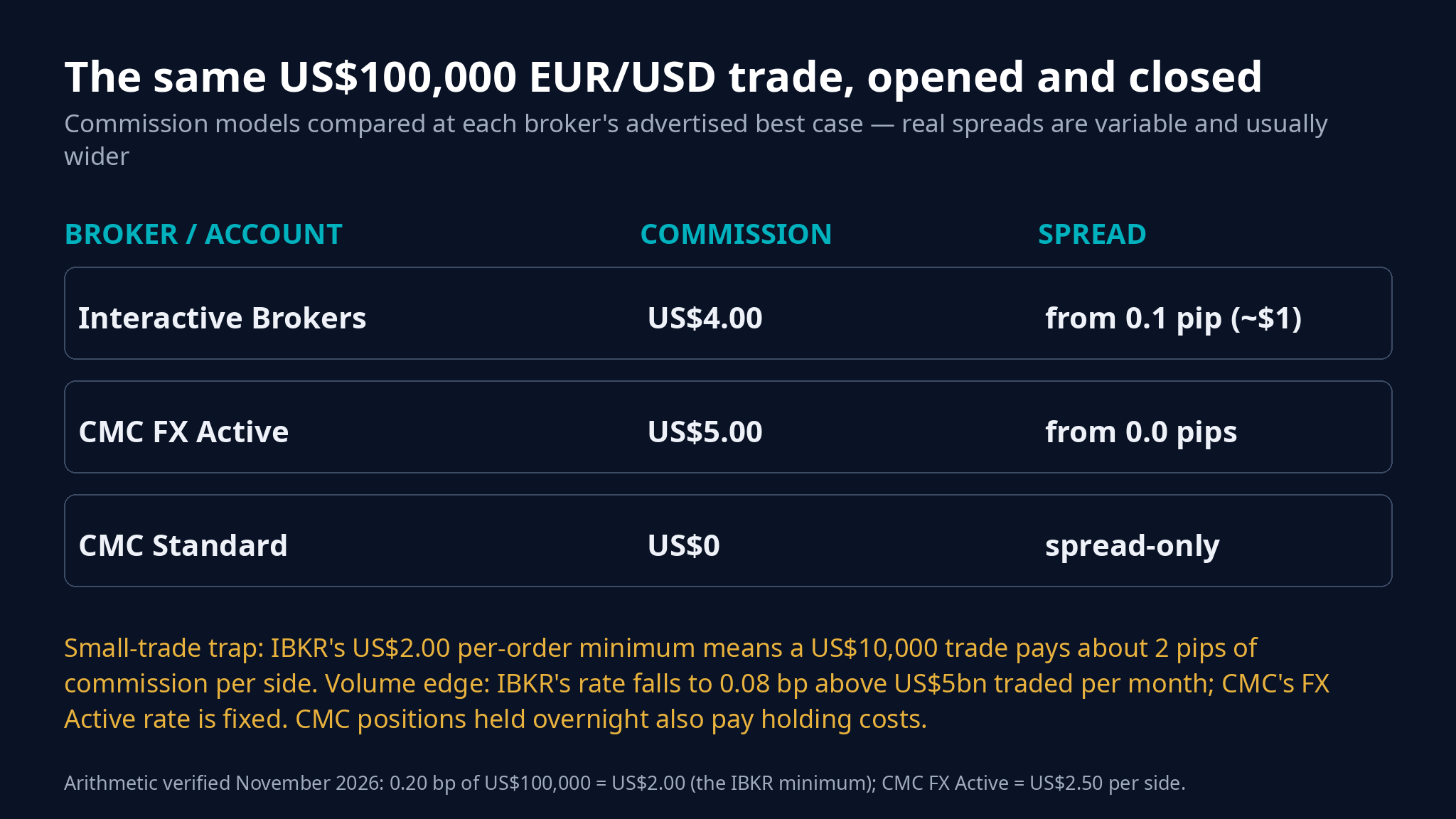
Run the two commission models over the same trade — US$100,000 of EUR/USD, opened and closed:
- IBKR: 0.20 basis points of US$100,000 is exactly US$2.00, so you pay the US$2.00 minimum per side — US$4.00 round trip — plus a spread that can be as tight as about US$1 at the advertised 0.1-pip minimum.
- CMC FX Active: US$2.50 per side — US$5.00 round trip — plus a spread that starts from 0.0 pips on EUR/USD.
At that size, at advertised best-case spreads, the two are within a dollar or two of each other. The models diverge at the edges: IBKR’s per-order minimum punishes small trades (on a US$10,000 position the US$2.00 minimum is roughly 2 pips of commission per side, where CMC Standard charges no commission at all), while IBKR’s percentage pricing keeps scaling down for genuinely high-volume traders in a way CMC’s fixed FX Active rate does not. Two traps to avoid at IBKR: the cheap headline rate applies to trades — converting currency with its auto-conversion service adjusts the rate by about 0.03% instead — and small, frequent trades are exactly where the minimum bites. At CMC, the equivalent trap is holding costs on positions kept overnight, which FX Active’s tight spreads do not protect you from. Whichever you choose, size positions so a normal losing streak cannot end the account — our leverage and risk management guide shows the arithmetic.
Platforms and tools
CMC gives you its own web and mobile platform — the strongest part of its offer, with deep charting and pattern tools — plus MetaTrader 4 and MetaTrader 5 for traders who live in that ecosystem, and a TradingView connection on platform accounts. The MT4/5 accounts access a narrower slice of the range (175+ forex pairs against 340+ on CMC’s own platform). The demo account comes with $10,000 in virtual funds and no time pressure.
Interactive Brokers gives you Trader Workstation, a genuinely professional desktop platform with 100+ order types, algorithmic orders and an API — and a learning curve to match. IBKR Desktop, the mobile apps, GlobalTrader and the web Client Portal soften that curve, and there is a TradingView connection and a paper-trading account. The honest summary: CMC’s platform is the easier one to be competent on within a week; IBKR’s is the more powerful one once you are. If you already trade MT4 or MT5 strategies, only one of these two brokers is even an option — CMC. Our individual reviews go deeper: the CMC Markets review and the Interactive Brokers review.
What else you can trade — and the registered-account divide
This is where the comparison stops being close. CMC’s 11,000+ instruments — indices, shares, commodities, ETFs, bonds — are all CFDs: leveraged, non-registered, and never yours. It is a superb range for a trading account, and it is the only kind of account CMC offers.
Interactive Brokers is a brokerage. The forex sits in the same account as real shares and ETFs on 175 markets, options, futures and bonds — and alongside RRSP, TFSA and FHSA accounts for your securities. Two limits matter for forex traders: currencies themselves cannot be traded inside IBKR’s registered accounts — spot FX lives in the non-registered account — and, as noted above, there are no CFDs of any kind for Canadian residents at IBKR, so the index and share CFD exposure CMC offers simply does not exist there. If your plan is “trade EUR/USD in the morning and hold a US equity portfolio in the same login,” that is an IBKR-shaped plan. If your plan is “trade the NAS100, gold and EUR/USD from one leveraged account,” that is a CMC-shaped plan. For a different pairing on the brokerage side, see our Questrade vs Interactive Brokers comparison; for CMC against a forex-only rival, see CMC Markets vs OANDA.
Who each broker suits
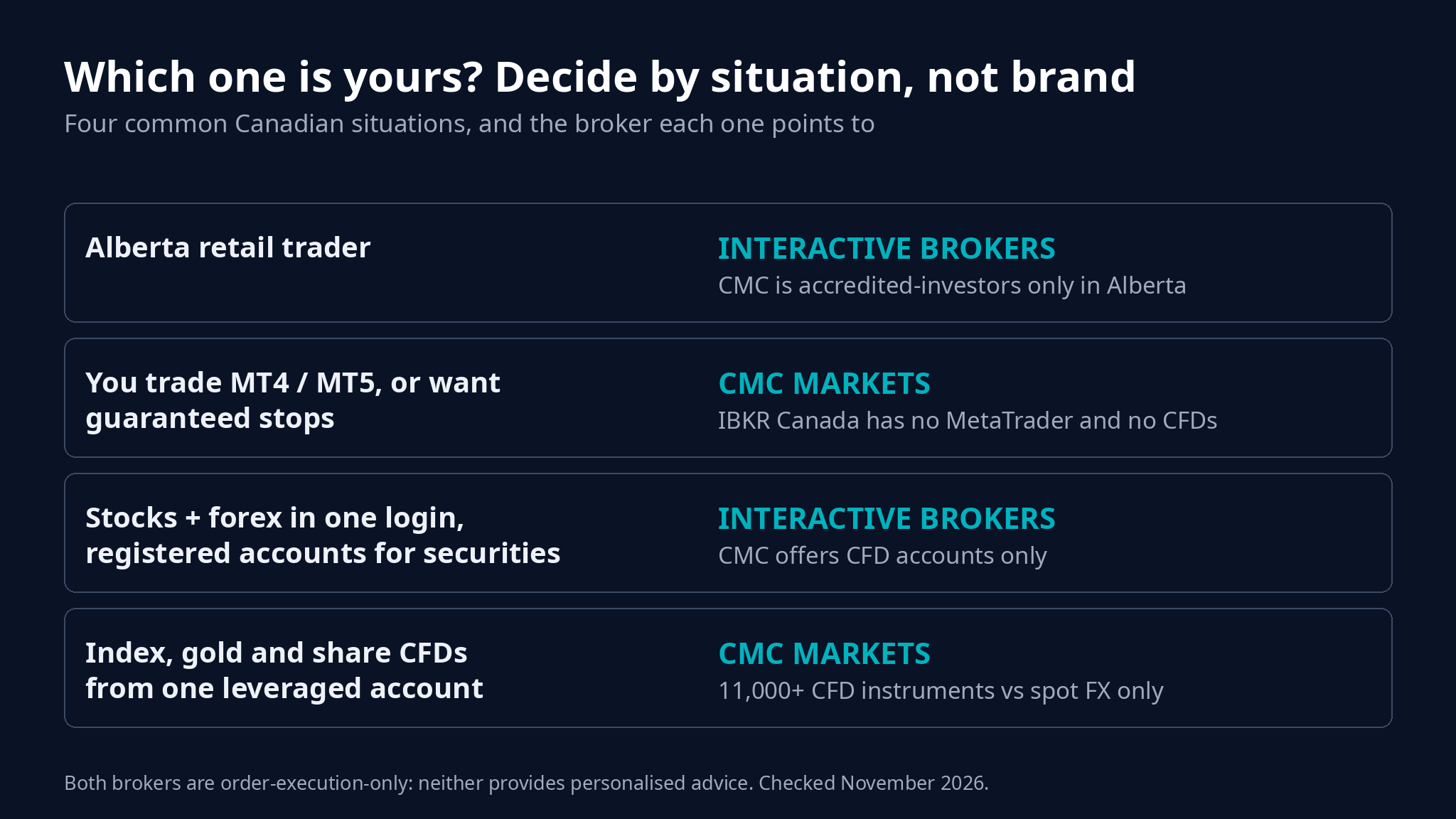
Choose CMC Markets if forex and CFD trading is the whole point of the account; you want MetaTrader or a polished proprietary platform; guaranteed stops matter to your risk plan; you trade a wide range of markets as CFDs; or you are a smaller, active trader who benefits from spread-only pricing with no per-order minimums. You must not be a non-accredited Alberta resident.
Choose Interactive Brokers if forex is one part of a wider portfolio; you want interbank-style pricing with a transparent commission and no markup; you hold or convert multiple currencies; you use (or want) API/algo access and professional order types; you want registered accounts for your securities under the same roof; or you are an Alberta retail trader, for whom CMC is not available.
Choose neither if you are a complete beginner who has never placed a leveraged trade. Both firms are order-execution-only — neither will advise you — and both products can lose money quickly. Start with a demo at either, and with position sizes that keep a bad week boring.
Frequently asked questions
Are both CMC Markets and Interactive Brokers regulated in Canada?
Yes. CMC Markets Canada Inc. and Interactive Brokers Canada Inc. are both CIRO dealer members and CIPF members. CIPF protection runs to C$1 million for all general accounts combined and covers missing property if the firm fails — never trading losses.
Can Alberta residents use both brokers?
Not on equal terms. CMC Markets Canada accepts Alberta residents only as accredited investors (its Terms of Business require that warranty). Interactive Brokers Canada publishes no Alberta restriction in its terms — confirm your eligibility when you apply.
Does Interactive Brokers offer CFDs in Canada?
No. IBKR’s Canadian forex is leveraged spot currency, and its CFD products are not available to Canadian residents. CMC Markets is the CFD provider in this comparison — every product on its platform is a CFD.
Can I trade forex in a TFSA or RRSP at either broker?
No. CMC’s accounts are non-registered CFD accounts. Interactive Brokers offers RRSP, TFSA and FHSA accounts for securities, but currencies cannot be traded inside its registered accounts — spot FX sits in the non-registered account.
Which broker is cheaper for forex?
At US$100,000 per trade, the advertised best cases are within a dollar or two: about US$4.00 round-trip commission at IBKR (plus a spread as narrow as 0.1 pip) against US$5.00 at CMC FX Active (plus spreads from 0.0 pips on six majors). For small trades, CMC Standard’s spread-only model avoids IBKR’s US$2.00 per-order minimum. For very high monthly volumes, IBKR’s tiered percentage commission falls further. Your real cost depends on your size, pairs and how long you hold — holding costs apply at CMC, and spreads at both brokers widen outside the advertised minimums.
What is the minimum deposit at each broker?
Neither broker requires a minimum deposit to open an account. You still need enough margin to open and hold any position — “no minimum deposit” is not an invitation to trade undercapitalised.
The bottom line
Pick by product, not by brand. CMC Markets is the better forex trading account: purpose-built, CFD-based, platform-strong, and fairly priced for active traders outside Alberta’s accredited gate. Interactive Brokers is the better financial account that also does forex properly: spot currency at interbank-style pricing inside a brokerage that can hold the rest of your financial life. Canadian traders are choosing between two properly regulated firms here — the rare comparison where the wrong answer is only wrong for your situation, not for your safety.
Last reviewed: November 2, 2026. Pricing and product details checked against each broker’s Canadian site and terms on that date; both change over time, so confirm on the broker’s own pages before opening an account.
Both brokers are ranked in context in our guide to the best forex brokers in Canada.