BlackBull Markets Review: Spreads, Fees, Regulation and Canada Availability
Affiliate disclosure: We may earn a commission if you open an account through some links on this page, at no extra cost to you. That never changes a broker’s ranking here. See our full affiliate disclosure.
Risk warning: Forex and CFD trading is leveraged and carries a high risk of loss. Most retail accounts lose money. Nothing on this page is investment, legal or tax advice.
Offshore — not CIRO-regulated, no CIPF protection: BlackBull Markets is not regulated in Canada and states it does not accept Canadian residents. Read the regulation and Canada sections below before you consider any account.
Written & researched by Mark Prosz — trading since 2015 · Licensed Alberta Realtor · Financial content creator & broker reviewer
Last reviewed: November 2026
- Quick verdict
- BlackBull Markets at a glance — key facts
- BlackBull Markets overview
- Is BlackBull Markets legit and safe? Regulation explained
- BlackBull Markets in Canada — availability for Canadians
- Account types
- BlackBull Markets spreads and fees
- Platforms
- Deposits and withdrawals
- Pros and cons
- Who BlackBull Markets is best for
- BlackBull Markets vs IC Markets
- Frequently asked questions
- Verdict
Quick verdict
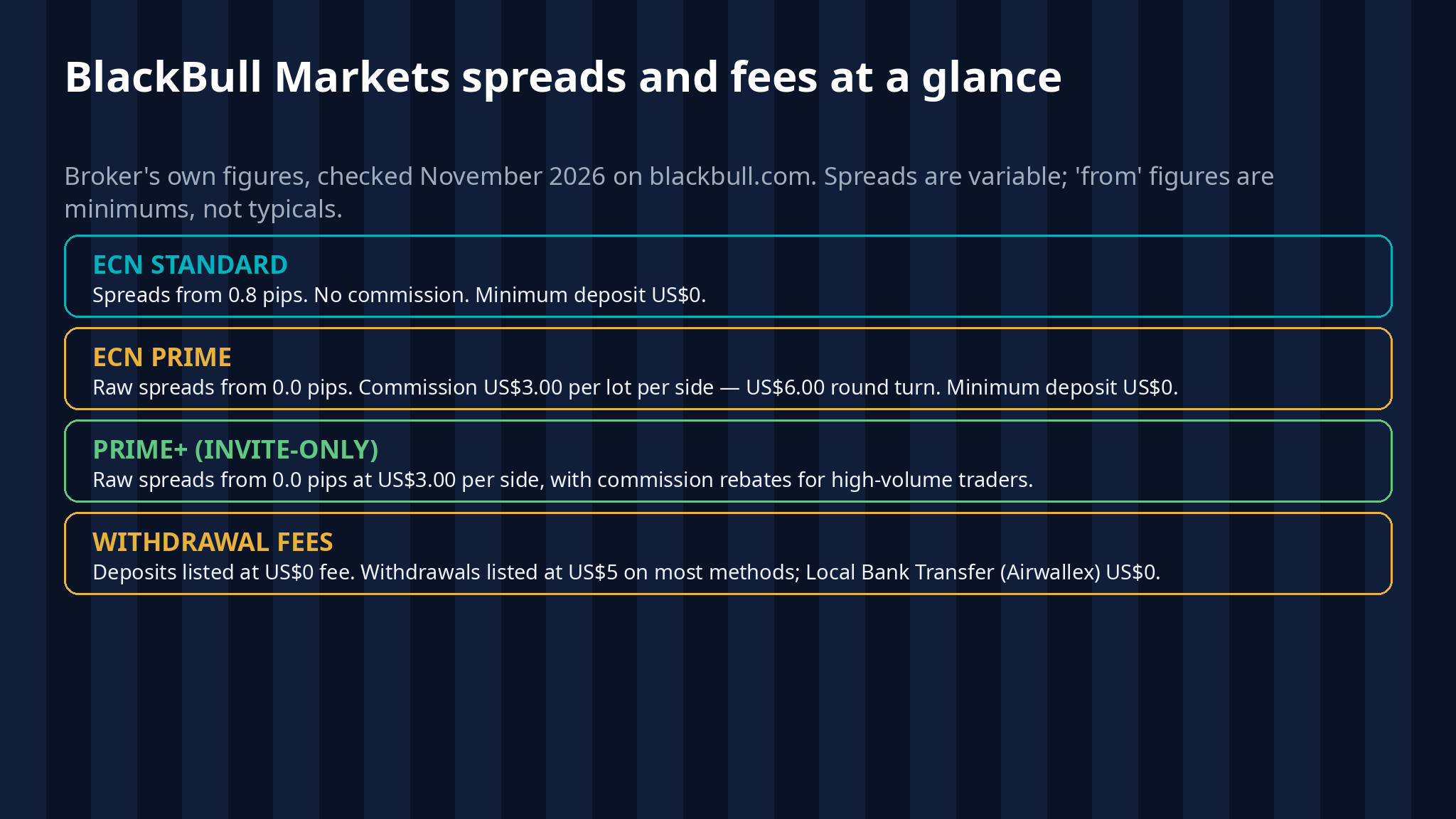
Our score: 3.4/5 (Canada-weighted). BlackBull Markets is an Auckland-headquartered ECN broker with a clean pricing offer: an ECN Standard account with spreads from 0.8 pips and no commission, and an ECN Prime account with raw spreads from 0.0 pips plus US$3.00 per lot per side — US$6.00 round turn. There is no minimum deposit, leverage runs up to 1:500, and the platform list (MetaTrader 4, MetaTrader 5, cTrader, TradingView, plus its own CopyTrader and Invest apps) is wider than most offshore rivals.
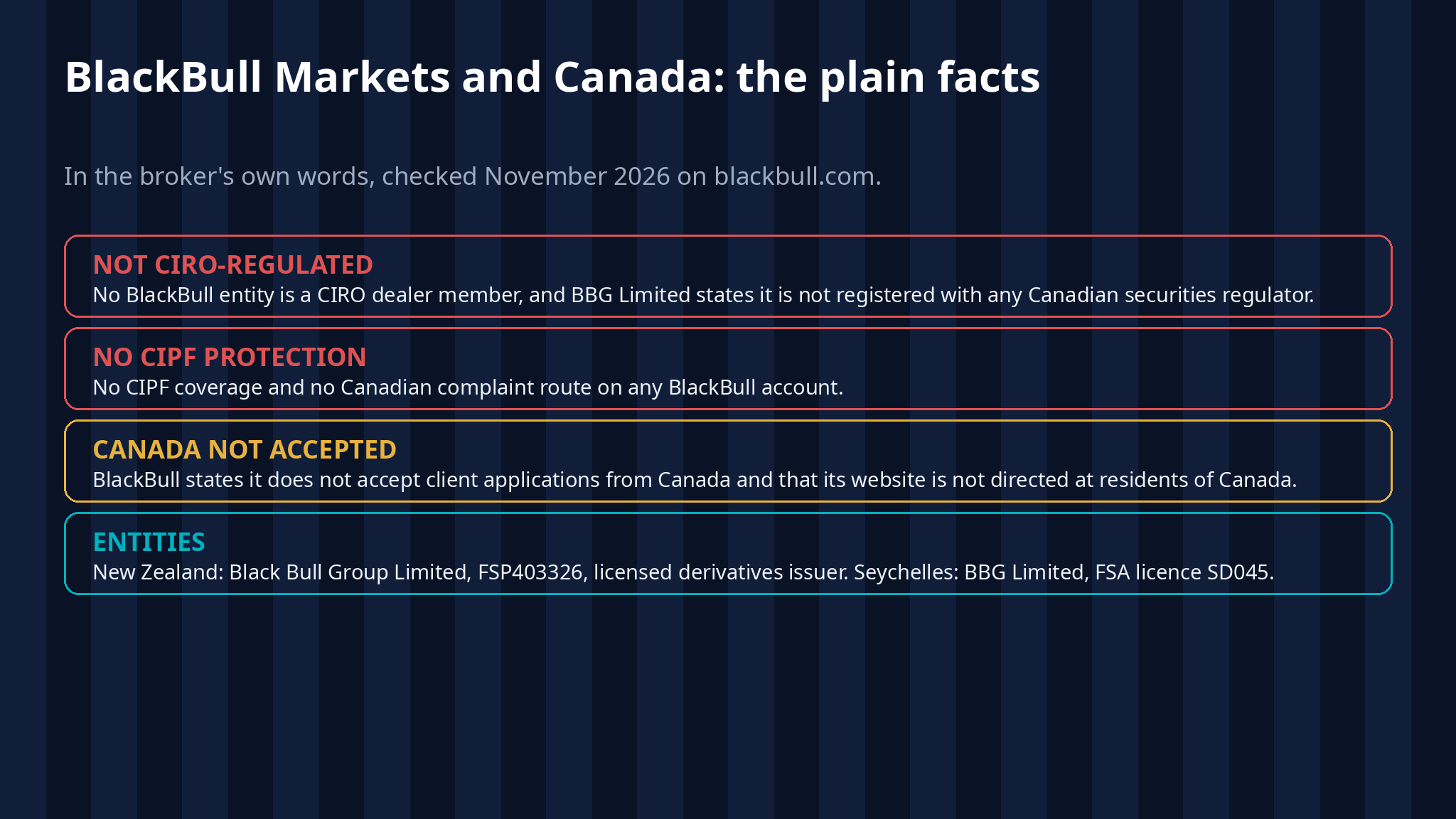
For Canadians, the same hard facts apply as with every offshore broker on this site — only more explicitly. BlackBull is not CIRO-regulated and offers no CIPF protection, and unlike some offshore brands it states the Canada position in plain language on its own site: it does not accept client applications from Canada, its website is not directed at residents of Canada, and its Seychelles entity is not registered with or regulated by any Canadian securities regulator. That clarity is welcome; it does not change the score a Canada-weighted review can give. 3.4/5 reflects strong global pricing under offshore regulation that Canadians cannot legally use.
Visit BlackBull Markets — offshore broker · not CIRO-regulated · no CIPF protection for Canadians.
BlackBull Markets at a glance — key facts
Checked November 2026 against blackbull.com, the broker’s own site.
| Item | BlackBull Markets (blackbull.com) |
|---|---|
| Head office | Level 20, HSBC Tower, 188 Quay Street, Auckland 1010, New Zealand |
| Entities | Black Bull Group Limited (New Zealand); BBG Limited (Seychelles); Black Bull Trade Limited (New Zealand) |
| Regulation | New Zealand: registered Financial Service Provider FSP403326 and licensed derivatives issuer (FMA framework); Seychelles: BBG Limited authorised by the FSA under licence SD045 |
| CIRO-regulated in Canada? | No |
| CIPF protection? | No |
| Canada availability | Does not accept client applications from Canada (broker’s own statement) |
| Account types | ECN Standard, ECN Prime, Prime+ (invite-only) |
| Minimum deposit | US$0 — no minimum deposit requirement; the broker states you can start with as little as US$1 |
| Spreads | From 0.8 pips on ECN Standard; from 0.0 pips on ECN Prime and Prime+ |
| Commission | ECN Standard: none; ECN Prime and Prime+: US$3.00 per lot per side (US$6.00 round turn) |
| Platforms | MetaTrader 4, MetaTrader 5, cTrader, TradingView, MetaTrader WebTrader, BlackBull CopyTrader, BlackBull Invest |
| Maximum leverage | Up to 1:500 |
| Deposit fees | US$0 on the methods listed on the broker’s deposit page |
| Withdrawal fees | US$5 on most methods listed; US$0 on Local Bank Transfer (Airwallex) |
| Interac | Not listed among the deposit or withdrawal methods |
BlackBull Markets overview
BlackBull Markets is a New Zealand company, incorporated as Black Bull Group Limited (company number 5463921) with its head office in Auckland. It presents itself as an ECN, non-dealing-desk broker: orders are executed at market, pricing comes from its liquidity, and the trader chooses between spread-only pricing (ECN Standard) and raw spreads plus commission (ECN Prime, and the invite-only Prime+ tier for higher-volume traders).
The range around that core is broad — the broker advertises more than 26,000 tradable instruments across forex, indices, commodities, shares and other CFDs, alongside a separate share-investing service, BlackBull Invest. This review concentrates on the forex and CFD accounts Canadians search for, priced and regulated as set out below. As with every offshore review on this site, we keep two questions separate: is it legal and protected for a Canadian, and how good is the offer on its own global terms?
Is BlackBull Markets legit and safe? Regulation explained
BlackBull is a real, regulated broker — in New Zealand and Seychelles, not in Canada. Its compliance page and site footer state the structure:
- Black Bull Group Limited is registered and incorporated in New Zealand, is a registered Financial Service Provider (FSP403326), and is described by the broker as a licensed derivatives issuer in New Zealand under the Financial Markets Authority framework. It is also a member of the Financial Services Complaints Limited (FSCL) dispute resolution scheme.
- BBG Limited, incorporated in Seychelles (company number 857010-1), is authorised and regulated by the Seychelles Financial Services Authority under licence SD045 for the provision of investment services.
- Black Bull Trade Limited, a further New Zealand company, is a registered Financial Service Provider (FSP1002113).
Which entity holds your account decides which regulator, which dispute scheme and which fund-handling rules apply — and for clients outside New Zealand, the Seychelles entity is commonly the contracting party in the broker’s own documents. Read the entity name in the account agreement, not the brand name on the homepage.
What “not CIRO-regulated, no CIPF” actually means
- No CIPF coverage. CIPF covers eligible property up to C$1 million for all general accounts combined if a Canadian member firm fails. No BlackBull entity is a CIPF member, so a BlackBull account has no CIPF coverage.
- No Canadian complaint route. FSCL membership covers the New Zealand company’s clients under its scheme; it is not OBSI or CIRO, and it does not give a Canadian a Canadian remedy.
- Different leverage and conduct rules. Leverage up to 1:500 is advertised. CIRO caps retail leverage far lower — roughly 1:50 on major forex pairs. The gap is itself the tell that the account sits outside the Canadian system.
- Your contract is offshore or in New Zealand. The governing entity is the one named in your agreement — Black Bull Group Limited or BBG Limited — under that jurisdiction’s law.
Our forex regulation in Canada guide explains the Canadian licence test in full, and the CIRO Broker Checker verifies any broker’s Canadian status in minutes.
BlackBull Markets in Canada — availability for Canadians
BlackBull’s own site answers this question directly, in three places checked for this review. Its compliance page states it will not accept clients from Canada and the United States. Its site footer states BlackBull Markets does not accept client applications from Canada and the United States. And its disclaimer states the website is not directed at residents of Canada, that it does not accept applications from Canadian residents, and that BBG Limited is not registered with, authorised by, or regulated by any Canadian securities regulator.
The Canadian position matches: no BlackBull entity is a CIRO dealer member, so there is no legal Canadian onboarding route for leveraged forex with this brand and no CIPF protection on an offshore account. Canadians searching “BlackBull Markets Canada” are usually asking whether they can open an account and whether their money is protected. On the broker’s own words, the answer to the first is no, and Canadian protection does not apply.
If you are in Canada, compare the CIRO-regulated brokers in our best forex brokers in Canada ranking. Our companion page, Is BlackBull Markets Safe and Legal in Canada?, covers the legality question on its own, and why offshore 500:1 leverage still targets Canadians explains the leverage trade-off in full.
Account types
All figures below are from the account comparison on blackbull.com, checked November 2026.
| Account | Spreads from | Commission | Minimum deposit | Leverage |
|---|---|---|---|---|
| ECN Standard | 0.8 pips | None | US$0 | Up to 1:500 |
| ECN Prime | 0.0 pips | US$3.00 per lot per side | US$0 | Up to 1:500 |
| Prime+ | 0.0 pips | US$3.00 per lot per side, with commission rebates available | US$0 | Up to 1:500 |
All three accounts share the same stated execution and account mechanics in the broker’s comparison: market execution, a 0.01-lot minimum trade size, margin call at 100% and stop out at 50%, and swap-free (Islamic) availability. Prime+ is the outlier by design: it is invite-only, aimed at professional and high-volume clients, and adds commission rebates, a dedicated account manager, VPS and no-swap-fee features per the comparison page. There is no separate “Institutional” account in the comparison — the broker’s own FAQ describes Prime+ as its institutional offering.
BlackBull Markets spreads and fees
Checked November 2026 on the broker’s account comparison and support pages. Spreads are variable and widen outside liquid hours; “from” figures are minimums, not typicals, and this review does not present an average EUR/USD spread for BlackBull because the pages checked did not publish one we could verify.
| Cost | ECN Standard | ECN Prime |
|---|---|---|
| EUR/USD pricing basis | Spread-only, from 0.8 pips | Raw spread, from 0.0 pips |
| Commission | US$0 | US$3.00 per lot per side (US$6.00 round turn) |
| Worked example — 1 standard lot at the “from” spread | About US$8.00 in spread at 0.8 pips, no commission | US$6.00 commission plus the live spread (US$0 at the 0.0-pip minimum; about US$2.00 at a 0.2-pip live spread) |
How to read that. Standard is the simple model: one number, no commission line, and a higher floor under your cost. Prime is cheaper whenever the live raw spread stays below roughly 0.2 pips on EUR/USD, because US$6.00 of commission plus 0.2 pips (about US$2.00) matches Standard’s 0.8-pip floor — and more expensive on the spread leg whenever markets widen. Active traders who trade liquid hours usually benefit from Prime; occasional traders often prefer knowing the floor in advance.
Other fees. The deposit page lists a US$0 fee for every method it shows. Withdrawals are the exception to the “no fees” offshore pattern: the withdrawal page lists a US$5 fee on most methods, with Local Bank Transfer (Airwallex) the one US$0 exception we found. We make no claim about inactivity or account-maintenance charges here, because the pages checked for this rebuild did not state a figure we could verify — confirm the current fee schedule in the live client agreement before funding, with any broker. Convert any spread into dollars at your size with our pip value calculator before comparing headline pips.
Platforms
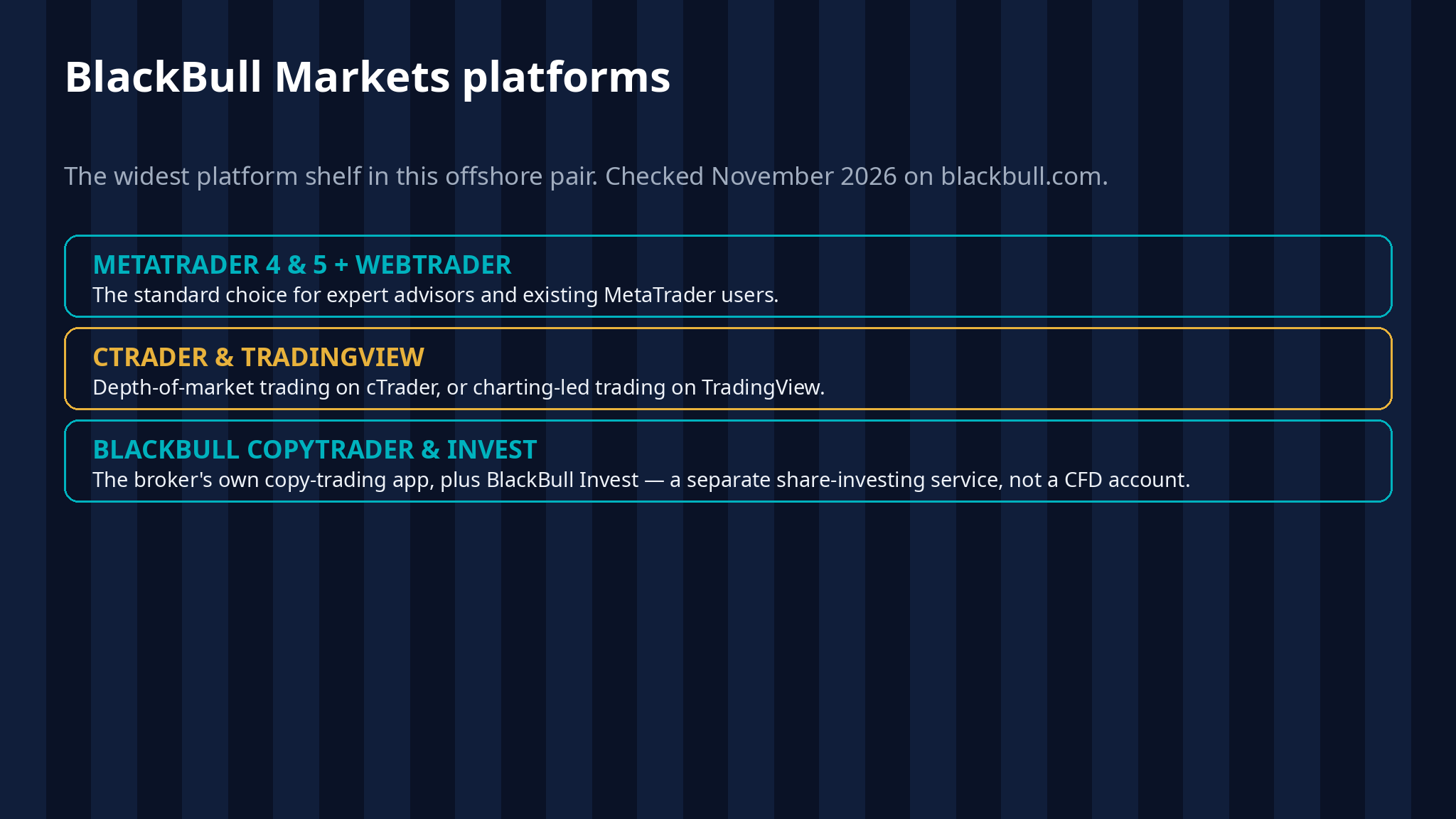
BlackBull’s platform list is one of its genuine strengths:
- MetaTrader 4 and MetaTrader 5, plus MetaTrader WebTrader — the standard choice for expert advisors and existing MT users.
- cTrader — for traders who prefer its depth-of-market interface.
- TradingView — charting-led trading connected to a BlackBull account.
- BlackBull CopyTrader — the broker’s own copy-trading app.
- BlackBull Invest — the separate share-investing service, distinct from the leveraged CFD accounts reviewed here.
Few offshore brokers offer MT4, MT5, cTrader and TradingView together. If platform choice is your deciding factor outside Canada, BlackBull earns its place on the shortlist on this section alone.
Deposits and withdrawals
The deposit page lists 15+ payment options, every one shown with a US$0 fee. Methods include Visa, Mastercard, Apple Pay and Google Pay (minimum US$50, instant on approval), cryptocurrency (minimum US$25, instant on approval), Skrill and Neteller (minimum US$50), bank transfer (minimum US$1, 1–3 business days), SEPA, POLi, UnionPay and several regional methods. One regional method, HexoPay, lists CAD among its supported currencies.
Interac is not listed on either the deposit or the withdrawal page. There is no Interac e-Transfer funding rail — the method most Canadians use with a CIRO broker is simply absent.
Withdrawals carry the US$5 fee described above on most methods. Stated minimum withdrawals are US$10 for most methods, US$50 for Skrill and Neteller, and US$25 for crypto. Stated processing times are same-day for Skrill, Neteller and crypto; 1–3 business days for bank transfer and SEPA; and 3–5 business days for cards. All of this is stated for the clients the broker serves — none of it creates a Canadian service, and the Canada restriction above stands regardless of the payment method.
Pros and cons
Pros
- Raw spreads from 0.0 pips on ECN Prime with a published US$3.00 per side commission.
- No minimum deposit on any account in the comparison.
- MT4, MT5, cTrader and TradingView, plus CopyTrader and Invest.
- A real home regulator: a New Zealand derivatives issuer licence (FSP403326) alongside the Seychelles entity.
- No deposit fees on the methods listed.
- Unusually plain Canada language on its own site — no ambiguity about who it accepts.
Cons
- Not CIRO-regulated; no CIPF protection; no Canadian complaint route.
- States directly that it does not accept Canadian residents — no legal route for Canadians.
- Many clients contract with the Seychelles entity (FSA SD045), a lighter regime than CIRO or the FMA.
- US$5 withdrawal fee on most methods, where several rivals charge none.
- Leverage up to 1:500 magnifies losses as fast as gains.
- No Interac funding.
Who BlackBull Markets is best for
On its global terms, BlackBull suits active traders outside its restricted countries who want raw pricing on a choice of serious platforms, trade 0.01-lot minimum sizes, and value a broker with a genuine home-market regulator in New Zealand. It is not suited to beginners who need Canadian guardrails, and it is not available to residents of Canada on the broker’s own terms. Canadians should start with our best forex brokers in Canada ranking and run any broker through our broker safety analyzer before funding an account.
BlackBull Markets vs IC Markets
These are the two offshore brokers at the top of our overall ranking, and they are close. BlackBull’s ECN Prime charges US$3.00 per lot per side with spreads from 0.0 pips; IC’s Raw Spread charges US$3.50 per lot per side on MetaTrader with spreads from 0.0 pips and a published 0.1-pip average EUR/USD figure. Both have a US$0 minimum deposit on their main accounts. BlackBull adds a US$5 withdrawal fee on most methods where IC states it charges none. BlackBull’s structure pairs a New Zealand derivatives issuer (FSP403326) with a Seychelles entity (FSA SD045) and caps leverage at 1:500; IC’s global entity is Seychelles-regulated (FSA SD018) with advertised leverage up to 1:5000. Both state they do not accept Canadian residents, neither is CIRO-regulated, and neither offers CIPF protection. Read the other side in our IC Markets review.
Frequently asked questions
Is BlackBull Markets legit?
Yes, as an offshore and New Zealand broker: Black Bull Group Limited is a New Zealand company, a registered Financial Service Provider (FSP403326) and a licensed derivatives issuer, and BBG Limited is authorised by the Seychelles FSA under licence SD045. Neither licence is a Canadian licence — there is no CIRO regulation and no CIPF protection.
Is BlackBull Markets safe for Canadians?
It does not offer Canadian safety protections, and it does not accept Canadians. An account would have no CIPF coverage and no Canadian complaint route — and on the broker’s own statements, a Canadian resident cannot open one in the first place.
Can I open a BlackBull Markets account in Canada?
No. The broker states on its compliance page, in its site footer and in its disclaimer that it does not accept client applications from Canada, that the website is not directed at residents of Canada, and that its Seychelles entity is not registered with any Canadian securities regulator.
What are BlackBull Markets’ spreads and fees?
ECN Standard prices from 0.8 pips with no commission. ECN Prime and Prime+ price from 0.0 pips plus US$3.00 per lot per side (US$6.00 round turn). Deposits are listed at US$0 fee; withdrawals are listed at US$5 on most methods, with Local Bank Transfer (Airwallex) at US$0.
What is the minimum deposit at BlackBull Markets?
There is no minimum deposit requirement. The account comparison lists US$0 for ECN Standard, ECN Prime and Prime+, and the broker states you can start trading with as little as US$1 — individual payment methods have their own funding minimums, such as US$50 for cards.
Does BlackBull Markets offer Interac?
No Interac option is listed on the broker’s deposit or withdrawal pages. Listed methods include cards, Apple Pay and Google Pay, Skrill, Neteller, bank transfer, SEPA, POLi, UnionPay and cryptocurrency.
What platforms does BlackBull Markets offer?
MetaTrader 4, MetaTrader 5, MetaTrader WebTrader, cTrader, TradingView, BlackBull CopyTrader and BlackBull Invest (its separate share-investing service).
Verdict
BlackBull’s global offer is coherent and competitive: raw pricing at US$3.00 per side, no minimum deposit, and the widest platform shelf in this offshore pair. Its regulation is a step above a purely offshore structure thanks to the New Zealand derivatives issuer licence. None of that reaches Canada: the broker is not CIRO-regulated, offers no CIPF protection, and says in plain language that it does not accept Canadian residents. Score: 3.4/5, Canada-weighted, unchanged. If you are in a country BlackBull serves, ECN Prime is a credible active-trader account. If you are in Canada, choose a CIRO-regulated broker instead.
Visit BlackBull Markets — offshore broker · not CIRO-regulated · no CIPF protection for Canadians.
Last reviewed: November 2026