

Currency Pairs Explained for Canadian Traders: Majors, Minors, Exotics and CAD Pairs
Affiliate disclosure: We may earn a commission if you open an account through some links on this page, at no extra cost to you. That never changes what we teach or recommend here. See our full affiliate disclosure.
Risk warning: Forex and CFD trading is leveraged and carries a high risk of loss. Most retail accounts lose money. Nothing on this page is investment, legal or tax advice. Knowing how a pair is built does not make trading it profitable — it only removes one layer of avoidable confusion.
Written & researched by Mark Prosz — trading since 2015 · Licensed Alberta Realtor · Financial content creator & broker reviewer
Last reviewed: November 20, 2026
- The short answer
- How to read a currency pair: base, quote, bid and ask
- The seven major pairs — and why USD/CAD is one of them
- Minor pairs (crosses): two majors, no US dollar
- Exotic pairs: one major, one emerging-market currency
- CAD pairs: the Canadian dollar beyond USD/CAD
- What the category changes: spreads, movement and margin
- Pip values in a Canadian-dollar account: the quote-currency rule
- A complete example: one USD/CAD trade in exact Canadian dollars
- Which pairs should a Canadian beginner start with?
- Common pair-selection mistakes
- Frequently asked questions
The short answer
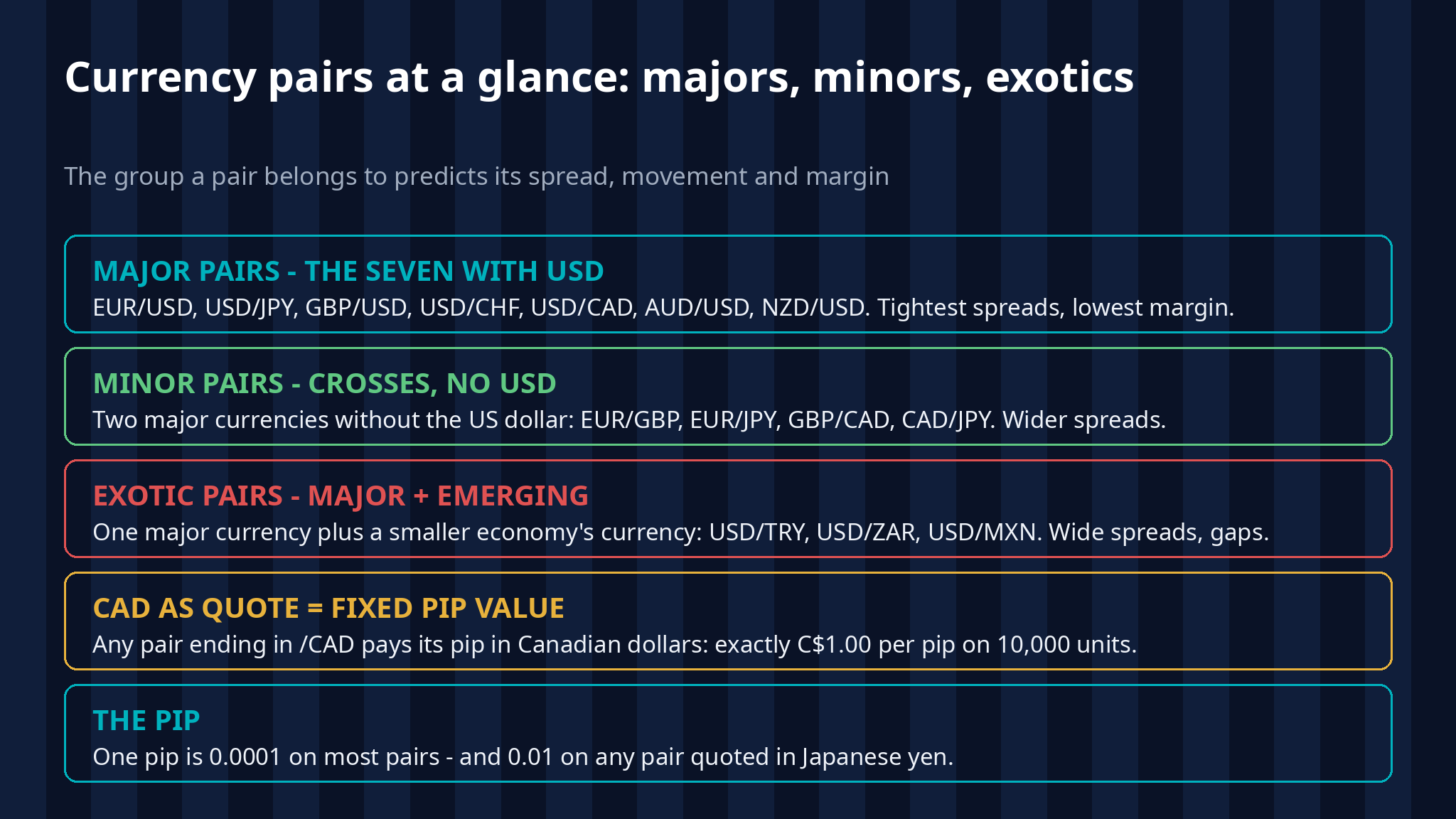
Every forex trade is an exchange between two currencies, quoted as a pair. The first currency is the base — the thing you are buying or selling — and the second is the quote currency, the price you pay for one unit of the base. Pairs fall into three groups. The majors are the seven pairs that combine the US dollar with one of the other seven most-traded currencies — and USD/CAD, the US dollar against the Canadian dollar, is one of them. Minor pairs (also called crosses) pair two major currencies without the US dollar: EUR/GBP, EUR/JPY, GBP/CAD and their relatives. Exotic pairs combine one major currency with a currency from a smaller or emerging economy, such as USD/TRY or USD/ZAR. The group a pair belongs to predicts most of what matters day to day: how wide its spread runs, how smoothly it moves, how much margin your broker requires, and — for a Canadian-dollar account — whether a pip is worth a fixed number of Canadian dollars or a number that changes with the exchange rate. Start on the majors, learn the CAD pairs properly, and leave the exotics alone until you can explain exactly why their costs are higher.
How to read a currency pair: base, quote, bid and ask
A quote such as USD/CAD 1.3600 says one thing precisely: 1 US dollar costs 1.3600 Canadian dollars. USD is the base currency and is always worth exactly one unit; CAD is the quote currency and carries the moving number. If USD/CAD rises to 1.3700, the US dollar has strengthened against the Canadian dollar — one US dollar now buys more Canadian dollars. If it falls to 1.3500, the Canadian dollar has strengthened. Traders tie themselves in knots asking whether a rising chart is “good for Canada”; the quote does not care. Rising USD/CAD means a stronger USD and a weaker CAD, full stop.
Your platform shows two prices, not one. The bid is where you sell the base currency; the ask is where you buy it. The gap between them is the spread, your first cost on every trade. Buying USD/CAD means buying US dollars and selling Canadian dollars in the same instant; selling the pair reverses both legs. There is no separate “buy CAD” button — shorting USD/CAD is buying CAD, expressed through the pair.
Two reading habits prevent most beginner errors. First, always name the base before you predict a direction: “I think the euro will rise” is a view on EUR/USD only if you also believe the US dollar will stand still, which it rarely does — a pair moves on both currencies, and the one you are not watching is usually the one that moves it. Second, remember that the pip — the standard unit of movement — sits in different places on different pairs: the fourth decimal (0.0001) on most pairs, but the second decimal (0.01) on any pair quoted in Japanese yen, because the yen’s unit value is small. Our guide to calculating pip value and profit or loss builds the full arithmetic on this page’s foundations.
The seven major pairs — and why USD/CAD is one of them
There are eight major currencies — the US dollar, euro, Japanese yen, British pound, Swiss franc, Canadian dollar, Australian dollar and New Zealand dollar — but only seven major pairs, because a major pair always includes the US dollar on one side:
- EUR/USD — euro / US dollar. The most traded pair in the world, and usually the cheapest to trade.
- USD/JPY — US dollar / Japanese yen. The yen is a classic safe-haven currency, so this pair often moves on global risk mood as much as on US or Japanese news.
- GBP/USD — British pound / US dollar, nicknamed “cable”. Tends to move further and faster than EUR/USD on the same news.
- USD/CHF — US dollar / Swiss franc. The franc is another safe-haven currency, which is why this pair often moves opposite to EUR/USD.
- USD/CAD — US dollar / Canadian dollar, nicknamed “the loonie” after the one-dollar coin. Canada’s pair, covered in depth below.
- AUD/USD — Australian dollar / US dollar. The Australian dollar is a commodity-linked currency that often tracks global growth and metals sentiment.
- NZD/USD — New Zealand dollar / US dollar. The smallest major, similar in character to AUD/USD.
The majors share three practical traits. They are the most liquid pairs — so many buyers and sellers that execution is fast and quotes are tight. Their spreads are the narrowest on your platform, which makes them the cheapest pairs to trade, trade after trade. And they are the pairs your broker’s margin table treats most generously: at CIRO-regulated dealers in Canada, the majors carry the lowest margin rates (the highest permitted leverage, around 50:1), while minors and exotics require more margin for the same position size. If you are still at the account stage, how to start forex trading in Canada walks through choosing a regulated dealer before any of this becomes live money.
USD/CAD deserves a Canadian reader’s special attention, because its drivers are the ones in your own news feed. The pair moves on the interest-rate gap between the Bank of Canada and the US Federal Reserve — when Canadian rates look high relative to US rates, holding CAD pays more, and the pair tends to fall. It moves on oil: Canada is a major energy exporter, so a rising oil price often supports the Canadian dollar (and pushes USD/CAD down), though the link is a tendency, not a law, and it weakens for weeks at a time. And it moves on the scheduled data both countries publish — jobs, inflation, retail sales — with the US releases usually hitting harder simply because the US economy is the bigger side of the pair.
Minor pairs (crosses): two majors, no US dollar
A minor pair — almost always called a cross — combines two major currencies without the US dollar: EUR/GBP, EUR/JPY, GBP/JPY, EUR/CHF, AUD/JPY, NZD/JPY, and the CAD crosses covered in the next section. Crosses exist because traders want the direct exchange rate between two economies without routing the view through the US dollar. EUR/GBP is the cleanest example: it is a near-pure bet on the euro area against the United Kingdom, and it can sit almost still while EUR/USD and GBP/USD both swing on a US data release.
Mechanically, a cross rate is built from the two pairs against the US dollar — EUR/JPY is, in effect, EUR/USD multiplied by USD/JPY — and your broker quotes it directly so you never do that arithmetic yourself. What you do feel is the cost difference: crosses trade less heavily than the majors, so their spreads run wider, and on some crosses much wider outside their home session. GBP/JPY is the famous warning case — it combines two lively currencies, routinely travels further in a day than EUR/USD, and has ended more beginner accounts than any exotic. “Minor” describes the pair’s membership, not its risk.
Exotic pairs: one major, one emerging-market currency
An exotic pair matches a major currency with a currency from a smaller or emerging economy: USD/TRY (Turkish lira), USD/ZAR (South African rand), USD/MXN (Mexican peso), USD/SEK (Swedish krona), EUR/TRY and dozens more. Brokers list long menus of them, and the menu is where the appeal ends for most traders.
Everything that is cheap and calm about the majors runs in reverse here. Liquidity is thin, so spreads are wide — often several times a major’s spread, and dramatically wider around that country’s news or outside its trading hours. Price can gap: where a major slides through levels, an exotic can jump over them, which matters when your stop-loss fills at the next available price rather than your level (the mechanics are in our forex order types guide). The smaller currency also carries its own political and central-bank risk — an unannounced rate decision or capital-control headline in the emerging economy can move the pair further in minutes than EUR/USD moves in a week. None of this makes exotics untradeable; it makes them a specialist instrument with specialist costs, and a poor classroom for learning position sizing.
CAD pairs: the Canadian dollar beyond USD/CAD
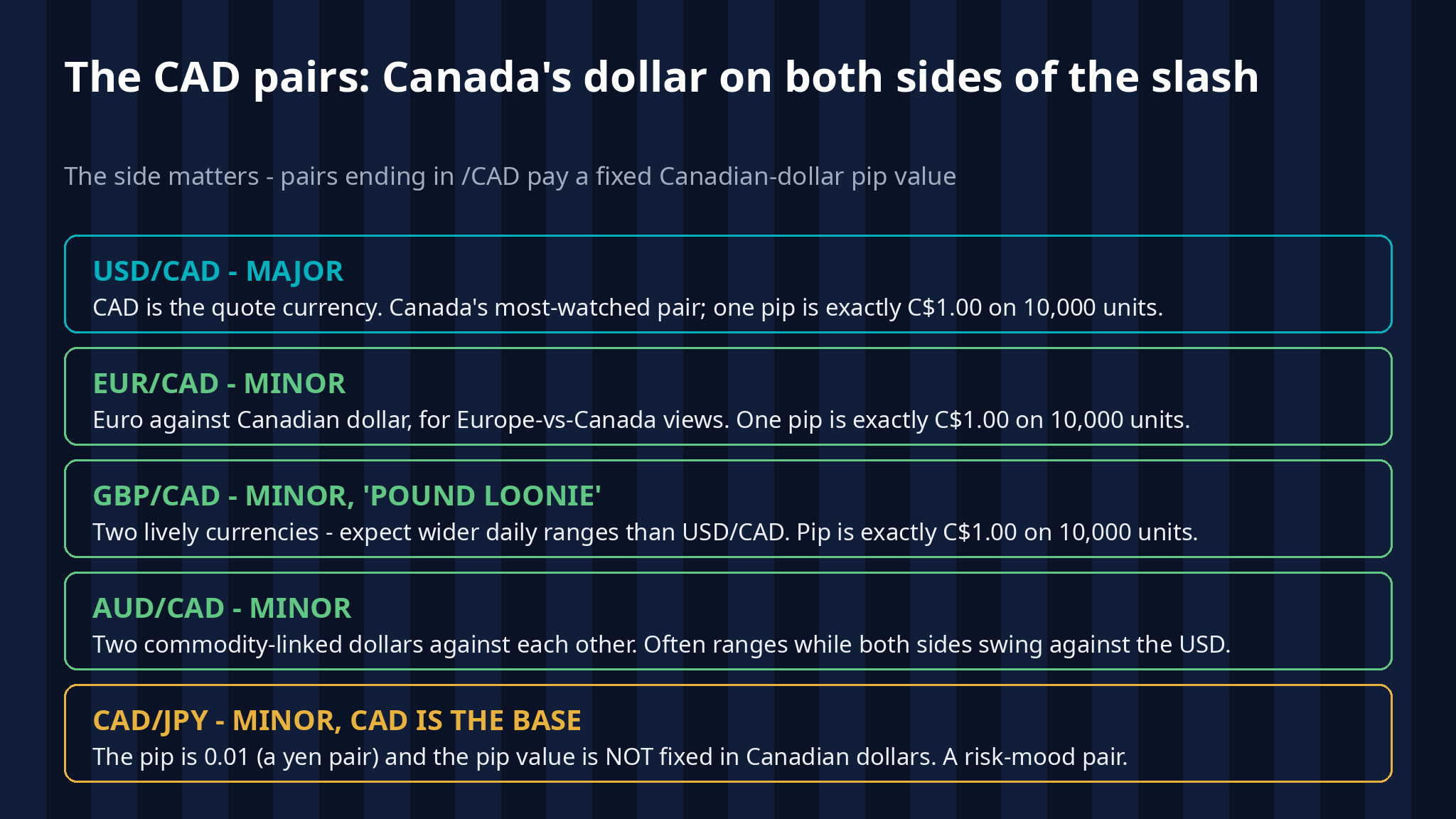
Canadians meet the Canadian dollar on both sides of the slash, and the side matters:
- USD/CAD (major) — CAD is the quote currency. The pair most Canadians watch, and the one whose pip value is fixed in Canadian dollars (next sections).
- EUR/CAD (minor) — euro against Canadian dollar. The pair to watch if your view is Europe versus Canada — for example, a European Central Bank decision against a quiet Bank of Canada week.
- GBP/CAD (minor) — pound against Canadian dollar, nicknamed “pound loonie”. Two lively currencies; expect wider daily ranges than USD/CAD.
- AUD/CAD (minor) — two commodity-linked dollars against each other. Because both currencies lean on resource exports, this pair often ranges while each side swings against the US dollar.
- CAD/JPY (minor) — here CAD is the base currency and the yen is the quote, so the pip sits at the second decimal (0.01) and the pip value is not fixed in Canadian dollars. A classic risk-mood pair: the yen strengthens when markets turn fearful, which usually means CAD/JPY falls.
One rule organises the whole list: any pair ending in /CAD has CAD as its quote currency, and that single fact fixes its pip value in a Canadian-dollar account, as the next section shows. Pairs where CAD comes first quote their profit and loss in the other currency, and the conversion comes back in.
What the category changes: spreads, movement and margin
The majors/minors/exotics split is not trivia — it is a cost and risk forecast for the pair in front of you:
- Spreads widen as you move down the list. A major in a calm market carries the tightest spread your broker offers. A cross typically costs more per trade, and an exotic more again — sometimes enough that the spread alone exceeds a beginner’s planned profit target on a small move. Our leverage and risk management guide shows how costs compound inside a position-sizing plan.
- Typical daily movement grows. Majors such as EUR/USD often travel in measured ranges; crosses like GBP/JPY and most exotics routinely travel further. A stop distance that is sensible on EUR/USD can be inside the ordinary noise on GBP/JPY — the pair decides the stop, then the stop decides your size.
- Margin requirements rise. Canadian dealers set margin per pair: majors sit at the lowest margin rate, minors higher, exotics highest. The same 10,000-unit position therefore ties up more of your account — and leaves less buffer before a margin call — on an exotic than on a major. Check the margin table for the specific pair, not the broker’s headline “up to” leverage figure, which always quotes the best major-pair rate.
- News sensitivity follows the two economies. Every pair answers to two central banks and two data calendars. Trading a pair whose news you do not follow — an exotic whose central bank meets while you sleep — is holding risk you cannot see coming.
Pip values in a Canadian-dollar account: the quote-currency rule
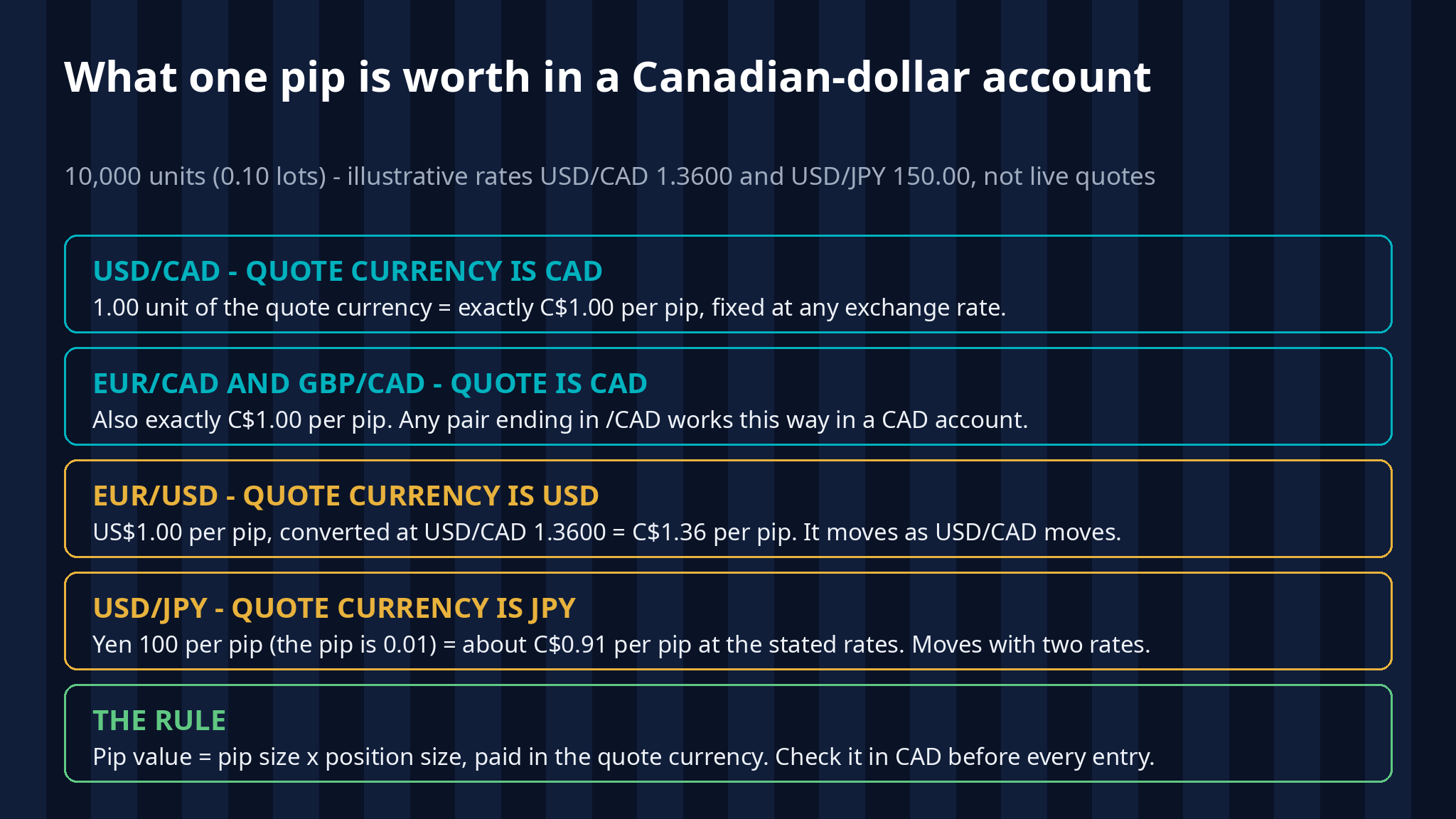
Here is the one formula this page exists to teach: a pip is worth pip size × position size, paid in the quote currency. For a 10,000-unit trade (0.10 standard lots) on a standard pair, that is 0.0001 × 10,000 = 1.00 unit of the quote currency per pip. What that is worth in your Canadian-dollar account then depends on where CAD sits:
- Quote currency is CAD (USD/CAD, EUR/CAD, GBP/CAD): 1.00 unit of quote currency is C$1.00. Your pip value is exactly C$1.00 per pip, at any exchange rate, forever. No conversion, no drift.
- Quote currency is USD (EUR/USD, GBP/USD, AUD/USD): the pip is US$1.00, converted into Canadian dollars at the USD/CAD rate. At an illustrative USD/CAD of 1.3600 — a stated rate for the arithmetic, not a live quote — that is C$1.36 per pip, and it edges up or down as USD/CAD moves.
- Quote currency is JPY (USD/JPY, CAD/JPY): the pip is 0.01, so 10,000 units earn ¥100 per pip, converted through two rates. At illustrative USD/JPY 150.00 and USD/CAD 1.3600, ¥100 is about US$0.67, or roughly C$0.91 per pip — approximate, and moving with both rates.
This is why the same 50-pip stop is a different dollar risk on every pair, and why position sizing starts from the pip value rather than the lot size. The position size calculator page runs the conversion for you; the habit to build is checking the pip value in Canadian dollars before entry, on every pair, every time.
A complete example: one USD/CAD trade in exact Canadian dollars
You trade from a Canadian-dollar account and your analysis says USD/CAD is expensive at 1.3650, wrong above 1.3700, and fairly valued back at 1.3550. You sell 10,000 units (0.10 lots):
- Entry — sell at 1.3650. You are selling US dollars and buying Canadian dollars: your view is that the Canadian dollar strengthens (the pair falls).
- Stop-loss at 1.3700: 50 pips of risk. USD/CAD ends in /CAD, so the pip value is exactly C$1.00 — planned risk is 50 × C$1.00 = C$50.00, exact, with no conversion to estimate.
- Take-profit at 1.3550: 100 pips of target, worth 100 × C$1.00 = C$100.00 if reached — twice the planned risk, a 1:2 trade defined before entry.
Run the identical shape on EUR/USD instead and the arithmetic softens: the 50-pip stop is 50 × C$1.36 = C$68.00 at the illustrative rate — and a few cents different next week, because the pip value itself floats with USD/CAD. Neither pair is “better”; the lesson is that USD/CAD hands a Canadian trader exact-dollar risk, while every pair quoted in a foreign currency adds a small, real conversion wobble to the plan. Spread and any overnight financing come off both outcomes, as always.
Which pairs should a Canadian beginner start with?
Start with one major pair and learn it properly — its usual daily range, its news calendar, the hours it moves and the hours it sleeps. For a Canadian, USD/CAD and EUR/USD are the natural first choices: USD/CAD because its drivers are your own economy’s news and its pip value in a CAD account never moves; EUR/USD because it is the deepest, cheapest market in the world and behaves comparatively smoothly. Add a second pair only when the first is boring.
Practise the mechanics on a demo account in the smallest sizes your broker allows — our guide to choosing a beginner broker explains why micro sizing and a real demo matter more than any feature list. When you do trade live, trade through a CIRO-regulated dealer so the account carries CIPF protection: the comparison of CIRO-regulated brokers for Canadians is the shortlist. And keep the exotics — and GBP/JPY — on the watchlist, not in the portfolio, until your sizing discipline has survived a few months of the calm pairs.
Common pair-selection mistakes
- Choosing a pair by its spread screenshot. The advertised spread is the calm-market best case. Exotics and crosses widen sharply exactly when markets get interesting, and the average cost over your actual trading hours is the number that matters.
- Trading a pair whose news you do not follow. Every pair has two central banks. If you cannot name both, and when each next meets, you are trading half a pair.
- Assuming “minor” means smaller risk. GBP/JPY is a minor pair and one of the fastest instruments on a retail platform. The category describes membership, not temperament.
- Sizing every pair the same. A fixed 0.10 lots is a different Canadian-dollar risk on EUR/USD, USD/JPY and USD/CAD, because the pip values differ. Size from the pip value and the stop distance — never from habit.
- Holding CAD on both sides without noticing. A trader long USD/CAD and long GBP/CAD at once is mostly making one bet — against the Canadian dollar — twice. Pairs that share a currency share its risk.
Frequently asked questions
What are the seven major currency pairs?
The seven majors are EUR/USD, USD/JPY, GBP/USD, USD/CHF, USD/CAD, AUD/USD and NZD/USD. A major pair always combines the US dollar with one of the other seven most-traded currencies — the euro, Japanese yen, British pound, Swiss franc, Canadian dollar, Australian dollar and New Zealand dollar. They are the most liquid pairs, with the tightest spreads and the lowest margin requirements.
Is USD/CAD a major pair?
Yes. USD/CAD — US dollar against Canadian dollar — is one of the seven majors, because the Canadian dollar is one of the eight major currencies and the pair includes the US dollar. For Canadians it is also the most practical major: its drivers are Bank of Canada and Federal Reserve policy, oil prices and North American data, and its pip value in a Canadian-dollar account is fixed.
What is the difference between a minor pair and an exotic pair?
A minor pair (a cross) combines two major currencies without the US dollar — EUR/GBP, EUR/JPY or GBP/CAD, for example. An exotic pair combines one major currency with a currency from a smaller or emerging economy, such as USD/TRY or USD/ZAR. Minors are reasonably liquid with moderate spreads; exotics are thinly traded, with wide spreads, larger gaps and higher margin requirements.
Why is a pip on USD/CAD worth exactly C$1.00 on a 10,000-unit trade in a CAD account?
Because a pip is always paid in the quote currency — the second currency in the pair. On a 10,000-unit trade, one pip (0.0001) is worth 0.0001 × 10,000 = 1.00 unit of the quote currency. USD/CAD is quoted in Canadian dollars, so that is C$1.00 with no conversion needed. On EUR/USD the same pip is US$1.00, which must be converted into Canadian dollars at the USD/CAD rate, so its Canadian-dollar value changes as the rate moves.
Which currency pair is best for a Canadian beginner?
A major pair, traded small. USD/CAD suits Canadians who want drivers they already follow — Bank of Canada decisions, oil and North American data — and an exact Canadian-dollar pip value. EUR/USD suits beginners who want the deepest market and the tightest spreads. Either way, learn one pair first, size from its pip value, and avoid exotic pairs and fast crosses such as GBP/JPY until your risk process is proven on calmer pairs.