Is Tickmill Legal in Canada? What Canadian Traders Need to Know
Affiliate disclosure: We may earn a commission if you open an account through some links on this page, at no extra cost to you. That never changes a regulatory verdict here — a broker that is not licensed for Canadians gets said so, commission or not. See our full affiliate disclosure.
Risk warning: Forex and CFD trading is leveraged and carries a high risk of loss. Most retail accounts lose money. Nothing on this page is investment, legal or tax advice. Regulation reduces the risk that a firm mishandles your money — it does not reduce the risk of the trades themselves. Verify a broker’s current status on the regulator’s own records before you fund an account.
Written & researched by Mark Prosz — trading since 2015 · Licensed Alberta Realtor · Financial content creator & broker reviewer
Last reviewed: November 25, 2026
The short answer
No. Tickmill is not legal for Canadian residents, and one test settles it: no Tickmill entity is a dealer member of the Canadian Investment Regulatory Organization (CIRO), and CIRO membership through a Canadian entity is what makes leveraged forex legal to offer to Canadians at all. Tickmill’s own website terms, checked again on November 25, 2026, do not name Canada as a restricted country — they name Singapore, the United States, Iran, India and Japan — but that silence changes nothing. A broker’s restricted list is not a licence: without a CIRO dealer member behind the brand, a Canadian cannot open a legitimate Tickmill account, and any account a Canadian does end up with sits outside every Canadian protection — no CIPF coverage, no CIRO supervision, no Canadian complaint route.
The rest of this page shows the working: who Tickmill is, what licences it genuinely holds, what its own terms actually say about Canada (and why the missing name does not help), what protection you would give up, and how to run this same check on any broker in a few minutes.
Who is Tickmill?
Tickmill is a global forex and CFD broker founded in 2014. It is best known for tight raw-spread pricing aimed at active traders: in the regions it serves, its headline offer is a Classic account with spread-only pricing and a Raw account with spreads from 0.0 pips plus a commission, a minimum deposit of US$100, and trading on MetaTrader 4, MetaTrader 5, its own Tickmill Trader platform and TradingView. Those terms are real — for traders in the countries Tickmill accepts. Canada is not one of them, which is why this page exists: Canadians searching for Tickmill are usually looking at marketing aimed at other countries, or at third-party sites that never checked the restriction.
Like most global broker groups, “Tickmill” is a brand, not a single company. Different Tickmill entities hold different licences in different countries, and the entity — never the brand — is what determines your regulator, your protections and your complaint route. That distinction decides the Canada question, so the next section takes it in order.
Is Tickmill regulated in Canada?
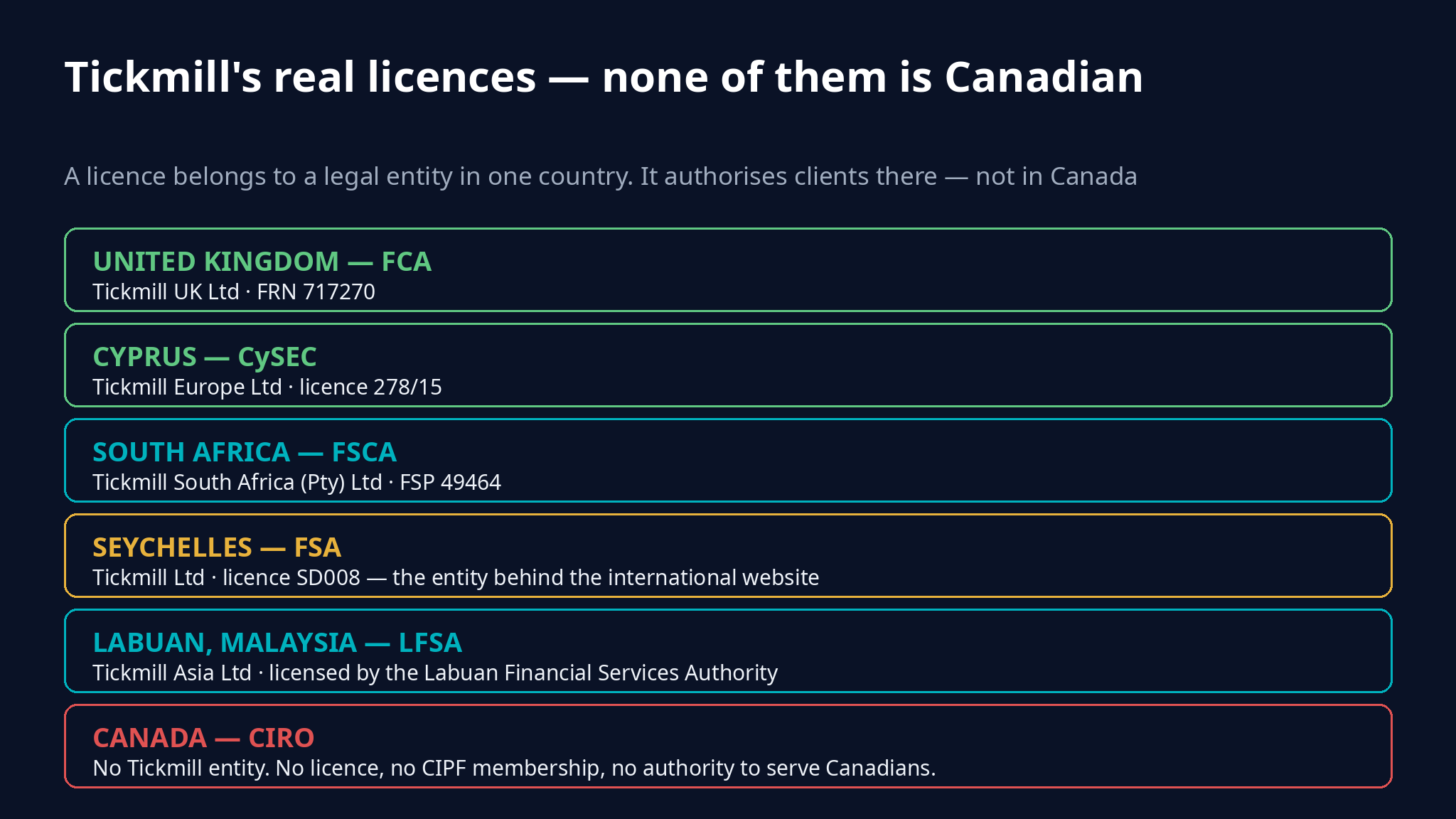
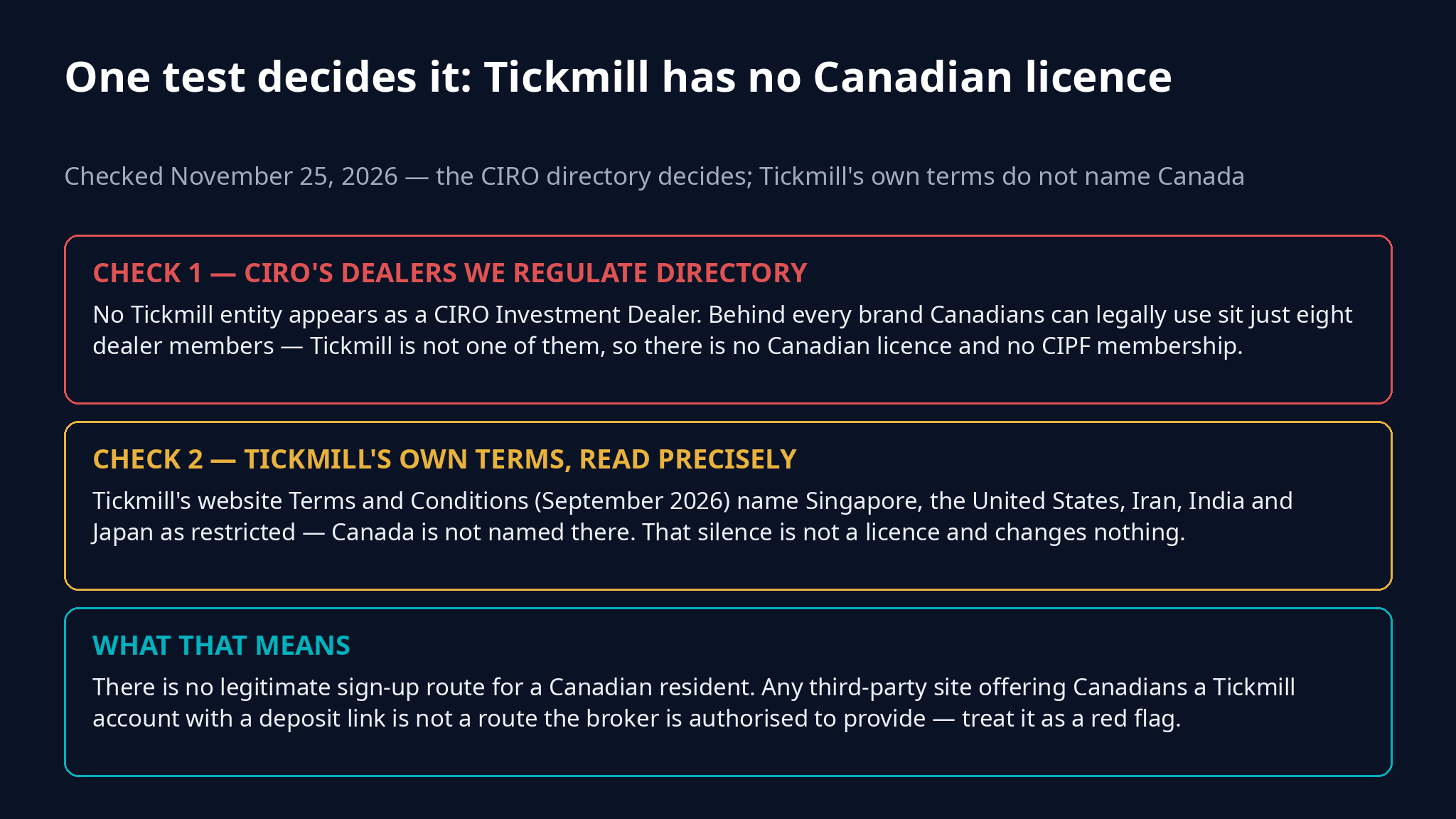
No. A broker is licensed to serve Canadian retail forex traders only when its Canadian legal entity passes a two-part test: it is a CIRO dealer member listed in CIRO’s “Dealers We Regulate” directory as an Investment Dealer, and that same entity is registered under provincial securities law. Behind every brand a Canadian can legally use sit just eight CIRO dealer members (nine brands), verified again this month — and no Tickmill entity is among them. There is no Tickmill Canada company, no CIRO listing, and no provincial registration.
Tickmill’s genuine licences are all elsewhere: Tickmill UK Ltd is authorised by the UK’s FCA (FRN 717270), Tickmill Europe Ltd is licensed by Cyprus’s CySEC (licence 278/15), Tickmill South Africa (Pty) Ltd is licensed by South Africa’s FSCA (FSP 49464), Tickmill Ltd is licensed by the Seychelles Financial Services Authority (licence SD008), and Tickmill Asia Ltd is licensed in Labuan, Malaysia — with a Dubai office held as a DFSA representative office of the UK firm, not a dealing licence of its own. Those are real licences, and the FCA and CySEC authorisations in particular are from well-regarded regulators. They authorise Tickmill to serve clients in the UK, the European Union, South Africa and the international entity’s markets respectively. A licence is territorial: an FCA or CySEC licence gives a firm no authority to open leveraged accounts for Canadians, and it gives a Canadian none of the protections those regulators provide to their own residents — no FSCS compensation, no Cyprus Investor Compensation Fund, no Financial Ombudsman route, because those schemes protect the clients of the entity in that country, not the brand’s customers worldwide.
For the full machinery — how CIRO licensing works and how the directory check runs — see our forex regulation in Canada hub. The plain-language version of the law is in Is Forex Trading Legal in Canada?
What Tickmill’s own terms say — and what they don’t
Some broker write-ups claim Tickmill’s own restricted list names Canada. We checked the source itself rather than repeat that: Tickmill’s website Terms and Conditions (September 2026 version, re-checked November 25, 2026) name Singapore, the United States, Iran, India and Japan as the countries whose residents may not use the site — Canada is not named there, and its Seychelles entity’s client agreement speaks only generally of geographical restrictions. Read that silence carefully. It is not permission, and it is not an invitation: a restricted list tells you which countries a broker has bothered to name, while the licence question is decided in Canada, by the CIRO directory. No Tickmill entity appears there, so no Tickmill entity may solicit Canadians for leveraged forex, whatever its terms omit.
Two practical consequences follow. First, there is no legitimate sign-up route to evaluate — no account type, spread or platform question arises, because a lawful Canadian account is not on offer to you. Second, treat anything that claims otherwise as a warning sign. Because there is no licensed route in, a website, ad or social-media account offering Canadians a “Tickmill” account with a deposit link is not a route Tickmill is authorised to provide — clone and impersonation sites feed on exactly this gap between a famous brand and a closed legal door. Our guide to checking whether any broker is safe in Canada walks through the impersonation red flags, and the CIRO Broker Checker runs the directory test in seconds.
CIPF protection: what you would give up
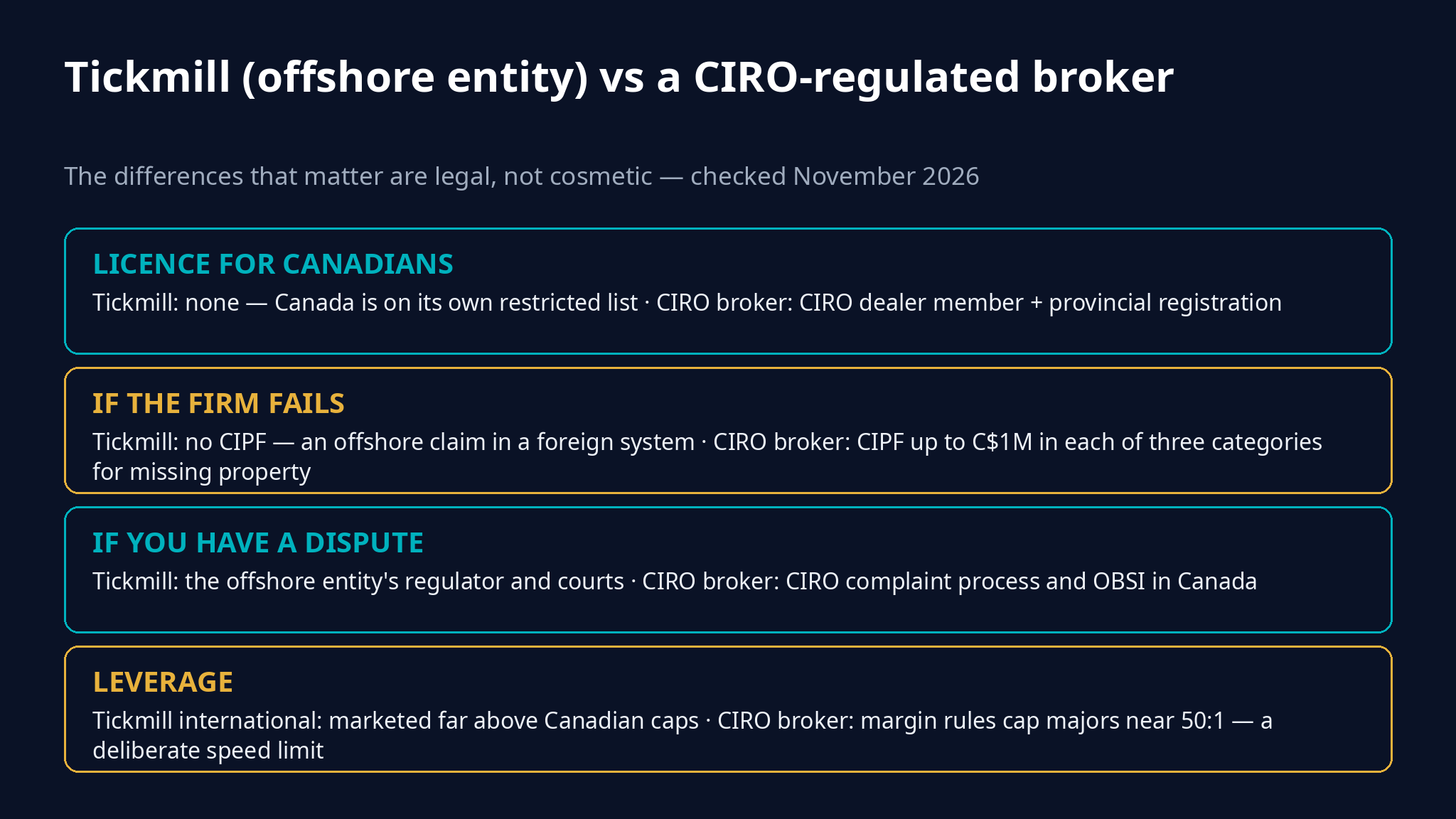
Accounts with a CIRO dealer member carry Canadian Investor Protection Fund (CIPF) coverage: if the member firm becomes insolvent and your property is missing, CIPF covers up to C$1 million for all general accounts combined, up to a further C$1 million for registered retirement accounts combined, and up to C$1 million for RESPs. CIPF does not cover trading losses or bad advice — it covers the firm failing with your assets gone, which is precisely the failure mode that matters most with a leveraged broker.
A Tickmill account — if a Canadian somehow held one through an offshore entity — carries none of it. Tickmill is not a CIPF member firm, the Seychelles-licensed international entity sits outside any comparable Canadian scheme, and a dispute would run through that entity’s regulator and courts, not through CIRO or the Ombudsman for Banking Services and Investments (OBSI). “Regulated somewhere” and “protected in Canada” are different sentences; only the second one pays out.
Leverage and risk
Tickmill’s international marketing leans on high leverage through its offshore entity, and the raw-spread pricing above is usually quoted beside it. Canada’s CIRO dealers operate under margin rules that cap effective leverage at roughly 50:1 on major currency pairs and less on everything else — a deliberate speed limit that the offshore market advertises its way around. The arithmetic does not change with the flag on the account: at 500:1 or more, a fraction-of-a-percent move against you wipes out your margin on the position. Our offshore leverage warning works through what that has meant for Canadian traders in practice, including the cases where the broker leaving the market — not the trade — was the event that cost people money, as Alberta’s Global Prime closures are demonstrating this month.
How to verify this yourself
Do not take this page’s word for it — the check takes a few minutes and it is the same one we run for every broker on this site:
- Find the legal entity. Read the broker’s account documents or legal footer. If the entity is in Seychelles, Labuan or any other offshore jurisdiction, you already have your answer.
- Search CIRO’s “Dealers We Regulate” directory for that entity. It must appear as an Investment Dealer, with no terms and conditions you haven’t read. No entry means no Canadian licence.
- Cross-check the CSA National Registration Search for the same entity and its provincial registrations (for Quebec, use the AMF’s registers instead).
- Confirm CIPF membership for that exact entity — protection attaches to the member firm, not the brand.
- Check the broker’s own restricted-countries list — but treat it as supporting evidence only. Tickmill’s own terms do not name Canada at all, and the verdict still stands, because the licence test in steps 2–4 is the one that decides.
Our Broker Safety Analyzer and the regulation hub’s step-by-step licence check package the same steps if you want them guided.
The safer alternative for most Canadians
If what attracted you to Tickmill was the package — MT4/MT5, raw-spread pricing, a low minimum deposit — Canadian dealers cover most of it inside the protections above. Our ranked guide to the best forex brokers in Canada compares the CIRO dealers on exactly those points: OANDA, for example, is reviewed in full in our OANDA review — $0 minimum, 1-unit position sizing, MT4 and TradingView, plus a core-pricing tier with commission pricing for active traders — with CIPF coverage behind it. The honest trade is narrower headline leverage and, on some pairs, wider pricing, in exchange for a licence, a compensation fund and a complaint route that all exist in your own country.
Frequently asked questions
Is Tickmill regulated by CIRO?
No. No Tickmill entity is a CIRO dealer member, and Tickmill has no Canadian entity. Its licences are held in the UK (FCA), Cyprus (CySEC), South Africa (FSCA), Seychelles (FSA) and Labuan — none of which authorises it to serve Canadian residents.
Can Canadians open a Tickmill account?
Not legitimately. Tickmill holds no CIRO licence, so it has no legal route to offer leveraged forex accounts to Canadian residents — and its own website terms do not name Canada either way. Any account a Canadian ends up with would sit with an offshore entity, outside CIPF protection and the Canadian complaint system.
Is Tickmill a scam?
That is not the right frame. Tickmill is an established global broker, founded in 2014, with genuine licences in several countries, including the FCA and CySEC. The Canada problem is different: it is not licensed here, so a Canadian has no legitimate route in — and should treat any third-party site offering one as a red flag.
What happens if I already trade through an offshore broker?
You hold an account with no CIPF protection and no Canadian complaint route, and — as the Global Prime Alberta closures show — an offshore broker can exit your province or country on a few weeks’ notice. Download your full statements and trade history now, while you can, and compare the CIRO-regulated alternatives before you need to move in a hurry.