
Forex Spreads Explained for Canadian Traders: How Spreads Work and What You Actually Pay
Affiliate disclosure: We may earn a commission if you open an account through some links on this page, at no extra cost to you. That never changes a broker’s ranking here. See our full affiliate disclosure.
Risk warning: Forex and CFD trading is leveraged and carries a high risk of loss. Most retail accounts lose money. Nothing on this page is investment, legal or tax advice.
Written & researched by Mark Prosz — trading since 2015 · Licensed Alberta Realtor · Financial content creator & broker reviewer
Last reviewed: November 27, 2026
- The short answer: a spread is the gap between buy and sell
- Why spreads exist, and why majors are tighter than exotics
- Fixed vs variable spreads: which one you are actually getting
- Spread-only vs raw spread plus commission
- What one pip of spread costs in Canadian dollars
- A complete comparison: two pricing models, one trade
- When spreads widen — and how to avoid paying the worst of it
- How to check a broker’s real spread before you deposit
- Frequently asked questions
Every forex trade starts slightly underwater. The moment you buy, you could sell back for a little less — and that small gap, the spread, is the most common way brokers get paid. It looks trivial: a pip here, half a pip there. Traded a few times a week it is a rounding error; traded fifty times a day it can be the difference between a strategy that works and one that cannot. This guide explains what a spread actually is, the four ways brokers present it, why it widens and narrows through the day, and — the part most guides skip — how to convert it into Canadian dollars for your own trade size, so you can compare two brokers on the cost you will really pay.
If you are still learning the instruments themselves, start with our currency pairs explained guide — majors, minors, exotics and the CAD pairs — then come back here for the cost side.
The short answer: a spread is the gap between buy and sell
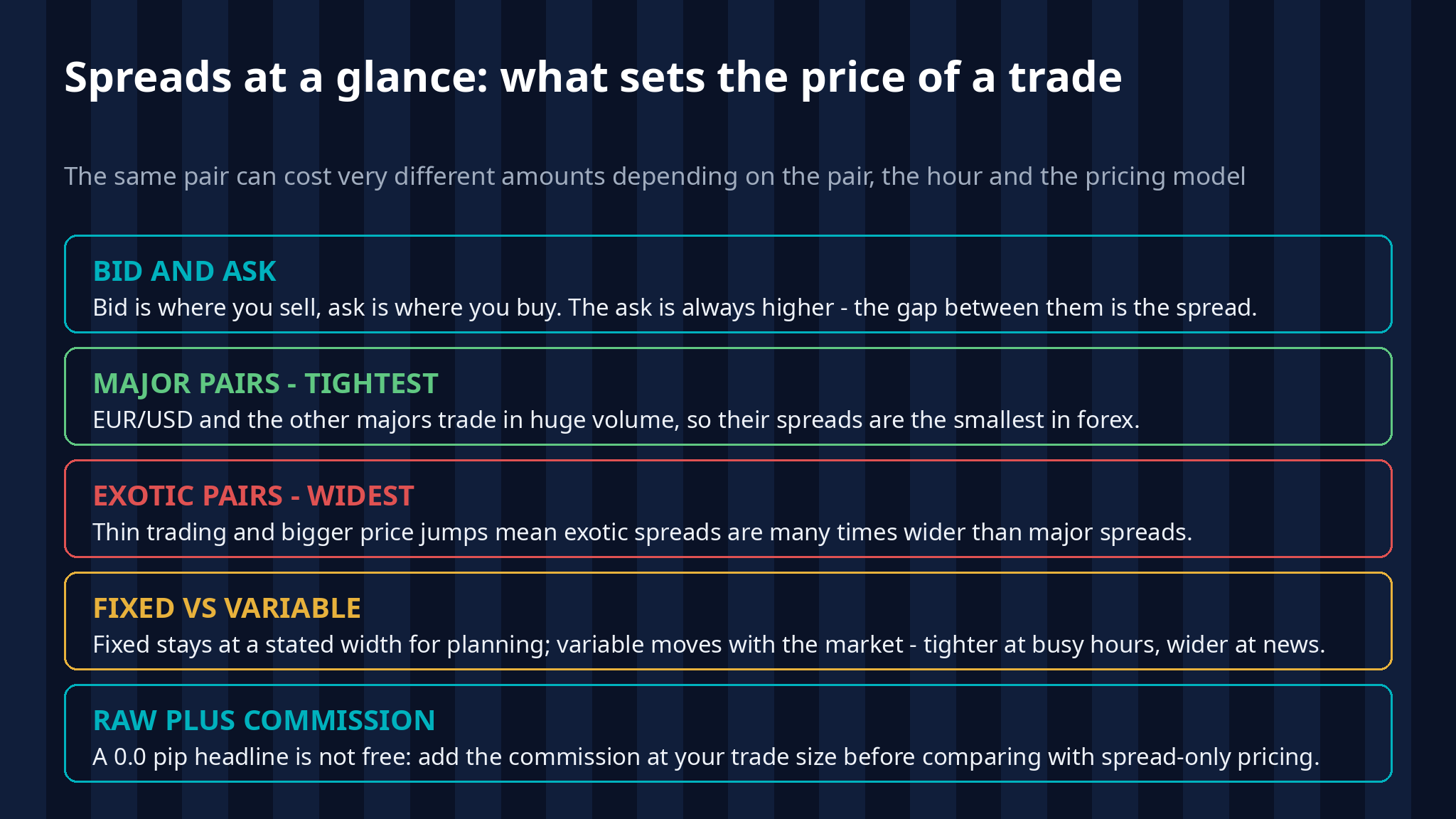
Every currency pair is quoted with two prices. The bid is the price at which you can sell the base currency. The ask (or offer) is the price at which you can buy it. The ask is always a little higher than the bid, and the difference between them is the spread, measured in pips.
A typical quote looks like this: EUR/USD bid 1.0850, ask 1.0851. The spread is 0.0001 — one pip. If you buy at 1.0851 and immediately sell at 1.0850, you lose that one pip before the market has moved at all. Your trade has to travel the width of the spread just to break even, which is why a position always opens showing a small loss.
That is not a trick and it is not hidden — it is simply how a market price works when someone stands ready to trade with you at both prices. The practical questions are how wide the gap is, whether it stays that wide, and what else you pay on top of it.
Why spreads exist, and why majors are tighter than exotics
A spread compensates whoever takes the other side of your trade for the risk and the work of doing so. The easier a pair is to trade onward in the global market, the cheaper that compensation is. EUR/USD changes hands in enormous volume all day, so spreads on it are the tightest in forex — often a pip or less on a standard account. An exotic pair such as USD/TRY or USD/ZAR trades far less, its price jumps around more, and the spread is priced accordingly: many times wider.
Three things drive the width on any given pair:
- Liquidity. The more buyers and sellers active in the pair, the tighter the spread. This is why the seven major pairs are cheap to trade and exotics are expensive.
- Volatility. When a price is moving fast, the other side of your trade demands more protection, and the spread widens.
- Time of day. Spreads follow the trading sessions, covered below — the same pair can cost two or three times as much at a quiet hour as at a busy one.
Understanding that a spread is a market price — not a fixed fee a broker invents — explains most of the confusing behaviour beginners meet: spreads that change second by second, widen at news, and differ between pairs and between brokers quoting the same pair.
Fixed vs variable spreads: which one you are actually getting
Brokers present spreads in two broad ways, and the label matters less than what happens at the moment you trade.
A fixed spread stays at a stated width regardless of market conditions, within the broker’s stated terms. It is simple to plan around, which suits beginners and anyone testing a strategy in a demo account. The trade-off is that a fixed spread is usually set a little wider than the average variable spread, because the broker is absorbing the moments when the market spread blows out.
A variable (floating) spread moves with the market. In liquid hours it can be very tight — tighter than any fixed offer — but it widens, sometimes sharply, around news releases, at session changes and in thin overnight trading. A variable spread rewards traders who trade busy hours and punishes anyone whose strategy fires at quiet or news-driven moments.
Neither is automatically better. The honest comparison is the spread you actually receive at the times you actually trade, which is why the worked examples below use your trade size and a stated hour, not a broker’s best-case headline.
Spread-only vs raw spread plus commission
The second presentation choice is how the broker charges you. On a spread-only account, the spread is the whole explicit cost: there is no separate commission line. The broker’s markup is inside the spread, which makes the cost easy to see on the quote — but you cannot separate the market spread from the markup.
On a raw-spread (or ECN-style) account, the quoted spread is passed through close to the raw market level — advertised as low as 0.0 pips on EUR/USD at busy moments — and you pay a separate commission, usually quoted per lot or per 100,000 units traded, per side or round turn depending on the broker. Raw pricing suits larger or more active traders when the commission is low enough; at small sizes the commission minimum or the per-side structure can make raw pricing the more expensive of the two.
The rule that settles every comparison: total cost = spread cost + commission + any overnight financing, all converted to Canadian dollars at your trade size. A “0.0 pip” headline with a commission can cost more than a clean 1.0-pip spread-only quote, and a wide spread with no commission can cost more than both. Our guide to how to calculate pip value and profit or loss gives the pip-value step this calculation depends on, and our low-spread forex brokers guide applies the same total-cost test to broker choice.
What one pip of spread costs in Canadian dollars
A spread is quoted in pips, but you pay it in dollars. The conversion is the pip-value rule from our currency pairs guide: one pip on a 10,000-unit trade is worth exactly C$1.00 when the quote currency is the Canadian dollar (any pair ending in /CAD), and US$1.00 when the quote currency is the US dollar — which must then be converted at the USD/CAD rate.
Using an illustrative USD/CAD rate of 1.3600 (a stated example rate, not a live quote), the arithmetic for a EUR/USD trade looks like this:
- On 10,000 units, one pip is US$1.00, which is C$1.36. A 1.0-pip spread therefore costs C$1.36 to enter. A 0.5-pip spread costs C$0.68.
- On 100,000 units, one pip is US$10.00, which is C$13.60. The same 1.0-pip spread now costs C$13.60, and a 0.5-pip spread costs C$6.80.
Nothing about the broker changed between those two lines — only your size did. That is why spread comparisons quoted without a trade size are meaningless, and why position sizing and cost belong in the same calculation. Our position-size calculator and our leverage and risk management guide show how to size a trade from the loss you can accept; work the spread cost into that same plan, not after it.
A complete comparison: two pricing models, one trade
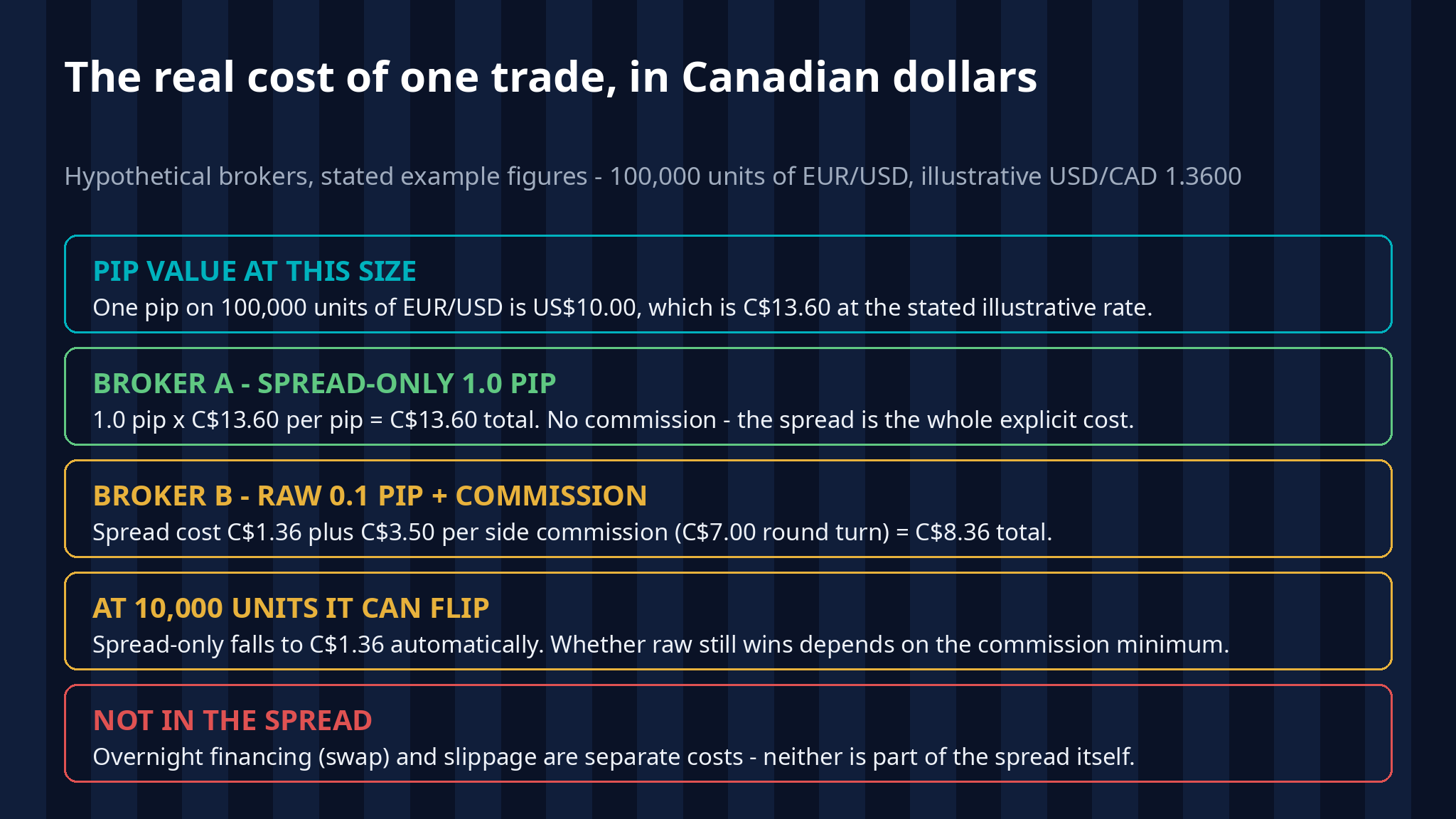
Take one trade — buy 100,000 units of EUR/USD, hold it briefly, sell it — and price it two ways. Both brokers are hypothetical and the figures are stated examples, not quotes from any named broker.
Broker A, spread-only: the spread at the moment of entry is 1.0 pip. Cost = 1.0 pip × C$13.60 per pip = C$13.60. No commission. That is the whole explicit entry-and-exit cost, because the spread is paid once, when you enter — exiting closes at the bid, which is already the other side of the quote.
Broker B, raw plus commission: the raw spread is 0.1 pip, which costs 0.1 × C$13.60 = C$1.36. The commission is stated as C$3.50 per side on 100,000 units, so entering and exiting costs C$7.00. Total = C$1.36 + C$7.00 = C$8.36.
On this size, raw pricing wins by about five dollars. Now shrink the trade to 10,000 units and assume the commission has a structure that does not shrink proportionally — for example a minimum charge. The spread-only cost falls to C$1.36 automatically, because it scales with size. Whether raw still wins depends entirely on that broker’s commission minimum and whether it charges per side or round turn. This is the same size-dependent flip Canadian traders meet in broker comparisons generally: the cheaper model at 100,000 units is not automatically the cheaper model at 10,000. Read the commission line before you believe a 0.0-pip headline, and run your own size through the formula above.
Two costs sit outside this comparison and must not be smuggled into it. Overnight financing (swap) is charged or credited when a position is held past the daily rollover — it is a separate line, driven by interest-rate differences, not part of the spread. Slippage is the difference between the price you requested and the price you received in a fast market; it is not a fee, but on a news spike it can cost more than the spread itself. Our forex order types guide explains how stop and limit orders behave when prices gap.
When spreads widen — and how to avoid paying the worst of it
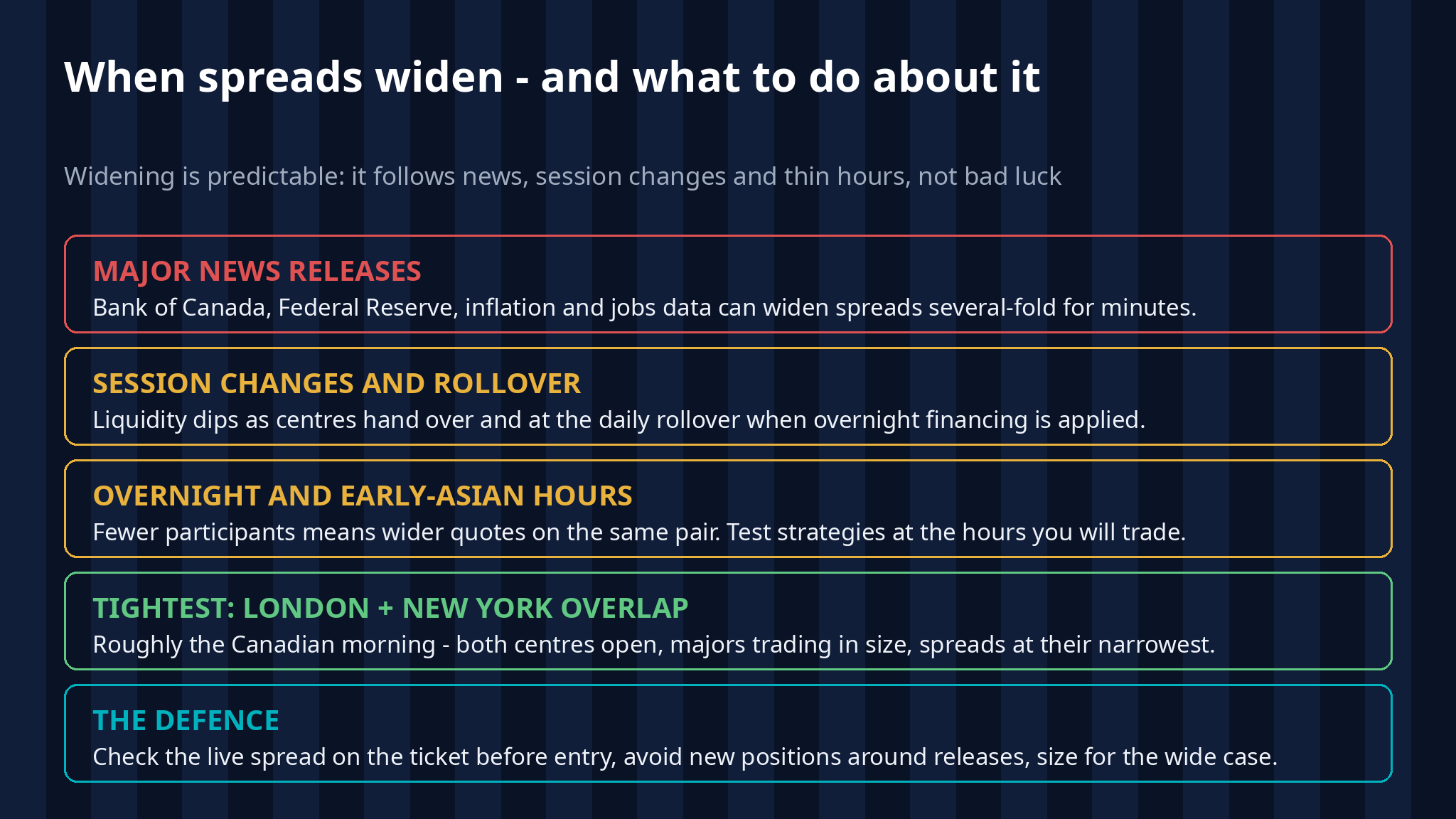
Spreads are at their tightest when London and New York are both open and major pairs are trading in size — roughly the morning in Canadian time zones. They widen predictably at these moments:
- Major news releases. Central-bank decisions, inflation prints and jobs reports — Bank of Canada and Federal Reserve events most of all for CAD pairs — can widen spreads several-fold for seconds to minutes around the release.
- Session changes and the daily rollover. Liquidity dips as one centre closes and another opens, and again at the rollover when overnight financing is applied.
- Overnight and early-Asian hours. With fewer participants, the same pair quotes wider. A strategy tested on daytime spreads can quietly fail on overnight costs.
- Weekend gaps. Markets reopen Sunday evening Canadian time; the first quotes of the week can be wide and prices can gap over stops.
The practical defences are unglamorous: trade the liquid hours for your pair, check the live spread on the ticket before you enter rather than trusting a pricing page, avoid opening new positions in the minute around a scheduled release unless that volatility is your strategy, and keep position size small enough that a temporarily wide spread cannot distort your planned risk. Beginners working through how to start forex trading in Canada should treat spread behaviour as part of broker selection, not an afterthought — and whichever broker you consider, confirm it is legal for you first in Is forex trading legal in Canada? and on the forex regulation in Canada hub. In Canada, that means a CIRO-regulated dealer with CIPF protection; an offshore broker quoting a tighter spread offers no Canadian protection in exchange.
How to check a broker’s real spread before you deposit
Do not judge any broker — CIRO-regulated or otherwise — by the “from” figure on its homepage. That number is a best case on its best pair at its best hour. Instead:
- Open a demo account and read the live spread on the pairs you will actually trade, at the hours you will actually trade them.
- Note the spread at a news release and at a quiet hour, not just mid-morning.
- Find the commission schedule in the broker’s own pricing or legal documents: per side or round turn, per lot or per 100,000 units, and any minimum.
- Find the overnight financing rates for your pairs if you hold past a day.
- Run your typical trade size through the total-cost formula in this guide for each broker on your shortlist, including the brokers on our best forex brokers in Canada page.
Five checks, about an hour in a demo account, and you will know more about a broker’s real cost than any advertisement tells you.
Frequently asked questions
What is a forex spread in simple terms?
A spread is the difference between the bid price, at which you can sell a currency pair, and the ask price, at which you can buy it. It is measured in pips and it is the main explicit cost of a trade: you buy at the ask and sell at the bid, so your position starts down by the width of the spread and must move that far before you break even.
Is a fixed or a variable spread better?
Neither is better for everyone. A fixed spread is predictable and simpler for beginners and demo testing, but it is usually set a little wider than the average variable spread. A variable spread can be tighter in busy, liquid hours but widens around news, at session changes and overnight. The right choice depends on the pairs and hours you trade — compare the spread you actually receive at those times.
Is a 0.0-pip spread really free trading?
No. A 0.0-pip headline describes the raw spread at a liquid moment on a major pair, before commission. Raw-spread accounts charge a separate commission, usually per lot or per 100,000 units, per side or round turn, and overnight financing applies if you hold the position. Add the commission to the spread cost at your own trade size before deciding it is cheaper than a spread-only account.
Why did my spread suddenly get much wider?
Almost always because liquidity dropped or volatility spiked: a major news release, a central-bank decision, a session change, the daily rollover, or thin overnight trading. Market makers widen the gap to protect themselves when prices move fast. The widening is usually brief, but a stop or entry filled inside it pays the wider price, which is why experienced traders avoid opening positions in the minute around scheduled releases.
How much does a 1-pip spread cost on a 10,000-unit trade?
It depends on the quote currency. On a pair ending in /CAD it is exactly C$1.00, because one pip on 10,000 units is worth one unit of the quote currency. On EUR/USD it is US$1.00, which converts to C$1.36 at an illustrative USD/CAD rate of 1.3600. The same 1-pip spread on 100,000 units costs ten times as much — C$10.00 on a /CAD pair, or C$13.60 on EUR/USD at that rate.