OANDA vs Interactive Brokers: Which Is Better for Canadian Traders?
Affiliate disclosure: We may earn a commission if you open an account through some links on this page, at no extra cost to you. That never changes our comparisons or recommendations. See our full affiliate disclosure.
Risk warning: Forex and CFD trading is leveraged and carries a high risk of loss. Most retail accounts lose money. Nothing on this page is investment, legal or tax advice. Spreads and commissions quoted are the brokers’ advertised figures checked on November 16, 2026 — live spreads vary by market conditions.
Written & researched by Mark Prosz — trading since 2015 · Licensed Alberta Realtor · Financial content creator & broker reviewer
Last reviewed: November 16, 2026
- The short answer
- OANDA vs Interactive Brokers at a glance
- Regulation and safety: level, and properly Canadian
- The real difference: forex CFDs vs spot currency
- Costs head to head: the answer flips with your trade size
- Platforms: simple and focused vs powerful and demanding
- Provinces: Alberta decides it, Quebec allows both
- Accounts, minimums and who each broker really wants
- Which one should you choose?
- Frequently asked questions
- Is OANDA or Interactive Brokers cheaper for forex?
- Can Alberta residents open an OANDA or Interactive Brokers account?
- Are both OANDA and Interactive Brokers regulated in Canada?
- Does Interactive Brokers offer MetaTrader, and does OANDA?
- What is the difference between OANDA’s CFDs and IBKR’s spot forex?
- Bottom line
The short answer
Both are properly regulated Canadian choices — and they are built for different people. OANDA is a forex-first CFD broker: one job, a simple platform, no minimum deposit, trades from a single unit of currency, and spread-only pricing you can understand in one line. Interactive Brokers (IBKR) is a full-service brokerage where spot forex is one market among many: you trade actual currencies at interbank-style prices with a small separate commission, alongside stocks, ETFs, options and futures, including inside registered accounts. If you only trade forex and trade small, OANDA is the easier and usually cheaper start. If you trade larger sizes, hold investments beside your forex, or want the lowest possible cost per trade at volume, IBKR wins. And one province settles it outright for many readers: OANDA does not accept Alberta residents at all, while IBKR publishes no Alberta exclusion.
OANDA vs Interactive Brokers at a glance
| OANDA (Canada) | Interactive Brokers Canada | |
|---|---|---|
| Canadian entity | OANDA (Canada) Corporation ULC | Interactive Brokers Canada Inc. |
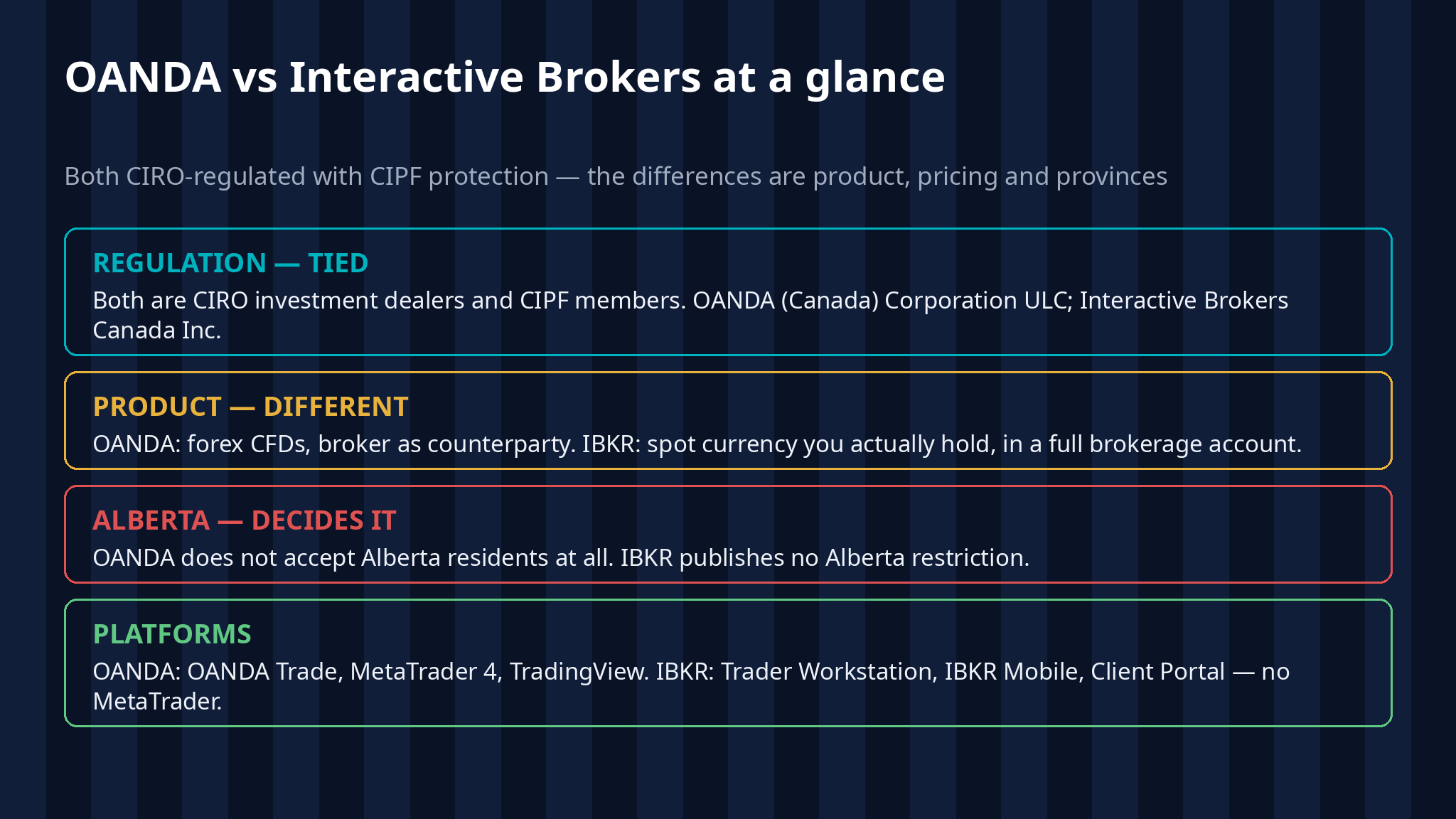
| Regulation | CIRO investment dealer; CIPF member | CIRO investment dealer; CIPF member |
| What you trade | Forex CFDs (plus index, commodity and other CFDs) | Spot currencies in a brokerage account (plus stocks, ETFs, options, futures, bonds) |
| Pricing model | Spread-only, or core pricing: raw spreads plus commission | Interbank quotes passed through with no markup, plus a separate commission |
| Advertised EUR/USD cost | 0.6 pips typical on spread-only; from 0 pips on core pricing | Spreads as narrow as 0.1 pip, plus commission |
| Commission | None on spread-only; core pricing C$1 per 10,000 units per side | 0.20 basis points of trade value, minimum US$2.00 per order |
| Minimum deposit | None (core pricing needs a C$10,000 initial deposit or balance) | None |
| Smallest trade | 1 unit of currency | Standard spot orders are US$25,000 and up; smaller orders fill as odd lots |
| Platforms | OANDA Trade (web/mobile), MetaTrader 4, TradingView | Trader Workstation, IBKR Mobile, Client Portal, TradingView connection |
| MetaTrader | MT4 yes; no MT5 in Canada | Neither MT4 nor MT5 |
| Registered accounts | No | Yes — TFSA, RRSP and other account types (for securities; leveraged forex does not belong in them) |
| Alberta | Does not accept Alberta residents | No published Alberta restriction |
| Quebec | Served (registered as a derivatives dealer in Quebec) | Served (AMF-qualified) |
Every figure in this table was checked against the two brokers’ own Canadian pages on November 16, 2026. The sections below explain what the numbers mean in practice — starting with the difference most comparisons skip: these two brokers do not sell you the same product.
Regulation and safety: level, and properly Canadian
This is the shortest section in the comparison because there is nothing to separate. OANDA (Canada) Corporation ULC and Interactive Brokers Canada Inc. are both investment dealers on CIRO’s Dealers We Regulate directory, and both are CIPF members, so eligible client property is protected up to C$1 million per category if the dealer fails — protection against the firm collapsing, never against your own trading losses. You can run the two-minute check yourself in our guide to forex regulation in Canada, which walks through the CIRO directory and the CSA National Registration Search step by step.
That puts both brokers in a different universe from the offshore brands that advertise to Canadians without a CIRO licence. If a name you are considering is not on the CIRO directory, it is not a legal retail offer in Canada, whichever licence it waves from overseas. Our full OANDA review and Interactive Brokers review cover each firm’s history and account terms in depth; the legality question itself is settled for both: yes, legal, licensed, and CIPF-covered.
The real difference: forex CFDs vs spot currency
OANDA sells you a CFD — a contract that tracks the exchange rate. You never own euros or US dollars; you gain or lose the difference between your entry and exit price, in your account currency, and the position is cash-settled with the broker as your counterparty. That is how almost every CIRO forex dealer in Canada works, and for a trader who simply wants price exposure with a stop-loss attached, it is all they need.
IBKR sells you the currency itself, as a spot trade inside a brokerage account. Buy EUR/USD at IBKR and your account actually holds euros against a US-dollar balance; the cash sits in your account, can be withdrawn or converted, and shows up in the same place as your shares and ETFs. IBKR streams quotes from 17 large FX dealers and passes them through without marking them up, charging its commission separately instead.
Three practical consequences follow. First, financing and conversion: at IBKR, converting CAD to USD for investing is a spot trade at near-interbank cost, which is why so many Canadian investors hold an account there even if they rarely “trade forex” at all. Second, account scope: an IBKR account is a whole brokerage — the forex position is one line in a portfolio. An OANDA account does one thing. Third, order size: IBKR’s standard spot market (IdealPro) is built for orders of US$25,000 and up; smaller orders still execute, as odd lots, generally within a pip of the best quote. OANDA sizes from a single unit, so a beginner can risk literal cents while learning. Neither product is “the real forex” and the other fake — but they suit different jobs, and the cost comparison below only makes sense once you see that.
Costs head to head: the answer flips with your trade size
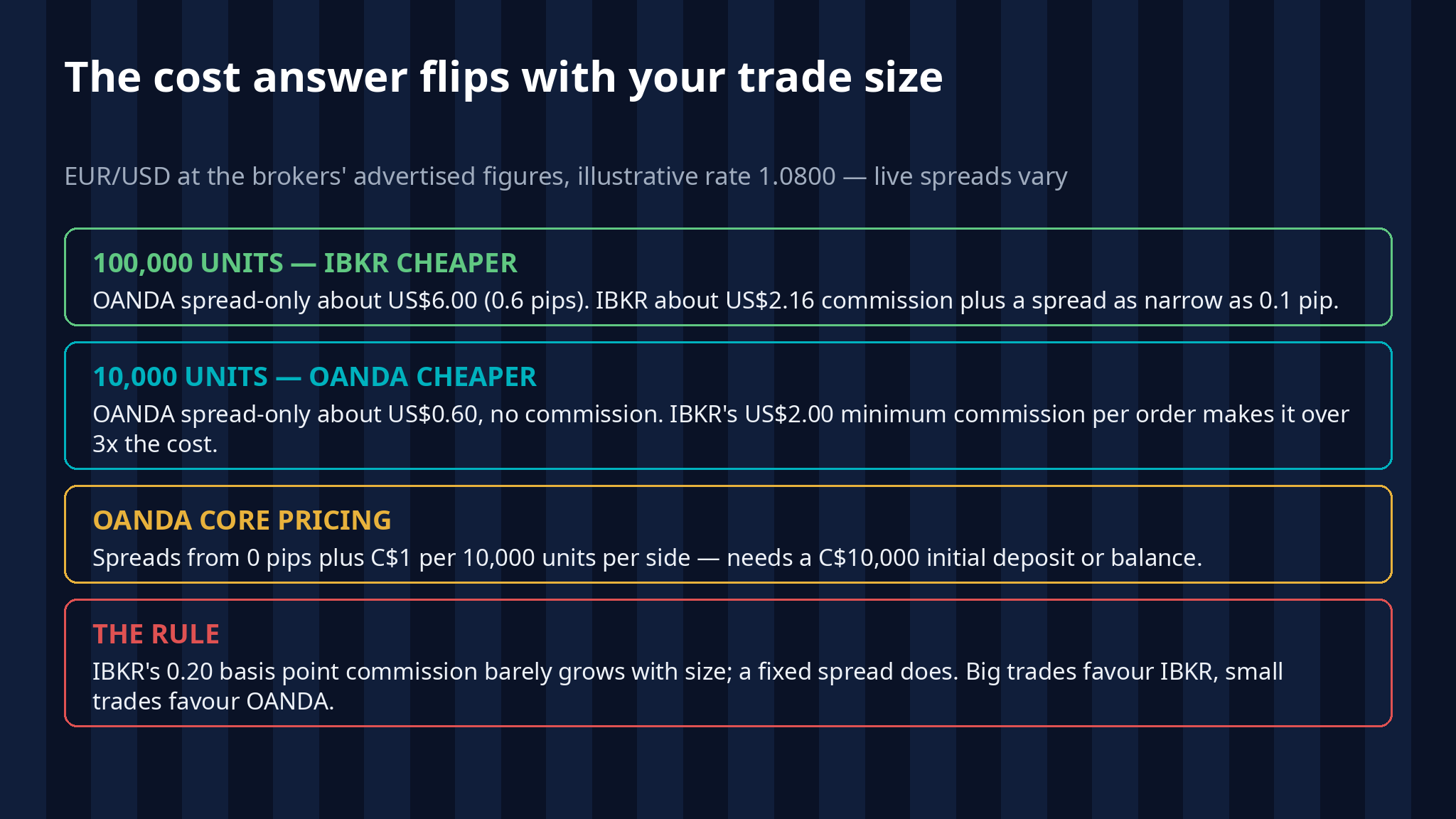
OANDA’s default pricing is spread-only: no commission, and its advertised typical EUR/USD spread is 0.6 pips. Its optional core pricing (which needs a C$10,000 initial deposit or maintained balance) drops spreads to as low as 0 pips and charges C$1 per 10,000 units per side instead. IBKR charges no spread markup — spreads as narrow as 0.1 pip — plus a commission of 0.20 basis points of trade value (0.002%), with a minimum of US$2.00 per order.
Run both models on the same trades, at the advertised figures (EUR/USD at an illustrative 1.0800, so one pip on 100,000 units is US$10):
- A 100,000-unit EUR/USD trade (about one standard lot). OANDA spread-only: 0.6 pips × US$10 = about US$6.00 of spread cost, no commission. OANDA core: spread from 0, plus C$10 commission per side. IBKR: roughly US$1.00 of spread at its narrowest, plus 0.20 bp × US$108,000 = US$2.16 commission per order. IBKR is cheapest at this size, and the gap widens as size grows, because 0.20 basis points barely moves while a 0.6-pip spread scales line by line.
- A 10,000-unit EUR/USD trade (a typical beginner size). OANDA spread-only: 0.6 pips × US$1.00 per pip = about US$0.60, no commission, no minimums. IBKR: the spread is pennies, but the US$2.00 minimum commission is the whole story — over three times OANDA’s total cost on this trade, before the spread.
So the honest cost verdict is a sentence with a comma in it: IBKR is the cheapest way to trade forex in size in Canada, and an expensive way to trade it small. OANDA’s spread-only account is the reverse — never the absolute cheapest at volume, but with no minimum commission and no minimum deposit, its cost on a learning-sized trade is close to zero. Whichever you choose, keep the total in perspective with our leverage and risk management guide: the spread is the smallest cost most beginners actually pay — oversizing is the big one.
Platforms: simple and focused vs powerful and demanding
OANDA gives you its own OANDA Trade platform on web and mobile — clean, quick to learn, with TradingView-powered charts — plus MetaTrader 4 for traders who want EAs and custom indicators, and a direct TradingView connection. It is a short menu, and everything on it is about forex and CFDs.
IBKR’s Trader Workstation (TWS) is the opposite philosophy: a professional-grade terminal covering dozens of markets, with order types and analytics most retail traders never touch — and a learning curve to match. The IBKR Mobile app and the simpler Client Portal web interface soften that, and Canadian clients can also connect TradingView. What IBKR does not offer at all is MetaTrader: if your strategy lives in MT4 or MT5, IBKR is a non-starter and OANDA (or another CIRO dealer) is your route. We compared IBKR’s platform trade-offs against a closer rival in CMC Markets vs Interactive Brokers — the same “power vs simplicity” split runs through both comparisons.
Provinces: Alberta decides it, Quebec allows both
Province rules are where Canadian broker comparisons are actually won and lost, and this pairing has the starkest split on the site. OANDA does not accept applications from Alberta residents — full stop, accredited or not. If you live in Alberta, this comparison is over: IBKR (or another dealer that serves Alberta retail, listed in our best forex brokers in Canada guide) is the choice by default. IBKR publishes no Alberta exclusion and onboarded Alberta clients on the same terms as the rest of Canada in our checks.
Quebec is the other province that often breaks a pairing — several CIRO dealers skip it. Not here: OANDA is registered as a derivatives dealer in Quebec, and IBKR is on the AMF’s qualified list, so Quebec residents can open either account, with French-language service obligations applying to both. Everywhere else in Canada, both brokers onboard retail clients on standard terms. The full province-by-province picture, including why Alberta’s accredited-investor rules shrink the CFD menu, is in our Alberta vs Ontario explainer.
Accounts, minimums and who each broker really wants
OANDA wants forex traders, including brand-new ones: no minimum deposit on the standard account, positions from 1 unit, a demo account, and a platform a beginner can learn in an afternoon. The C$10,000 balance requirement only appears if you opt into core pricing as an active trader.
IBKR wants investors and active traders who will use the whole brokerage: no account minimum either, but the value shows up when you also hold ETFs, trade options, convert currency for US investing, or run registered and margin accounts in one place. Its fee schedule rewards size and activity; its interface assumes you will invest the time to learn it. A pure forex beginner can start at IBKR — the odd-lot fills work fine — but will pay the US$2 minimum commission on every small order and climb a steeper platform hill for a market that is one corner of the building.
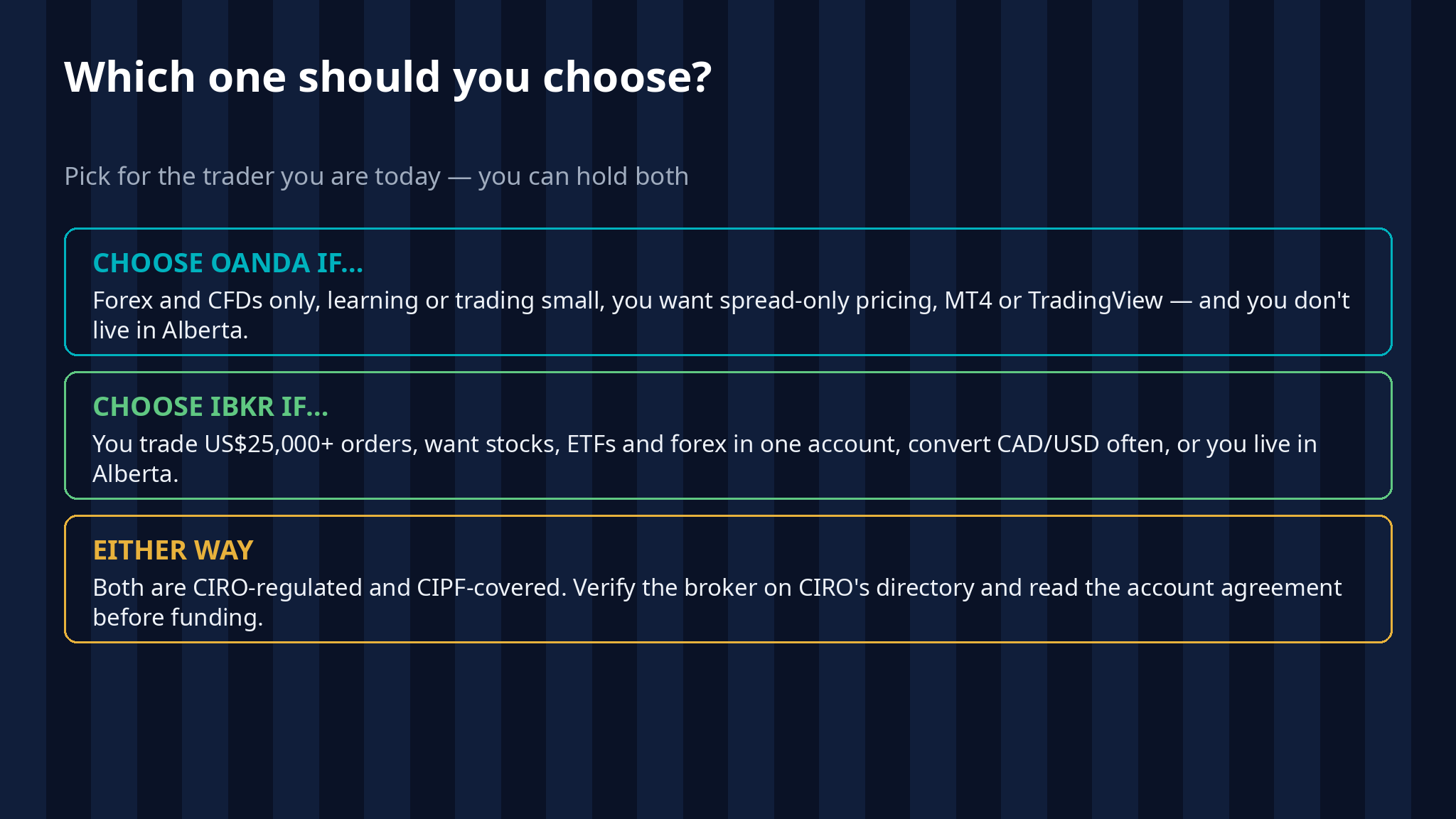
Which one should you choose?
Choose OANDA if you trade forex and CFDs only, you are learning or trading small sizes, you want spread-only pricing with no commission maths, you use MetaTrader 4 or TradingView, and you do not live in Alberta.
Choose Interactive Brokers if you trade larger sizes (US$25,000+ per order is its home turf), you want investments and forex under one roof, you convert CAD/USD regularly for investing, you want registered-account capability for your securities, or you live in Alberta — where it is the only one of the two you can open.
Choose neither yet if you have not confirmed the basics: both firms are on the CIRO directory today, but check your own province eligibility and read the account agreements before funding. Our best forex brokers in Canada ranking shows how both compare against the other CIRO dealers, including CMC Markets, FOREX.com, Plus500CA and Questrade.
Frequently asked questions
Is OANDA or Interactive Brokers cheaper for forex?
It depends on your trade size. At IBKR’s advertised figures, a 100,000-unit EUR/USD trade costs about US$2.16 in commission plus a spread as narrow as 0.1 pip — cheaper than OANDA’s advertised 0.6-pip spread-only cost of about US$6.00. On a 10,000-unit trade the result flips: OANDA costs about US$0.60 in spread, while IBKR’s US$2.00 minimum commission per order makes it the more expensive of the two. Small traders pay less at OANDA; large traders pay less at IBKR.
Can Alberta residents open an OANDA or Interactive Brokers account?
Alberta residents cannot open an OANDA account — OANDA (Canada) does not accept applications from Alberta at all. Interactive Brokers Canada publishes no Alberta exclusion and onboards Alberta clients on its standard terms, so Albertans comparing this pair only have one available choice.
Are both OANDA and Interactive Brokers regulated in Canada?
Yes. OANDA (Canada) Corporation ULC and Interactive Brokers Canada Inc. are both CIRO investment dealers and CIPF members. That means Canadian regulation, segregated client property rules, and CIPF protection of up to C$1 million per category if the dealer fails. You can verify both in minutes on CIRO’s Dealers We Regulate directory.
Does Interactive Brokers offer MetaTrader, and does OANDA?
OANDA offers MetaTrader 4 in Canada (alongside its own OANDA Trade platform and TradingView). Interactive Brokers offers neither MT4 nor MT5 — its platforms are Trader Workstation, IBKR Mobile and Client Portal, with a TradingView connection. If your strategy depends on MetaTrader, that settles the choice in OANDA’s favour.
What is the difference between OANDA’s CFDs and IBKR’s spot forex?
At OANDA you trade a contract for difference: you never own the currency, you settle the price difference in cash, and the broker is your counterparty. At IBKR you trade spot currency inside a brokerage account: you actually hold the currency you buy, alongside any stocks and ETFs in the same account, at interbank-style quotes passed through without a markup, plus a separate commission.
Bottom line
OANDA and Interactive Brokers are both safe, legal, CIRO-regulated answers for Canadians — the choice is about fit, not safety. OANDA is the focused forex tool: simplest pricing, smallest possible trade sizes, MT4 and TradingView, no minimum deposit — and no Alberta. IBKR is the full brokerage with the cheapest forex costs at size, real spot currency, and every other market attached — at the price of a US$2 minimum commission that punishes small trades and a platform that takes real learning. Pick the one that matches the trader you actually are today; you can hold both, and many Canadians end up with OANDA for forex and IBKR for investing.
Last reviewed: November 16, 2026. Broker facts (entities, CIRO status, pricing, province availability) re-verified on November 16, 2026 from the brokers’ own Canadian pages and the CIRO framework described in our regulation guide.