Is Forex Trading Legal in Canada?
Affiliate disclosure: We may earn a commission if you open an account through some links on this page, at no extra cost to you. That never changes our verdicts — a broker’s legal status in Canada is a matter of public record, not opinion. See our full affiliate disclosure.
Risk warning: Forex and CFD trading is leveraged and carries a high risk of loss. Most retail accounts lose money. Nothing on this page is legal, investment or tax advice. Verify a broker’s current CIRO status and your own province eligibility before you fund an account.
- The short answer
- Who regulates forex in Canada
- The nine brands that are actually legal
- What about offshore brokers?
- Leverage rules: what “legal” leverage looks like
- The province traps
- What changed in 2026
- Can you trade forex in a TFSA or RRSP?
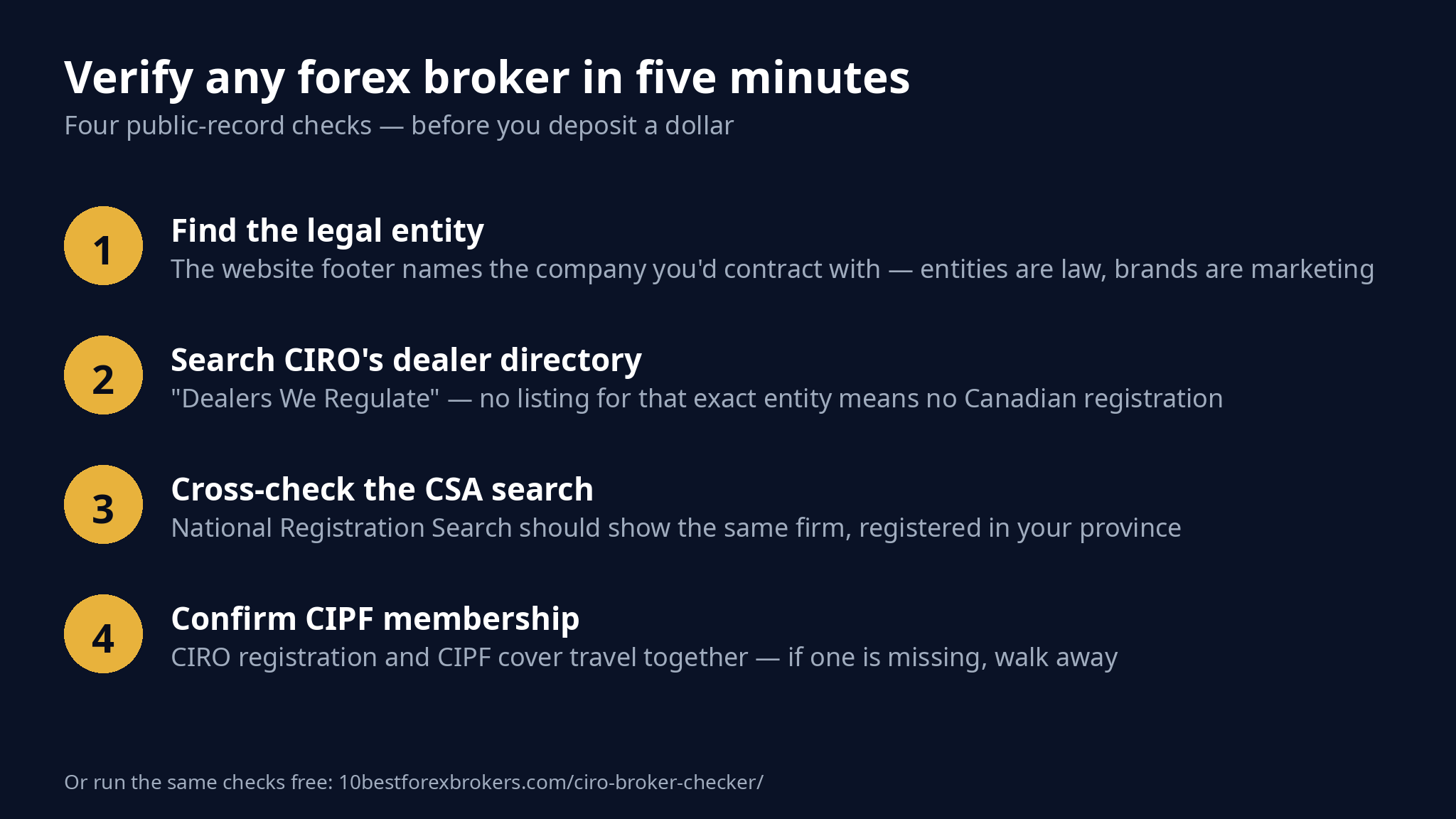
- How to verify any broker in five minutes
- Frequently asked questions
- Bottom line
The short answer
Yes. Forex trading is completely legal in Canada — for you. The legal restriction sits on the broker’s side of the trade: a firm needs Canadian registration to sell leveraged forex and CFDs to Canadian retail clients, and that registration runs through one body, the Canadian Investment Regulatory Organization (CIRO).
That single rule explains almost everything confusing about this market:
- There are only eight CIRO dealer members behind nine forex brands in the whole country — and only eight of those brands can actually open you an account today. We rank them in our Best Forex Brokers in Canada 2027 flagship.
- The hundreds of other brokers advertising to Canadians — 500:1 leverage, deposit bonuses, sign-up in five minutes — are not registered here. They are not allowed to solicit Canadian retail clients, and money you send them has no Canadian protection of any kind: no CIPF cover, no ombudsman, no Canadian regulator to call.
- Your province matters almost as much as your broker. Some CIRO dealers won’t take Alberta retail clients at all, one won’t take Quebec, and Quebec runs its own derivatives registration on top of the national rules.
So the real question is never “is forex legal in Canada?” It is “is this broker legal for me, in my province?” The rest of this page gives you the full picture — and a five-minute way to check any broker yourself. For the deep version, see our complete guide to forex regulation in Canada.
Who regulates forex in Canada
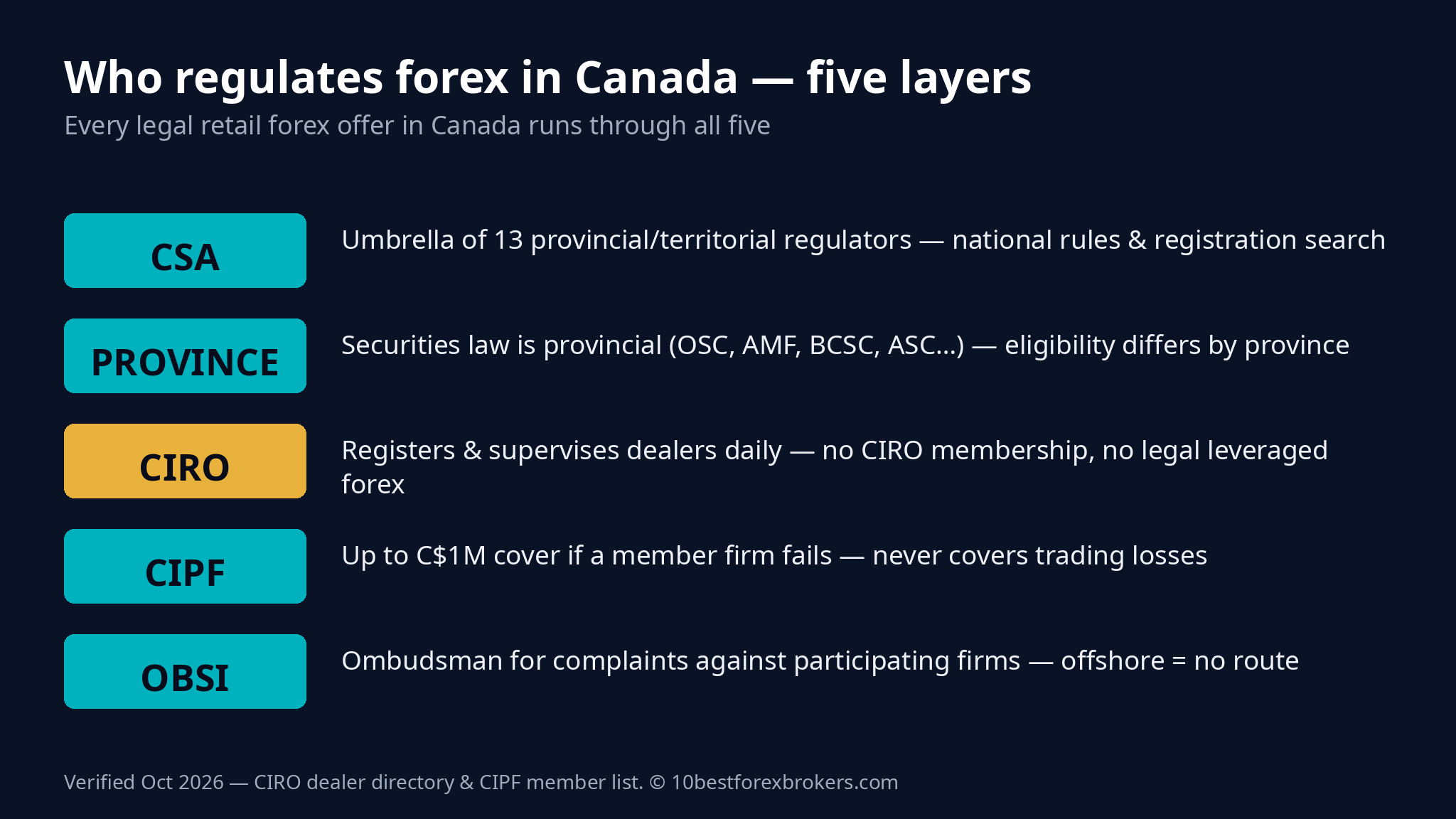
Canada has no single national securities regulator. Forex oversight is layered, and each layer does a different job:
The CSA (Canadian Securities Administrators) is the umbrella council of the 13 provincial and territorial securities regulators — the OSC in Ontario, the AMF in Quebec, the BCSC in British Columbia, the ASC in Alberta, and so on. The CSA coordinates national rules, runs the National Registration Search, and sets cross-country policy such as the binary-options prohibition covered below.
Your provincial regulator writes and enforces the securities law that actually applies to you. Registration is provincial in law even when it looks national in practice, which is why eligibility and product rules can differ province to province.
CIRO is the national self-regulatory organization formed in 2023 from the merger of IIROC and the MFDA. CIRO registers and supervises investment dealers day to day — capital, audits, business conduct, margin rules. If a firm legally sells leveraged forex to Canadian retail clients, it is a CIRO dealer member. Full stop.
CIPF (Canadian Investor Protection Fund) is the safety net: if a member firm becomes insolvent, CIPF cover protects eligible client property up to C$1 million for all general accounts combined per person. It covers missing property on a firm’s failure — never trading losses.
OBSI (Ombudsman for Banking Services and Investments) is your escalation route for complaints against participating firms. Offshore brokers sit outside all five of these layers. Our Is Your Forex Broker Safe? page walks through what that means in practice.
The nine brands that are actually legal
Every leveraged-forex brand a Canadian retail trader can legally use runs through one of these CIRO dealer members (verified against CIRO’s dealer directory and the CIPF member list, October 2026):
- OANDA (Canada) Corporation ULC — OANDA
- GAIN Capital – FOREX.com Canada Ltd. — FOREX.com
- CMC Markets Canada Inc. — CMC Markets
- Interactive Brokers Canada Inc. — Interactive Brokers
- Plus500CA Ltd. — Plus500 (CIRO-registered since June 2025)
- Questrade Inc. — Questrade
- Friedberg Mercantile Group Ltd. — AvaTrade and FXCM, both offered through Friedberg Direct
- Fortrade Canada Limited — Fortrade, a CIRO dealer that is currently barred by a temporary order from opening new client accounts, so it cannot take you on today
That’s the whole list. If a broker pitching you is not on it — directly, or clearly through Friedberg — it is not CIRO-regulated, whatever its website implies. Our ranking of the best forex brokers in Canada compares the legal options; our CIRO Broker Checker and Broker Safety Analyzer let you test any name in under a minute.
What about offshore brokers?
This is where most Canadians get tripped up, because two different statements are both true:
- For the broker, marketing leveraged forex to Canadian retail clients without CIRO registration is not permitted. Offshore firms that target Canadians are operating outside the registration regime.
- For you, there is no law that fines you for holding an offshore account — but you trade entirely at your own risk. No CIPF cover if the firm fails. No OBSI complaint route. No Canadian regulator with jurisdiction over the firm. Withdrawal problems, frozen accounts and vanished firms are your problem to solve in a foreign legal system, if there is one.
In practice, most of the big offshore brands have stopped even trying: when we re-verified all eleven offshore brokers covered on this site in October 2026, ten of them — Exness, XM, JustMarkets, RoboForex, Pepperstone, FXTM, Octa, IC Markets, BlackBull Markets and FP Markets — do not accept Canadian residents at all. Canada sits on their own restricted-country lists. Some offshore names are at least regulated somewhere credible — CySEC in Cyprus, ASIC in Australia, the FCA in the UK — and we assess each one honestly on its own terms: see, for example, our Exness in Canada legality page, and the matching pages for XM, Pepperstone, IC Markets and the rest, each linked from our regulation guide. But “regulated somewhere” is not “legal and protected in Canada,” and the difference only matters on the worst day — the day a firm fails or refuses your withdrawal.
One reliable tell: leverage. A broker offering a Canadian 1:200 or 1:500 is telling you, in its own marketing, that it is not following Canadian rules.
Leverage rules: what “legal” leverage looks like
Canada does not set one flat leverage cap. CIRO dealers set margin requirements by currency pair and by your account’s base currency, and the effective leverage falls out of that. Real examples from CIRO dealers’ published margin schedules (checked October 2026):
- EUR/USD: 5% margin in a CAD account = 20:1 effective leverage; 3% in a USD account = about 33:1
- USD/CAD: as high as 50:1 at some dealers — that is the ceiling, not the standard
- Gold and other CFDs: typically around 20:1 or lower, and riskier products are lower still
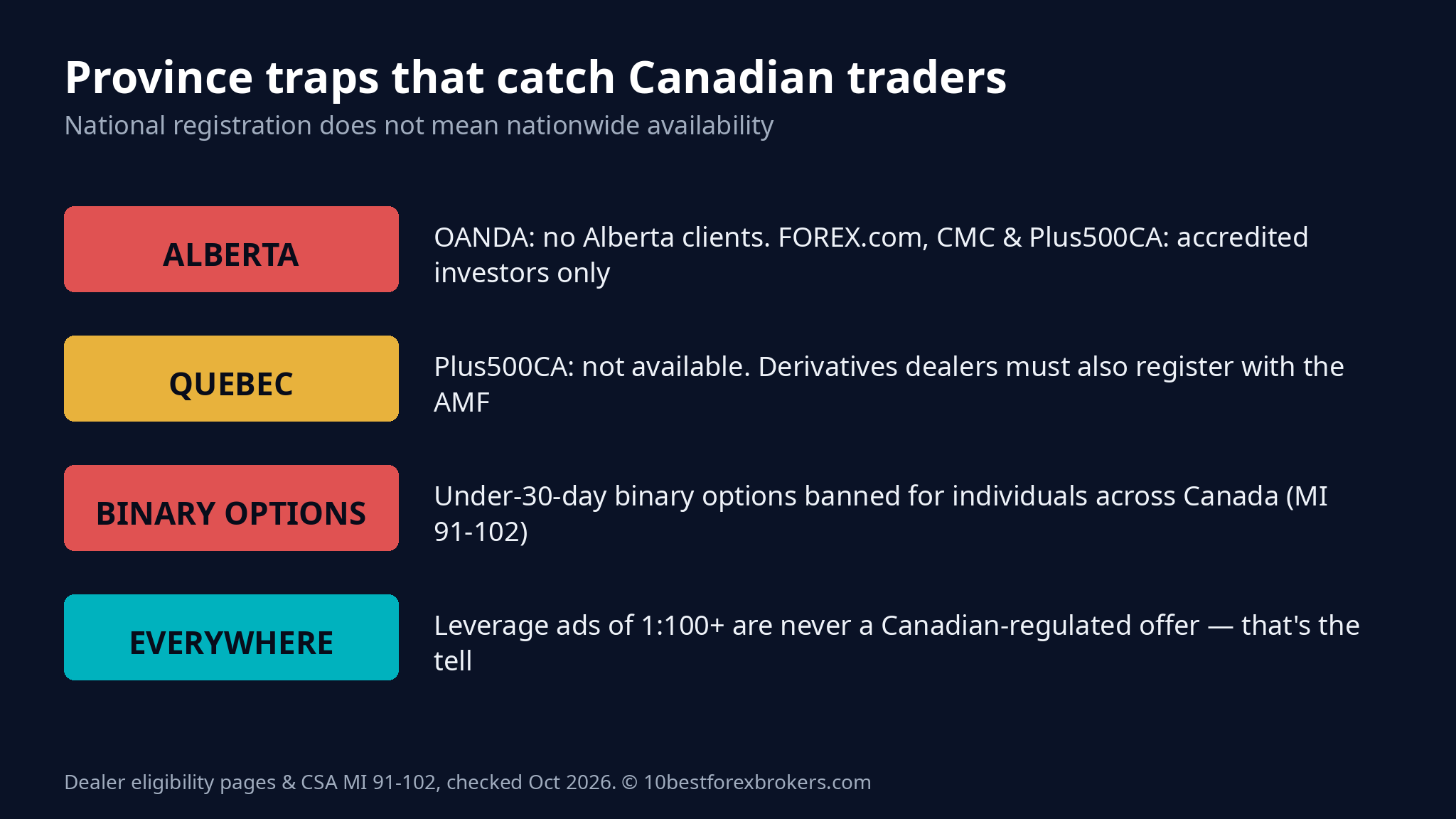
So “50:1 in Canada” is a half-truth you will see repeated everywhere: it applies to one pair, in one currency, at some dealers. Our forex leverage in Canada guide breaks down the full margin tables. Anything dramatically above these levels — 1:100, 1:500 — is, by definition, not a Canadian-regulated offer.
The province traps
National registration does not mean nationwide availability. The traps that catch real traders:
Alberta. Several CIRO dealers restrict Alberta. OANDA does not accept Alberta residents at all. FOREX.com, CMC Markets and Plus500CA accept Alberta clients on an accredited-investor basis only. If you are an Alberta retail trader, your legal choice set is smaller than the national ranking suggests — see our forex trading in Alberta page.
Quebec. Plus500CA does not serve Quebec. Dealers offering derivatives in Quebec must also be registered as derivatives dealers with the AMF — OANDA and FOREX.com both are — which is one reason Quebec availability differs from the rest of the country. Details: forex trading in Quebec.
Ontario is the most straightforward large market — every CIRO dealer serves it — but it is still worth reading the forex trading in Ontario page for the OSC’s role. The same goes for the other provinces, each with its own regulator and quirks: British Columbia, Manitoba, Saskatchewan, Nova Scotia, New Brunswick and Newfoundland and Labrador.
Binary options are a hard no almost everywhere: under CSA Multilateral Instrument 91-102, advertising, offering or selling binary options with a term under 30 days to an individual is prohibited across Canada (British Columbia, which did not adopt the instrument, handles binary options under its own guidance with the same practical effect — no legitimate retail offer exists). Any website pitching binary options to Canadians is a red flag for fraud, full stop.
Alberta and Ontario sit at opposite ends of that spectrum — our Alberta vs Ontario comparison works through both rulebooks dealer by dealer.
What changed in 2026
The framework itself did not move — CIRO registration is still the whole game — but 2026 added two signals worth knowing:
- Event contracts arrived, narrowly. On March 26, 2026, CIRO published a bulletin setting strict terms under which dealer members can facilitate event contracts (prediction-market style products), and on April 2, 2026 the CSA and CIRO jointly reminded the market that event contracts that are securities or derivatives carry full registration requirements. As our CIRO event contracts coverage explains, only two dealer members were authorized at the time, under tight conditions. It does not change anything about forex — but it shows the direction of travel: new leveraged products enter Canada through CIRO registration, or not at all.
- Quebec oversight consolidated. Effective July 4, 2026, CIRO assumed oversight of Quebec mutual fund dealer representatives under an amended AMF recognition order — covered in our Quebec oversight report. Not a forex change in itself, but another step toward one national supervisor operating under provincial law.
And one non-change worth repeating: offshore brokers marketing 1:500 leverage to Canadians remained a standing problem through 2026 — see our offshore leverage warning.
Can you trade forex in a TFSA or RRSP?
No — not leveraged forex or CFDs. Registered accounts cannot hold these products; CIRO dealers do not offer leveraged forex inside a TFSA, RRSP or FHSA. Forex trading happens in a non-registered (taxable) account, and the profits are taxable — as capital gains or as business income, depending on how you trade. Our forex trading taxes in Canada guide covers the CRA’s tests. Legality and taxability are separate questions: legal to trade, taxable to profit.
How to verify any broker in five minutes
Do this before any deposit, for any broker, including ones we rank:
- Find the legal entity. The broker’s website footer names the company you would actually contract with. Brand names are marketing; entities are law.
- Search CIRO’s “Dealers We Regulate” directory for that exact entity. No listing, no Canadian registration.
- Cross-check the CSA National Registration Search. It should show the same firm, registered in your province.
- Confirm CIPF membership on CIPF’s member list. CIRO registration and CIPF membership travel together — if one is missing, something is wrong.
Or shortcut steps 2–4 with our free CIRO Broker Checker and Broker Safety Analyzer, which run the same public records. Then read the dealer’s own province eligibility page before you apply — remember OANDA and Alberta.
Frequently asked questions
Is forex trading legal in Canada?
Yes. Any Canadian adult can legally trade forex — through a CIRO-registered dealer. The registration requirement binds the broker, and it is what gives you CIPF protection and a Canadian complaint route.
Is it illegal to use an offshore forex broker as a Canadian?
You are not the one breaking the registration rule — the unregistered broker soliciting you is. But you give up every Canadian protection: no CIPF, no OBSI, no regulator with jurisdiction. If the firm fails or blocks your withdrawal, you are on your own in a foreign system.
What is the maximum legal leverage in Canada?
There is no single number. Margin is set per pair and per account currency: EUR/USD works out to about 20:1 in a CAD account and 33:1 in a USD account at major CIRO dealers, with USD/CAD reaching the 50:1 ceiling. Offers of 1:100+ are never Canadian-regulated offers.
Do I pay tax on forex profits in Canada?
Yes. Profits in a non-registered account are taxable, as capital gains or business income depending on your trading pattern. Leveraged forex cannot be traded inside a TFSA or RRSP.
Are binary options legal in Canada?
Binary options with a term under 30 days cannot legally be offered to individuals anywhere in Canada (MI 91-102; British Columbia applies its own equivalent approach). Sites offering them to Canadians are operating illegally and are a leading fraud vector.
How many legal forex brokers are there in Canada?
Nine brands through eight CIRO dealer members — and eight brands that can open an account today, because Fortrade Canada is barred by a temporary order from taking new clients. They are all ranked in our flagship guide.
Bottom line
Forex trading is legal in Canada. What is restricted — deliberately — is who may sell it to you. Trade through a CIRO dealer and you get segregated-fund rules, CIPF cover up to C$1 million, an ombudsman and a regulator that answers to Canadian law. Trade offshore and you get higher leverage and none of that. Check your province, check the dealer directory, and then make the choice with your eyes open: start with how to start forex trading in Canada.
And when tax season approaches, our forex tax year-end checklist covers the CRA deadlines, instalments and records that apply to those accounts.