
How to Calculate Pip Value and Profit or Loss: Worked Examples for Canadian Forex Traders
Affiliate disclosure: We may earn a commission if you open an account through some links on this page, at no extra cost to you. See our full affiliate disclosure.
Risk warning: Forex and CFD trading is leveraged and carries a high risk of loss. Most retail accounts lose money. Nothing on this page is investment or tax advice. The exchange rates in the worked examples are round illustrative rates chosen to make the arithmetic easy to follow — they are not live quotes. Run your own trade through the calculators with the current rate before you rely on a number.
- The short answer
- What a pip is — and what a pipette is
- Lot sizes: the units behind every pip value
- The formula: three cases, one idea
- Pip values in a CAD account: worked table
- From pips to profit or loss: two worked trades
- The costs that sit between gross and net
- Pip value is position sizing
- Using this site’s calculators instead of doing it by hand
- Common pip-value mistakes
- Frequently asked questions
- Bottom line
The short answer
A pip is worth what your position size says it is worth — nothing more mysterious than that:
- Pip value = pip size × position size in units, converted into your account currency if the pair’s quote currency is not already your account currency.
- On a standard lot (100,000 units) of a pair quoted in US dollars, such as EUR/USD, one pip is US$10. A mini lot (10,000 units) makes it US$1; a micro lot (1,000 units) makes it US$0.10.
- In a Canadian-dollar account, that US$10 still has to be converted. At an illustrative USD/CAD rate of 1.3600, one pip on a standard lot of EUR/USD is worth C$13.60 — the conversion step is the one Canadian traders most often forget, and it changes every risk number that follows.
- Profit or loss = pips gained or lost × pip value, minus your trading costs (spread, any commission, and overnight financing on positions held past the daily rollover).
Everything below is those four lines worked slowly, pair by pair, in Canadian dollars. If you want the answer without the arithmetic, our pip value calculator and profit and loss calculator do exactly this math — this page explains what they are doing, so you can spot when an input is wrong.
What a pip is — and what a pipette is
A pip is the standard unit of price movement in forex:
- For most pairs, a pip is the fourth decimal place: 0.0001. EUR/USD moving from 1.0850 to 1.0851 is a one-pip move.
- For pairs involving the Japanese yen, a pip is the second decimal place: 0.01. USD/JPY moving from 150.00 to 150.01 is a one-pip move. Yen pairs are quoted with fewer decimals because one yen is a much smaller unit of value than one dollar or euro.
Most Canadian dealers quote one digit further — a fifth decimal (or a third for yen pairs). That extra digit is a pipette: one-tenth of a pip. A spread shown as 12 pipettes is 1.2 pips. When you count pips from a price move, divide the pipette count by ten first, or every profit figure you produce will be ten times too large — a common and expensive misreading.
Lot sizes: the units behind every pip value
Forex position sizes are described in lots, but a lot is just a bundle of currency units:
| Lot name | Units of the base currency | Typical platform size |
|---|---|---|
| Standard lot | 100,000 units | 1.00 |
| Mini lot | 10,000 units | 0.10 |
| Micro lot | 1,000 units | 0.01 |
Canadian CIRO dealers also let you trade in single units on some platforms, so a position does not have to be a round lot at all — 29,400 units is a perfectly valid size, and the position-sizing example below lands on exactly that kind of number. What matters for pip value is always the unit count, not the lot label.
The formula: three cases, one idea
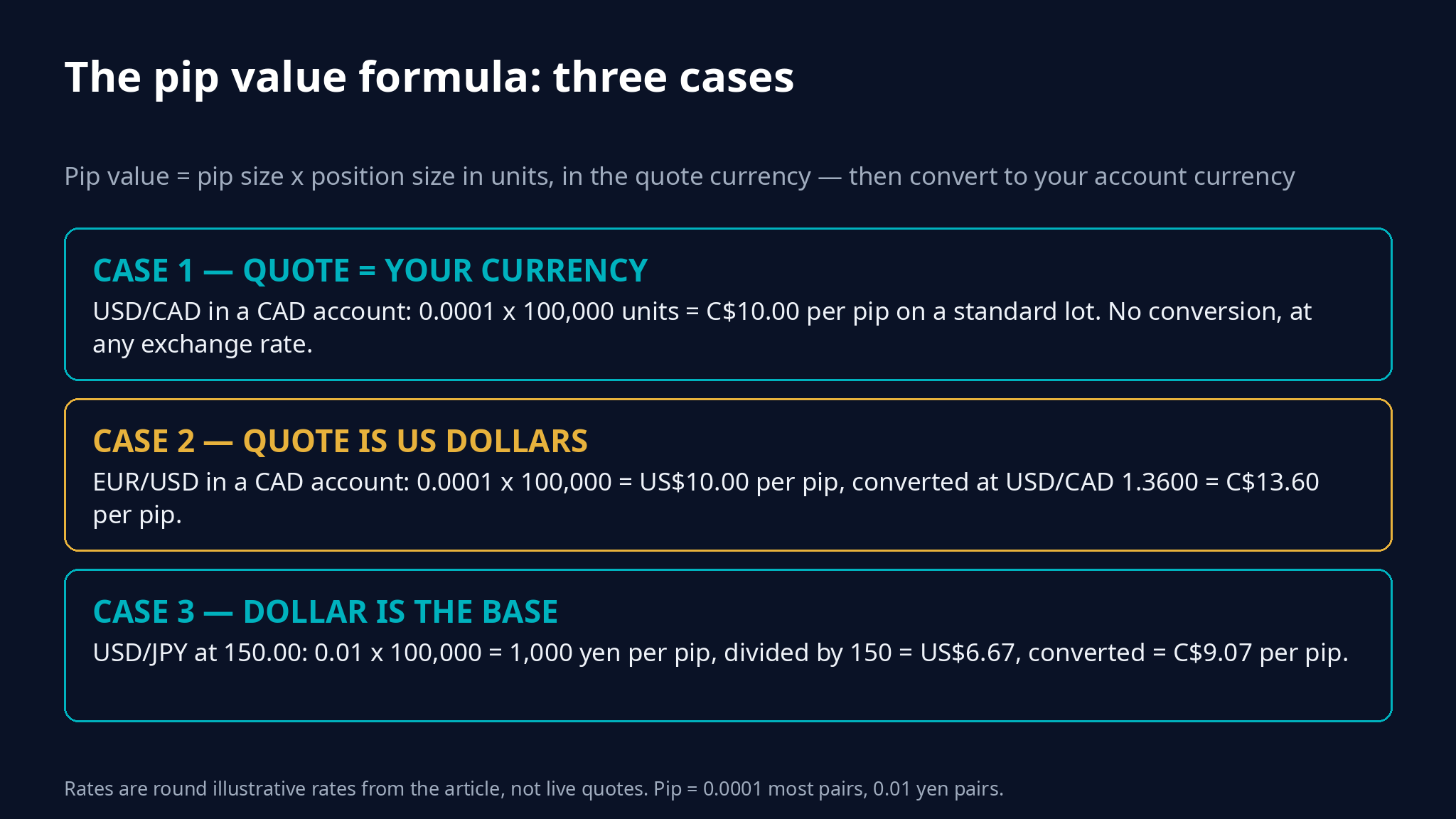
The pip value is first calculated in the pair’s quote currency — the second currency in the pair name, the one the price is written in. Then, if your account is held in a different currency, it is converted. That gives three cases:
Case 1 — The quote currency is your account currency. No conversion. Trading USD/CAD in a CAD account: pip value = 0.0001 × units, in Canadian dollars, at any exchange rate. A standard lot is C$10 per pip, always.
Case 2 — The quote currency is US dollars and your account is in CAD. Pip value = 0.0001 × units, in US dollars, then multiplied by the USD/CAD rate to get Canadian dollars. EUR/USD on a standard lot: US$10 per pip, which is C$13.60 per pip at USD/CAD 1.3600.
Case 3 — The US dollar (or another currency) is the base currency. For USD/JPY, one pip on a standard lot is 0.01 × 100,000 = ¥1,000. Convert by dividing by the pair’s own rate: at USD/JPY 150.00, that is ¥1,000 ÷ 150 = US$6.67 per pip, or about C$9.07 at USD/CAD 1.3600. The same divide-by-the-rate step applies to USD/CAD quoted into a US-dollar account, and to crosses such as EUR/GBP, where one pip on a standard lot is £10, converted at the GBP/USD rate.
The general formula that covers all three cases is:
Pip value (in quote currency) = pip size × position size in units — then convert to your account currency at the current rate between the quote currency and your account currency.
Pip values in a CAD account: worked table
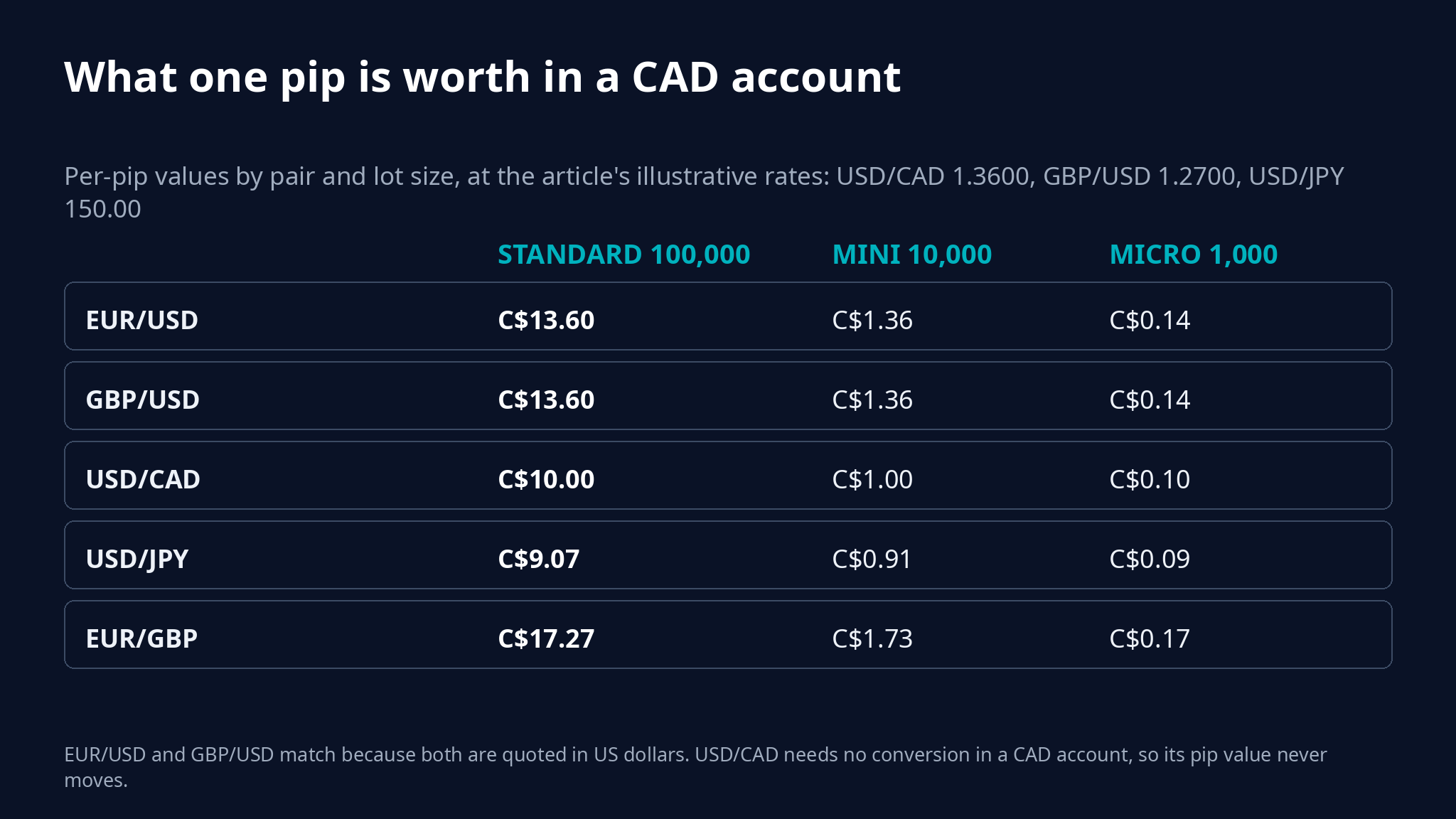
Using the illustrative rates USD/CAD 1.3600, GBP/USD 1.2700 and USD/JPY 150.00, here is what one pip is worth in a Canadian-dollar account. The first two rows never move; the last three move with the exchange rate, which is why the figures are worked at the rates named.
| Pair | Standard lot (100,000) | Mini lot (10,000) | Micro lot (1,000) |
|---|---|---|---|
| EUR/USD | C$13.60 | C$1.36 | C$0.14 |
| GBP/USD | C$13.60 | C$1.36 | C$0.14 |
| USD/CAD | C$10.00 | C$1.00 | C$0.10 |
| USD/JPY | C$9.07 | C$0.91 | C$0.09 |
| EUR/GBP | C$17.27 | C$1.73 | C$0.17 |
Two patterns are worth memorising. First, EUR/USD and GBP/USD have the same pip value in any account, because both are quoted in US dollars — the pair’s own price does not enter the calculation. Second, USD/CAD is the cheapest standard lot per pip for a Canadian, because no conversion inflates it: C$10 exactly. A trader who sizes a USD/CAD trade using the EUR/USD figure overstates their risk by 36% at these rates.
From pips to profit or loss: two worked trades
Profit or loss is pip value applied to the distance price actually travelled, in the direction of your trade.
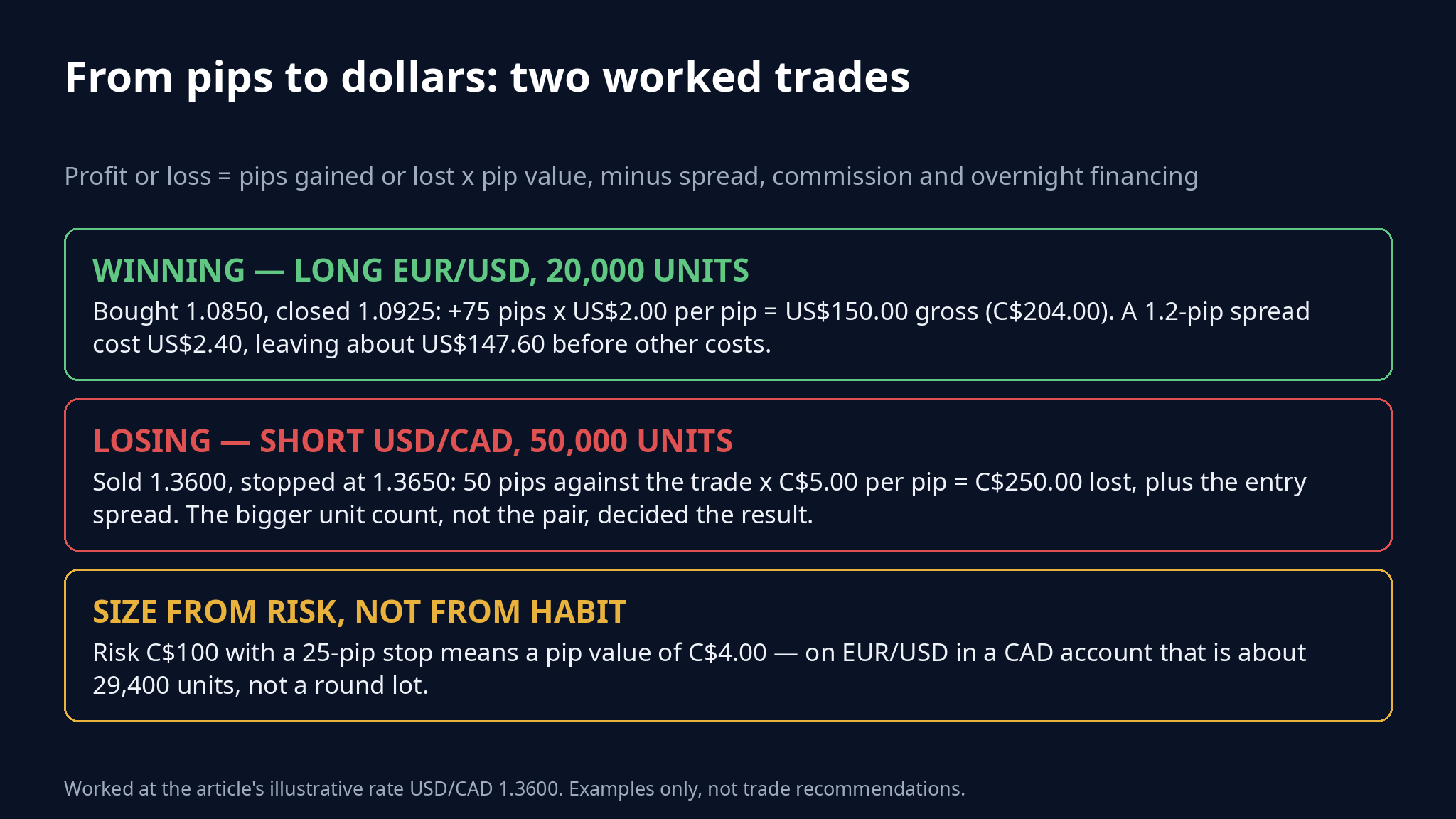
A winning trade. You buy 0.20 lots (20,000 units) of EUR/USD at 1.0850 and close at 1.0925.
- Distance: 1.0925 − 1.0850 = 0.0075 = 75 pips in your favour.
- Pip value: 20,000 × 0.0001 = US$2.00 per pip.
- Gross profit: 75 × US$2.00 = US$150.00, which is C$204.00 at USD/CAD 1.3600.
- Costs: if the spread you paid was 1.2 pips, that cost you 1.2 × US$2.00 = US$2.40. Net before any commission or overnight financing: about US$147.60 (C$200.74).
A losing trade. You sell 0.50 lots (50,000 units) of USD/CAD at 1.3600, and price rises to 1.3650, where your stop closes you out.
- Distance: 50 pips against you (you were short, and price went up).
- Pip value: 50,000 × 0.0001 = C$5.00 per pip — no conversion, because CAD is the quote currency and your account currency.
- Loss: 50 × C$5.00 = C$250.00, plus the spread you paid on entry.
Note what decided both results: not the pairs, but the unit counts. The losing trade was on the “cheaper per pip” pair and still lost more, because the position was two and a half times larger. That is the whole argument for calculating pip value before you open a trade, not after — and it is why pip value is the input our guide to leverage and risk management for Canadian traders builds its position-sizing method on.
The costs that sit between gross and net
The pips-times-pip-value figure is your gross result. Four costs reduce it, and each one is also priced through pip value:
- The spread — the difference between the buy and sell price at entry. A 1.2-pip spread on a standard lot of EUR/USD in a CAD account costs 1.2 × C$13.60 = C$16.32 the moment you open. On a micro lot the same spread costs C$0.16. Spread is a per-pip charge multiplied by your size, which is why it is trivial on small positions and material on large ones.
- Commission, on commission-based accounts (typically the raw-spread pricing tiers at Canadian dealers). This is charged per lot traded, in your account currency, and simply subtracts from the gross figure.
- Overnight financing (swap) — a charge or credit applied when a leveraged position is held past the daily rollover, reflecting the interest-rate difference between the two currencies. It is quoted per lot per night, so a position held for ten nights pays it ten times. Day traders who close before the rollover never see it; swing traders must include it.
- Currency conversion on the result itself — if your account is in CAD and the trade’s profit was earned in US dollars or yen, your dealer converts it at the prevailing rate when the trade closes. The CAD figure you actually receive can differ slightly from the figure you calculated at entry if the conversion rate moved while the trade was open.
Our profit and loss calculator takes entry, exit, direction and size and returns the gross figure; subtract the costs above for the net figure your statement will show. For the tax side of that net figure — Canadian dealers report in account currency, and the CRA taxes the result — see our guide to forex trading taxes in Canada. Keeping your own CAD-denominated record of each trade’s gross result and costs is what makes that filing straightforward.
Pip value is position sizing
Turn the formula around and pip value becomes the risk tool. If you decide in advance that a trade may lose at most C$100 if it reaches a stop 25 pips away, then:
- The pip value you can afford is C$100 ÷ 25 pips = C$4.00 per pip.
- On EUR/USD in a CAD account, each unit contributes C$0.000136 per pip (0.0001 × USD/CAD 1.3600), so the position size is C$4.00 ÷ C$0.000136 = about 29,400 units — roughly 0.29 lots.
- Check: 29,400 units × 0.0001 = US$2.94 per pip = C$4.00 per pip, and 25 pips × C$4.00 = C$100. The risk you chose is the risk you get.
Do this calculation with the converted pip value for your account currency, every time. A Canadian who sizes with the familiar “US$10 per standard lot” figure while holding a CAD account understates their true per-pip exposure by the full USD/CAD conversion — at 1.3600, a 36% understatement, on every trade. Our dedicated walkthrough of the position size calculator applies the same method to account balance and risk percentage, and the forex leverage guide explains how the resulting position interacts with CIRO margin.
Using this site’s calculators instead of doing it by hand
By hand is how you learn it; the calculators are how you check it quickly before a trade:
- Pip value first. Open the pip value calculator, enter the pair, your position size in units, and CAD as the account currency. The figure it returns is the one to use in your risk calculation — if it differs from your hand calculation, one of the inputs is wrong, and it is usually the unit count.
- Then the trade. Open the profit and loss calculator and enter your planned entry, your target and your stop. It returns the gross profit at target and the gross loss at stop, in account currency — the two numbers that tell you whether the trade’s reward justifies its risk before you place it.
- For longer horizons, the compound growth calculator shows what a given monthly return does to an account over time — useful mainly as a reality check, because it makes plain how small the monthly returns that compound into serious money actually are, and how unrealistic a “10% a week” expectation is.
Common pip-value mistakes
- Forgetting the CAD conversion. Covered above because it is the most consequential: pip values quoted online are almost always in US dollars.
- Counting pipettes as pips. A 125-pipette move is 12.5 pips. Divide by ten.
- Using the standard-lot figure for every size. Pip value scales exactly with units. Half a lot is half the pip value; there is no rounding to the nearest lot.
- Dividing when you should multiply (and the reverse). If the result is in the quote currency and your account currency is “stronger per unit” in the quoted pair — as with converting yen profits at USD/JPY 150 — you divide by the rate. A sanity check helps: one pip on a standard lot is worth roughly C$9–C$17 on the majors at typical rates. If your calculation returns C$1,360 or C$0.14 for a standard lot, a conversion went the wrong way.
- Ignoring the spread in a short trade’s maths. On a trade targeting 10 pips with a 1.5-pip spread, the spread consumes 15% of the target before price moves at all. Short targets need the costs subtracted first, not last.
- Assuming pip value stays fixed on every pair. On USD-quoted pairs it does; on USD/JPY and the crosses it drifts with the exchange rate, so last month’s pip value is not this month’s.
Frequently asked questions
How much is 1 pip worth in Canadian dollars?
It depends on the pair and your position size. In a CAD account at the illustrative rates used on this page (USD/CAD 1.3600), one pip on a standard lot is worth C$13.60 on EUR/USD and GBP/USD, C$10.00 on USD/CAD, about C$9.07 on USD/JPY and about C$17.27 on EUR/GBP. A mini lot is worth one-tenth of those figures and a micro lot one-hundredth. Use the pip value calculator with the current rate for a live figure.
Why is my pip value different from the $10 figure I see everywhere?
Because the $10 figure assumes a US-dollar account trading a US-dollar-quoted pair at standard size. A Canadian-dollar account adds a conversion: US$10 × the USD/CAD rate. At USD/CAD 1.3600 your EUR/USD pip on a standard lot is C$13.60, not C$10 — and your risk per pip is 36% higher than the dollar figure suggests.
How do I calculate profit in pips?
Subtract the entry price from the exit price (for a buy; reverse it for a sell) and divide by the pip size — 0.0001 for most pairs, 0.01 for yen pairs. A buy entered at 1.0850 and closed at 1.0925 gained (1.0925 − 1.0850) ÷ 0.0001 = 75 pips. Multiply the pip count by your pip value for the money result, then subtract spread, commission and any overnight financing.
Is a pip the smallest move a price can make?
No. Most dealers quote a further digit — a pipette, one-tenth of a pip — so prices can move in increments smaller than a pip. Spreads and price moves quoted with that extra digit need dividing by ten to express them in pips.
Does leverage change my pip value?
No. Pip value is set by the pair and your position size in units only. Leverage changes how much margin you must post to hold that position — not what each pip is worth. This is why a highly leveraged small-margin account can still carry a large per-pip exposure: the pip value follows the units, not the deposit. Our leverage and risk management guide works through that relationship in full.
Do I pay tax on the gross or the net result?
In Canada you are taxed on your trading result after allowable costs, reported in Canadian dollars — which is why the costs section above matters at filing time as well as at trade time. Whether your result is taxed as capital gains or business income depends on how you trade. This page is general information, not tax advice; our forex tax guides explain the classification, and an accountant can apply it to your situation.
Bottom line
Canadian traders: calculate pip value in Canadian dollars, in three steps — pip size × units gives the value in the quote currency; convert it at the current rate if your CAD account is not already in that currency; then multiply by the pips gained or lost and subtract your costs. The two errors that actually cost Canadians money are skipping the CAD conversion (a 36% risk understatement at USD/CAD 1.3600) and counting pipettes as pips (a tenfold error). Learn the formula once, check it against the pip value calculator until the two agree, and size every position from the converted figure — that habit, plus the position-sizing method in our leverage and risk management guide, is most of practical risk control. For the brokers whose platforms run these calculations natively, see our ranking of the best forex brokers in Canada.
Last reviewed: November 6, 2026. All worked examples use the stated illustrative rates (USD/CAD 1.3600, GBP/USD 1.2700, USD/JPY 150.00) chosen for clear arithmetic; they are not live quotes. Pip definitions, lot sizes and the pip-value formula were re-verified at draft time against standard dealer and educational sources. Confirm a live pip value on your dealer’s platform or the calculators linked above before trading.
The pip figures in this guide apply at any of the CIRO-regulated brokers in Canada — the account currency you choose there is the one this math converts into.