Forex Order Types Explained for Canadian Traders: Market, Limit, Stop, Stop-Loss and Take-Profit Orders
Affiliate disclosure: We may earn a commission if you open an account through some links on this page, at no extra cost to you. That never changes what we teach or recommend here. See our full affiliate disclosure.
Risk warning: Forex and CFD trading is leveraged and carries a high risk of loss. Most retail accounts lose money. Nothing on this page is investment, legal or tax advice. An order type controls how a trade opens or closes — it does not make a trade a good one, and no order type can guarantee a price in a fast or gapping market.
Written & researched by Mark Prosz — trading since 2015 · Licensed Alberta Realtor · Financial content creator & broker reviewer
Last reviewed: November 13, 2026
- The short answer
- Why the order type is part of your risk plan, not a formality
- Market orders: filled now, at the price the market gives you
- Limit orders: your price or no trade
- Stop entry orders: buy above, sell below — entering on proof
- Stop-loss and take-profit: the two orders that close on your plan
- A complete trade, order by order, in Canadian dollars
- The variations worth knowing: trailing stops, stop-limit and time in force
- Common order mistakes, and what they cost
- Before you place any order: the 30-second checklist
- Frequently asked questions
- How we make money & how we research
The short answer
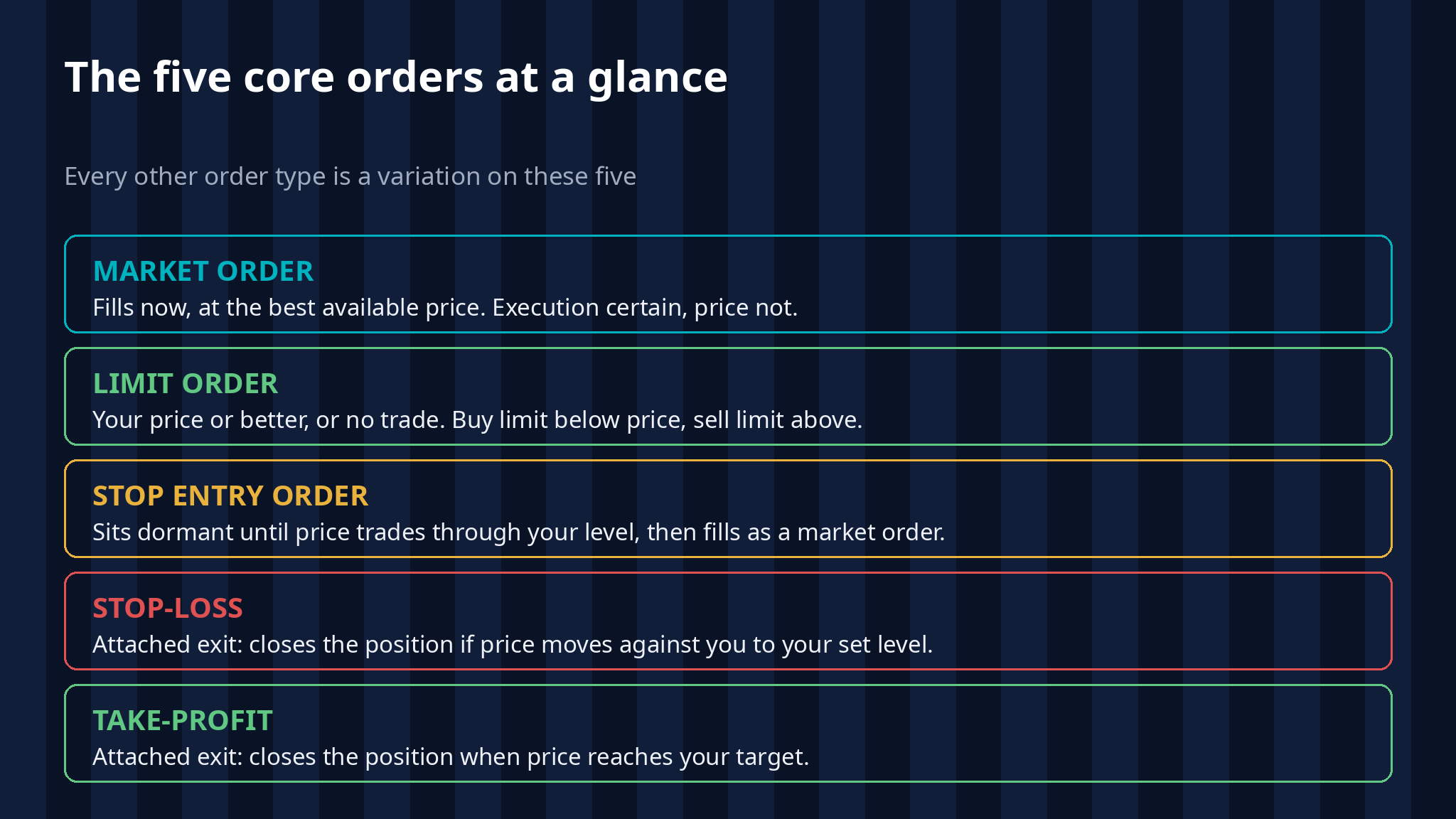
An order type is the instruction you give your broker’s platform for how a trade should open or close. A market order fills immediately at the best available price. A limit order waits and fills only at your price or better — a buy limit sits below the current price, a sell limit above it. A stop order (stop entry) does the opposite: a buy stop sits above the current price and a sell stop below it, and the order only triggers once price trades through your level, then fills as a market order. Two attached orders manage an open trade: a stop-loss closes it if price moves against you to a set level, and a take-profit closes it when price reaches your target. Every other order you will meet — trailing stops, stop-limit orders, one-cancels-the-other (OCO) orders — is a variation on those five. Learn the five properly and the rest take minutes.
Why the order type is part of your risk plan, not a formality
Beginners treat the order ticket as paperwork: pick buy or sell, pick a size, click. But the order type decides three things that matter more than most strategy rules. It decides the worst price you can be filled at (a market order has no worst price; a limit order does). It decides whether you need to be watching (pending and attached orders work while you are at your day job; a market order only exists in the moment you click). And it decides whether your exit is pre-decided or improvised — a stop-loss and take-profit attached at entry close the trade on your plan, while a position with no attached orders closes whenever fear or greed gets loud enough.
The Canadian setting sharpens all three. CIRO-regulated dealers cap effective leverage at roughly 50:1 on major pairs and less on minors and exotics, so position sizes — and therefore the distance to a margin problem — are smaller than offshore marketing suggests, but the arithmetic of a badly placed stop is unchanged. And Canadian platforms do not all offer every order variation: guaranteed stop-loss orders, a paid extra at some overseas CFD providers, are not a standard feature of CIRO dealer platforms, which is one more reason the plain stop-loss deserves respect rather than blind trust. Our leverage and risk management guide covers the sizing side of this; this page covers the instructions themselves. If you are still at the account-opening stage, work through how to start forex trading in Canada first and come back here before your first live trade.
Market orders: filled now, at the price the market gives you
A market order is the simplest instruction: buy or sell now, at the best price currently available. A buy fills at the ask, a sell at the bid — the difference between the two is the spread, your first cost on every trade. What you get is certainty of execution: in normal conditions you are in (or out) within moments. What you give up is certainty of price. The quote on your screen is the last price, not a promise, and in a fast market — a Bank of Canada decision, a US jobs report, the Sunday-evening open — the fill can land measurably away from it. That difference is called slippage, and it is a normal feature of market orders, not a broker trick.
Use a market order when being in or out matters more than the exact price: closing a position that is going wrong, or entering on a setup that is happening now and will not wait. Avoid it in the seconds around major data releases and in thin markets (exotic pairs, holiday sessions), where spreads widen sharply and a market order accepts whatever is on offer. If the price matters more than the moment, that is what limit and stop orders are for.
Limit orders: your price or no trade
A limit order fills only at the price you name, or better. It never fills worse. That single property makes it the patient trader’s entry tool — and the reason some trades never happen at all.
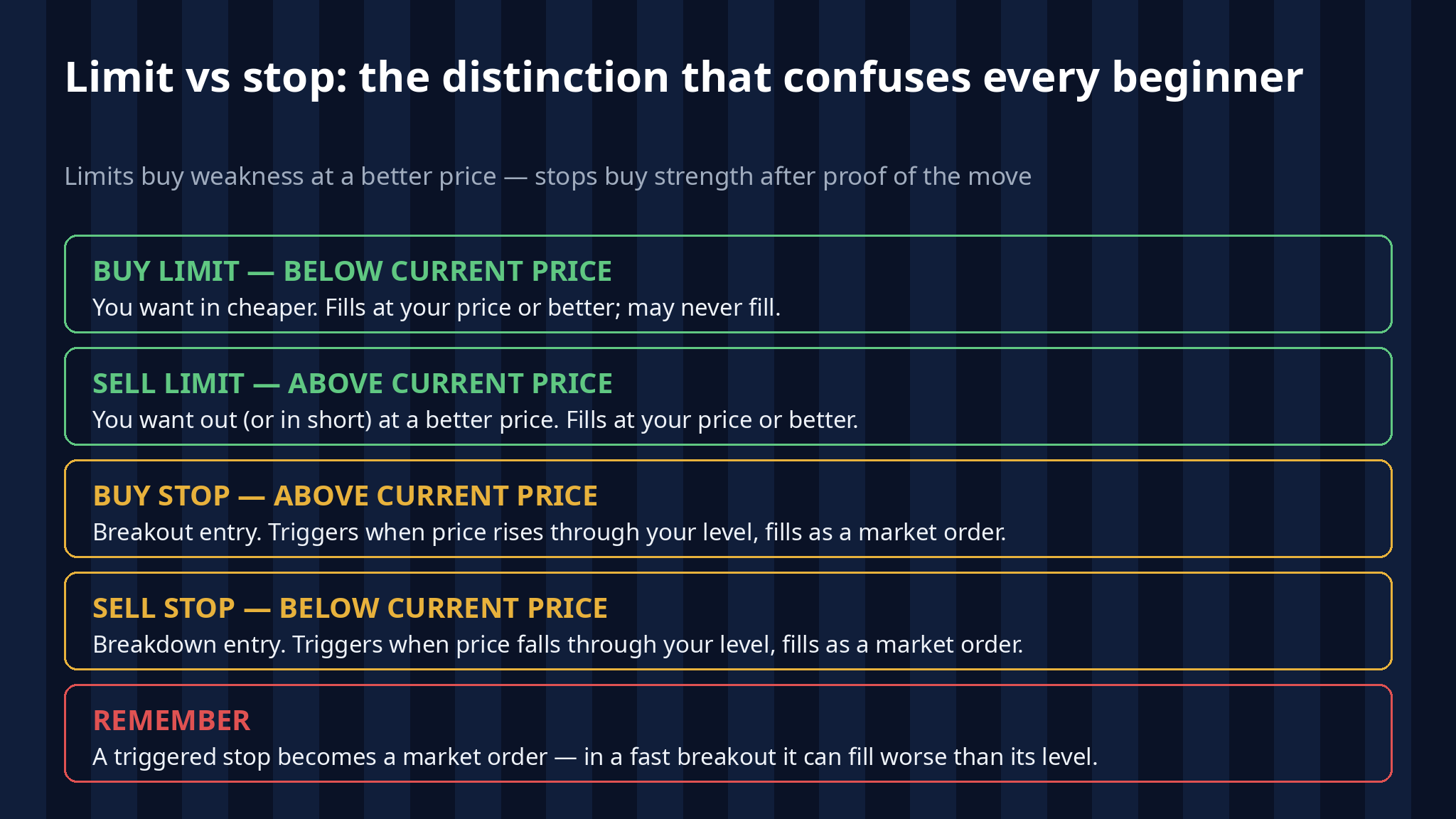
- A buy limit is placed below the current price. You use it when you want to own a pair cheaper than it trades now: you expect a dip toward a support level first, and you are only interested at that lower price.
- A sell limit is placed above the current price. You use it when you expect a rise to a resistance level first and want to sell into that strength.
The trade-off is explicit: price certainty in exchange for execution uncertainty. Price has to reach your level, trade there in enough size, and reach your place in the queue — a pair can touch your price for seconds and your order can still be left unfilled, after which price may run to where your target was without you. Traders find that maddening exactly once, then learn the rule: a limit order is a statement that you would rather miss the trade than pay more (or accept less) than your price. If missing it would genuinely ruin the plan, the plan needed a market or stop order instead.
Stop entry orders: buy above, sell below — entering on proof
A stop entry order (platforms label it a stop order, or a buy stop / sell stop) inverts the limit’s logic. It sits dormant until price trades through your level in the direction of the move, then triggers and fills as a market order.
- A buy stop is placed above the current price. You use it for breakouts: you do not want to buy while price is stuck under resistance, only once it has pushed through and shown strength.
- A sell stop is placed below the current price. You use it when you want to sell a breakdown — support giving way — rather than guessing the fall in advance.
Because a triggered stop becomes a market order, it carries the market order’s slippage risk at exactly the moment slippage is likeliest: breakouts happen in fast markets. A buy stop set at 1.3620 can fill at 1.3624 on a violent move. That is not a malfunction; it is the design. Remember it when you place stops a single pip above a famous round number that every other trader is also watching.
The limit-versus-stop distinction confuses almost every beginner, so fix it with one sentence: limits buy weakness and sell strength at a better price; stops buy strength and sell weakness after proof of the move. The comparison card below puts the four pending orders side by side.
Stop-loss and take-profit: the two orders that close on your plan
A stop-loss is an attached order that closes your open position if price moves against you to a level you set when you enter (or any time after, but entry is when your head is clearest). For a buy, the stop-loss sits below your entry; for a sell, above it. When price reaches it, the stop-loss triggers and closes the position as a market order. Two consequences deserve emphasis. First, a stop-loss caps your intended loss, not your guaranteed loss: because it fills as a market order, a gap — over a weekend, or through a data release — can fill you beyond your level, occasionally well beyond. Second, a stop-loss only works if it exists. The most expensive sentence in retail trading is “I’ll close it manually if it gets there,” spoken by someone who then watched it get there and did nothing.
A take-profit is the mirror image: an attached order that closes the position when price reaches your target. Technically it behaves like a limit order, so it fills at your target or better. Its value is behavioural as much as financial: it banks the trade your analysis planned, instead of letting a winning position ride on hope until it becomes a losing one. Placed together at entry, the stop-loss and take-profit define the trade completely — entry, worst case, target — before emotion gets a vote. Platforms treat the pair as linked: when one fills, the other is cancelled (an arrangement called one-cancels-the-other, or OCO).
Where do the levels come from? From your position size, worked backwards. Decide the Canadian-dollar amount you are willing to lose on the trade, measure the distance in pips from entry to stop-loss, and let that set your size — not the other way around. Our guide to calculating pip value and profit or loss does that arithmetic step by step, and the position size calculator page runs it for you.
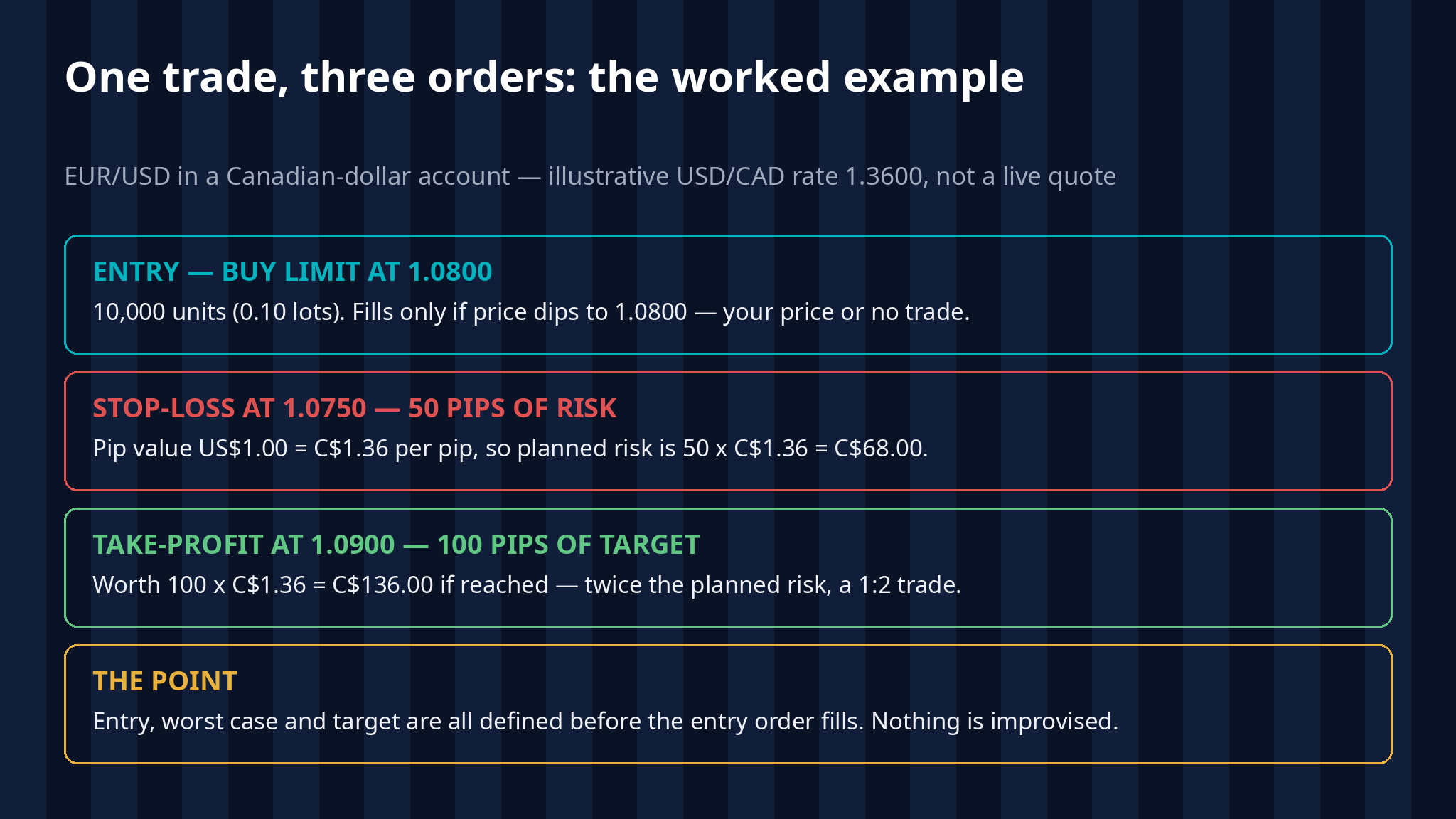
A complete trade, order by order, in Canadian dollars
EUR/USD trades at 1.0850. Your analysis says the pair is cheap if it dips to 1.0800, wrong if it falls through 1.0750, and fairly valued again at 1.0900. You trade from a Canadian-dollar account, and USD/CAD is 1.3600 — an illustrative rate for the arithmetic, not a live quote. Here is the whole trade as orders:
- Entry — buy limit at 1.0800 for 10,000 units (0.10 standard lots). Nothing happens until price falls to 1.0800. If it never does, you were never in — the limit order did its job.
- Stop-loss at 1.0750, attached at entry: 50 pips of risk. For EUR/USD, one pip on 10,000 units is US$1.00, which is C$1.36 at the stated rate. Your planned risk is therefore 50 × C$1.36 = C$68.00.
- Take-profit at 1.0900: 100 pips of target, worth 100 × C$1.36 = C$136.00 if reached — twice the planned risk, a 1:2 risk-to-reward trade, defined in full before the entry order has even filled.
Price dips to 1.0800, the buy limit fills, and from that moment the trade needs nothing from you. If price falls to 1.0750, the stop-loss closes it near that level for roughly the planned C$68 loss (a gap could make it worse — see above). If price rises to 1.0900, the take-profit closes it for roughly C$136 before costs. Spread and any overnight financing come off both outcomes, which is why the pip-value guide insists on counting costs inside the plan rather than after it.
The same skeleton works with a stop entry instead: if USD/CAD is coiling under resistance at 1.3620, a buy stop there — with its stop-loss and take-profit attached — enters only on the breakout, accepting possible slippage as the price of proof. The order types change; the discipline of defining all three prices before entry does not.
The variations worth knowing: trailing stops, stop-limit and time in force
- A trailing stop is a stop-loss that follows price by a fixed distance — say 30 pips — as the trade moves in your favour, and never moves backward. It locks in progressively more profit on a run while still giving the trade room. It does not protect against gaps any better than a fixed stop, and on some platforms it only works while your trading terminal stays open and connected — check your platform’s rule before relying on one overnight.
- A stop-limit order pairs two prices: a stop that triggers the order and a limit that caps the fill. It answers the stop entry’s slippage problem — and replaces it with the limit’s problem: in a fast move, price can jump through both prices and the order never fills at all, leaving you out of a breakout you called correctly. MetaTrader 5 offers stop-limit entries; many simpler platforms do not.
- Time in force is the expiry instruction on a pending order. Good-til-cancelled (GTC) leaves the order working until it fills or you cancel it — including weeks later, in a market you have stopped watching, which is its own risk. A day order expires at the end of the trading day. Expired-order surprises and forgotten-GTC surprises both come from skipping this field; set it deliberately.
- OCO (one-cancels-the-other) links two orders so the first fill cancels the second. The stop-loss/take-profit pair on an open position behaves this way, and some platforms let you bracket a news release with a buy stop above and a sell stop below the range — a legitimate technique that demands small sizing, because both legs sit in slippage territory.
Common order mistakes, and what they cost
- Entering at market into a data release. The spread at 8:30 a.m. on a US jobs Friday can be many times its normal width for seconds. A market order accepts all of it. Pending orders placed well before, or patience, avoid the toll.
- Placing the stop inside the noise. A stop-loss 8 pips from entry on a pair that routinely swings 15 pips in an hour is not risk management; it is a scheduled donation. Stop distance belongs to the chart’s structure and the pair’s volatility — size then adjusts to keep the dollar risk constant.
- Moving the stop-loss further away mid-trade. This converts a planned C$68 loss into an unplanned one and breaks the only arithmetic that made the trade acceptable. Moving a stop closer to protect profit is a decision; moving it away to avoid being wrong is a hope.
- No take-profit, no plan. A position with a stop but no target tends to be closed by mood. Decide the target at entry, when the analysis is fresh, or write down the condition that replaces a fixed target (a trailing stop, a time exit) — and honour it.
- Forgetting a GTC pending order. A buy limit placed in October can fill in December’s thin holiday market at a price you no longer want, in a size your account plan no longer supports. Review working orders weekly; cancel the ones your analysis no longer stands behind.
None of these mistakes is about intelligence. They are what happens when the order ticket is treated as a formality. Slow down for the thirty seconds it takes to set entry type, stop, target and expiry as one decision, and most of them disappear.
Before you place any order: the 30-second checklist
- Entry type chosen on purpose — market for now, limit for a better price, stop for proof of a move.
- Stop-loss attached, at a level set by the chart, sized so the Canadian-dollar loss is an amount you decided in advance — our guide to choosing a beginner broker explains why 1-unit and micro sizing at a CIRO dealer makes this easier to honour.
- Take-profit or exit rule written down before the entry fills.
- Expiry set — day or GTC, deliberately, with a note to review working orders.
- Costs counted — spread now, financing if the trade may run overnight, and the CAD conversion on pairs quoted in US dollars.
Order types are the vocabulary; the checklist is the habit. Pair both with a regulated account — the comparison of CIRO-regulated brokers for Canadians is where to choose one — and you have removed most of the unforced errors that end beginner accounts.
Frequently asked questions
What is the difference between a limit order and a stop order?
A limit order fills at your price or better and sits on the near side of the market: a buy limit below the current price, a sell limit above it. A stop order sits on the far side — a buy stop above, a sell stop below — and only triggers once price trades through your level, then fills as a market order. Limits buy weakness at a better price; stops buy strength after proof of the move.
Is a stop-loss guaranteed to close at my price?
No. A stop-loss triggers at your level but fills as a market order at the next available price. In a fast market or a weekend gap, that fill can be worse than your level, sometimes materially. Guaranteed stop-loss orders are not a standard feature of CIRO-regulated dealer platforms in Canada, so size every trade on the assumption that the stop is a strong intention, not a promise.
Which order type should a beginner use?
Start with the combination, not a single type: a market or limit entry with a stop-loss and a take-profit attached at the same time, in the smallest size your broker allows. Practise placing all three on a demo account until the ticket is boring, then trade live small. Avoid stop entries around major news until you have seen what slippage does to them.
What is a trailing stop and when does it help?
A trailing stop is a stop-loss that follows price by a fixed distance as your trade moves into profit, and never moves back. It helps on trending trades you cannot watch continuously, because it locks in more of the move while still giving the trade room. It does not protect against gaps, and on some platforms it only works while your terminal is open and connected — check before relying on it overnight.
Do pending orders expire?
They follow the time-in-force instruction you set. A day order expires at the end of the trading day; a good-til-cancelled (GTC) order works until it fills or you cancel it, which can be weeks later. Review your working orders regularly and cancel any your analysis no longer supports.
How we make money & how we research
We may earn a commission if you open an account through some links on this page, at no cost to you. We do not test brokers with live-funded accounts; our ratings are built from regulatory records (CIRO, CIPF, provincial regulators), public disclosures, and documented broker terms. See our methodology and affiliate disclosure.