Forex Trading in Quebec: Why the AMF, French-Language Rules and Two Missing Brokers Change Your Choice
Affiliate disclosure: We may earn a commission if you open an account through some links on this page, at no extra cost to you. See our full affiliate disclosure.
Risk warning: Forex and CFD trading is leveraged and carries a high risk of loss. Most retail accounts lose money. Nothing on this page is legal, investment or tax advice. Verify a broker’s current CIRO status, its AMF position and your own eligibility before you fund an account.
- The short answer
- Quebec vs the rest of Canada at a glance
- The AMF: an integrated regulator with its own gate
- Who is actually authorised in Quebec — and who is not
- French-language service is a right, not a courtesy
- Complaints: Quebec’s extra avenue, with real deadlines
- What is identical to the rest of Canada
- Taxes: the two-return province
- Moving to or from Quebec? Your account may not move with you
- How to check a broker from Quebec in five minutes
- Frequently asked questions
- Bottom line
The short answer
Quebec is not just another province on a dealer’s registration list. It runs the only genuinely separate derivatives regime in Canada, and it changes your broker choice in three concrete ways:
- An extra gate no other province has. Before any forex or CFD product can be offered to the Quebec public, the firm behind it must be qualified by the Autorité des marchés financiers (AMF) under Quebec’s Derivatives Act — on top of CIRO membership. The AMF publishes the list of qualified firms, and it is short.
- Two familiar names are missing from it. Plus500CA does not serve Quebec at all, and Fortrade Canada is registered in every province and territory except Quebec (and is separately barred from opening new accounts anywhere). A national ranking that lists either firm is a ranking a Quebec resident cannot fully use.
- Rights other Canadians do not have. Service and contracts in French as a legal right, a provincial complaint route with deadlines that were tightened in 2025, and a second tax return to file every spring.
The protection stack underneath is the same as everywhere else in Canada — CIRO dealers only, CIPF cover, national margin rules. This page explains the Quebec layer: who is actually authorised to take your account, what the French-language rules mean in practice, and how to check a firm in the AMF’s own registers. Our dedicated Quebec province guide covers the basics; this explainer goes into the machinery.
Quebec vs the rest of Canada at a glance
| Quebec | Rest of Canada | |
|---|---|---|
| Provincial regulator | AMF — integrated regulator (securities, derivatives, insurance, deposits) | A securities commission per province (OSC, ASC, BCSC…) |
| Extra product gate | Yes — AMF qualification under the Derivatives Act before a derivative can be offered to the public | No equivalent qualification list |
| Dealers authorised for retail forex | Six AMF-qualified CIRO dealer entities (seven brands) | Eight CIRO brands can open accounts today |
| Dealers refusing the province | Plus500CA and Fortrade Canada | None refuse Ontario; Alberta is refused or gated at several dealers |
| Language rights | Service and contracts in French by law (Charter, as amended by Bill 96) | No equivalent right |
| Complaint route | Firm → AMF complaint-file review and mediation, alongside CIRO/OBSI | Firm → CIRO process → OBSI |
| Tax filing | Two returns: CRA federal + Revenu Québec provincial | One return (provincial tax collected on the federal return) |
| Leverage and CIPF | Identical nationally — CIRO margin, CIPF up to C$1M | Identical nationally |
The AMF: an integrated regulator with its own gate
Every other province regulates forex through a securities commission. Quebec routes it through the Autorité des marchés financiers, a single integrated regulator covering securities, derivatives, insurance and deposit institutions. Retail forex falls under Quebec’s Derivatives Act (in force since 2009), and that Act adds a step the rest of the country does not have.
Under the Act, anyone who wants to create or market a derivative — and the AMF’s own page names foreign exchange contracts and CFDs as the typical examples — must first apply to the AMF for qualification before the product is offered to the public. Since July 1, 2025, the qualified firm must also offer those derivatives through a dealer, or be registered as a dealer with CIRO itself. In plain terms: CIRO membership gets a firm into Canada; AMF qualification is what gets its forex and CFD products legally in front of a Quebec resident.
That is why the AMF’s published list of qualified persons is the single most useful document a Quebec trader can read. It is also refreshingly binary — a firm is on it, or it is not authorised to offer you derivatives, whatever its national marketing says. The national layer still applies in full: our guide to whether forex trading is legal in Canada and the complete guide to forex regulation in Canada cover the CIRO and CIPF side.
Who is actually authorised in Quebec — and who is not
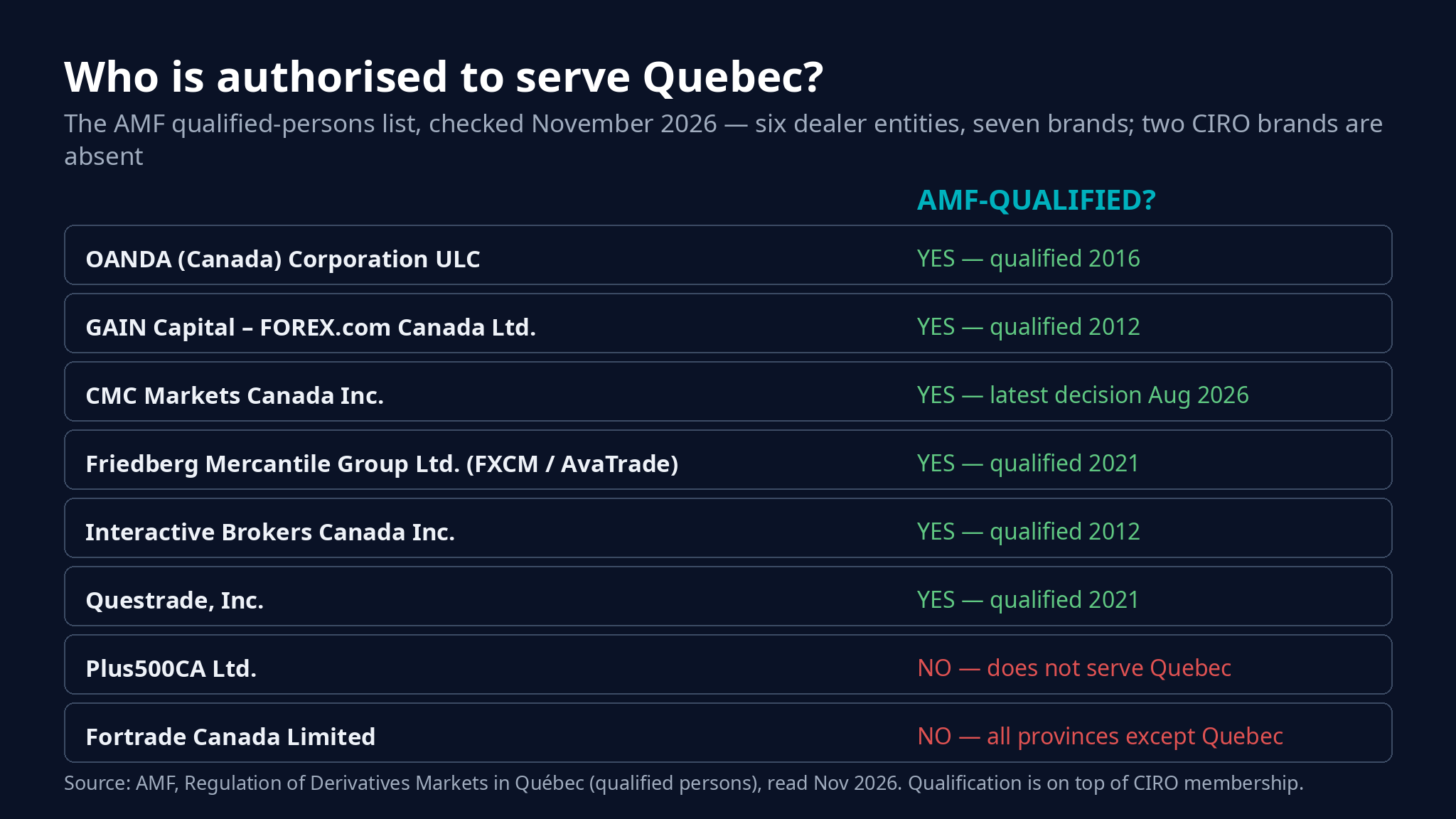
These are the firms on the AMF’s qualified-persons list, checked against the AMF’s own page in November 2026:
| Dealer (legal entity) | Brands you know it by | AMF-qualified? |
|---|---|---|
| OANDA (Canada) Corporation ULC | OANDA | Yes — qualified 2016 |
| GAIN Capital – FOREX.com Canada Ltd. | FOREX.com | Yes — qualified 2012; registered as a derivatives dealer in Québec |
| CMC Markets Canada Inc. | CMC Markets | Yes — most recent qualification decision August 2026; a derivatives dealer in Quebec |
| Friedberg Mercantile Group Ltd. | FXCM and AvaTrade, via Friedberg Direct | Yes — qualified 2021 |
| Interactive Brokers Canada Inc. | Interactive Brokers | Yes — qualified 2012; the Canadian entity is domiciled in Montreal |
| Questrade, Inc. | Questrade | Yes — qualified 2021 |
| Plus500CA Ltd. | Plus500 | No — does not serve Quebec |
| Fortrade Canada Limited | Fortrade | No — registered in every province and territory except Quebec |
Six qualified entities cover seven retail brands, because Friedberg Mercantile Group carries two brands (FXCM and AvaTrade) through its Friedberg Direct division. If you are comparing the two most different authorised dealers head to head, our CMC Markets vs Interactive Brokers comparison is written for exactly that choice — and both firms are on the AMF list.
The two absences deserve emphasis, because national content keeps getting them wrong:
- Plus500CA built its Canadian service on its CIRO licence but never serves Quebec residents — its own Canadian terms exclude the province. We set out the full province map in Plus500 vs OANDA: Plus500CA is a real option in Ontario and (for accredited investors) Alberta, but for a Quebec resident it simply does not exist.
- Fortrade Canada states its position in its own registration footprint: an investment dealer in every province and territory except Quebec. It is also barred from opening new accounts at all at the moment, so it is doubly closed to Quebecers — but the Quebec exclusion is structural, not temporary.
One more consequence follows from the qualification system: a firm can be perfectly legal elsewhere in Canada and still have no right to offer you a forex account from a Quebec address. National “best broker” lists that never mention Quebec are not lying about the other nine provinces — they are just incomplete for you. Start from the AMF list, then work through the national Best Forex Brokers in Canada ranking with the two missing names crossed out.
French-language service is a right, not a courtesy
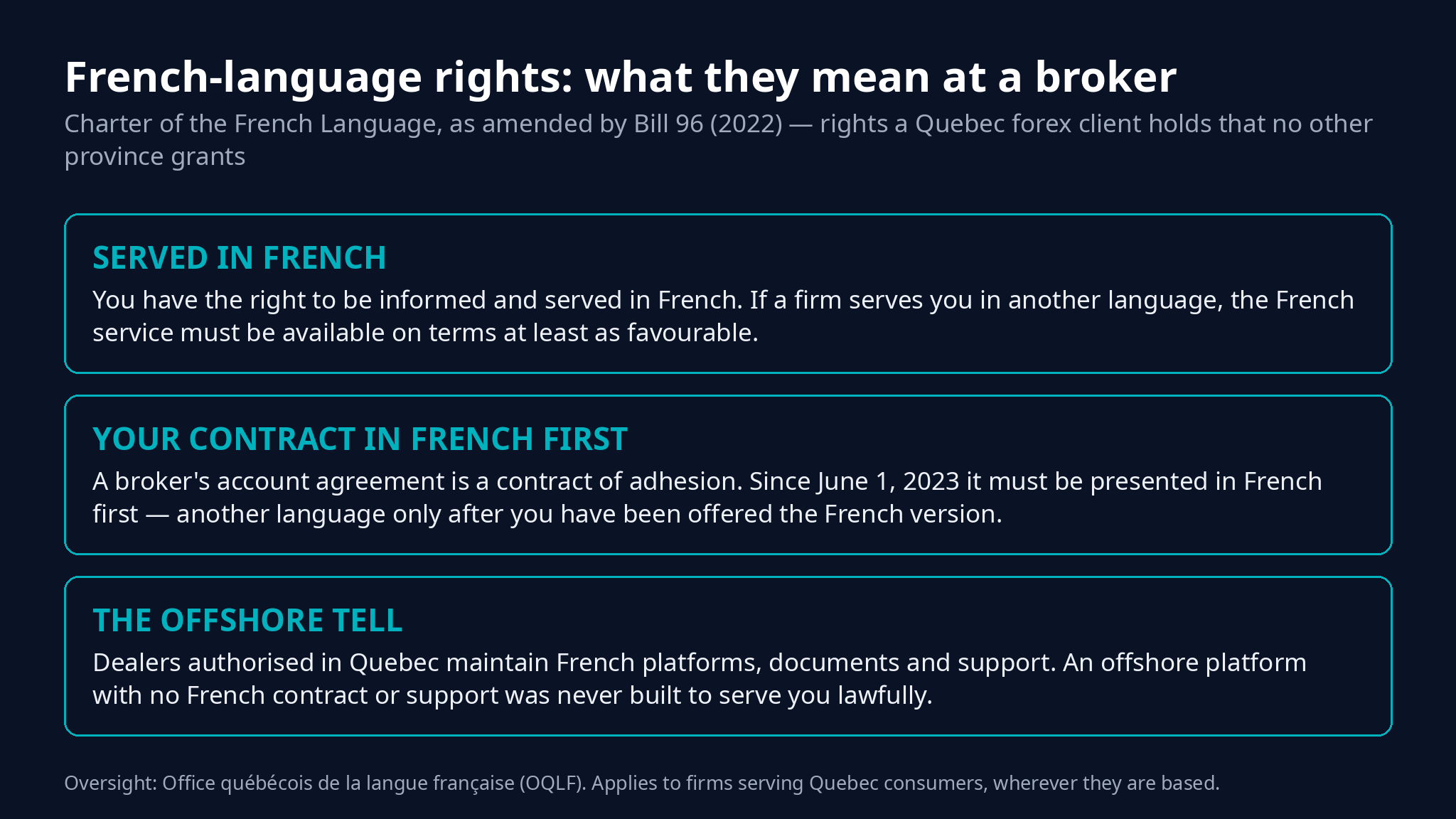
Quebec’s Charter of the French Language, strengthened by Bill 96 in 2022, gives consumers the right to be informed and served in French. If a business serves you in another language, the French service has to be available on terms at least as favourable. For a trading account, this bites in specific places:
- Your contract. A broker’s standard account agreement is a contract of adhesion — take-it-or-leave-it terms you cannot negotiate. Since June 1, 2023, a contract of adhesion must be presented to you in French first; you can choose another language afterwards, but the French version has to exist and be offered before that choice.
- Your documents and support. Disclosures, statements and customer service for Quebec clients are part of the French-service obligation — which is why every dealer on the AMF list maintains French platforms, documents or support channels.
- A practical fraud tell. An offshore platform soliciting Quebecers almost never offers a real French contract, French disclosures or French support. That absence is not proof of fraud on its own — but a firm that was never built to serve Quebec lawfully usually shows it here first, long before you reach its leverage offer.
Treat French availability as a screening tool, not a preference setting: if a “broker” cannot contract with you in French, ask what else about Quebec law it has decided to skip.
Complaints: Quebec’s extra avenue, with real deadlines
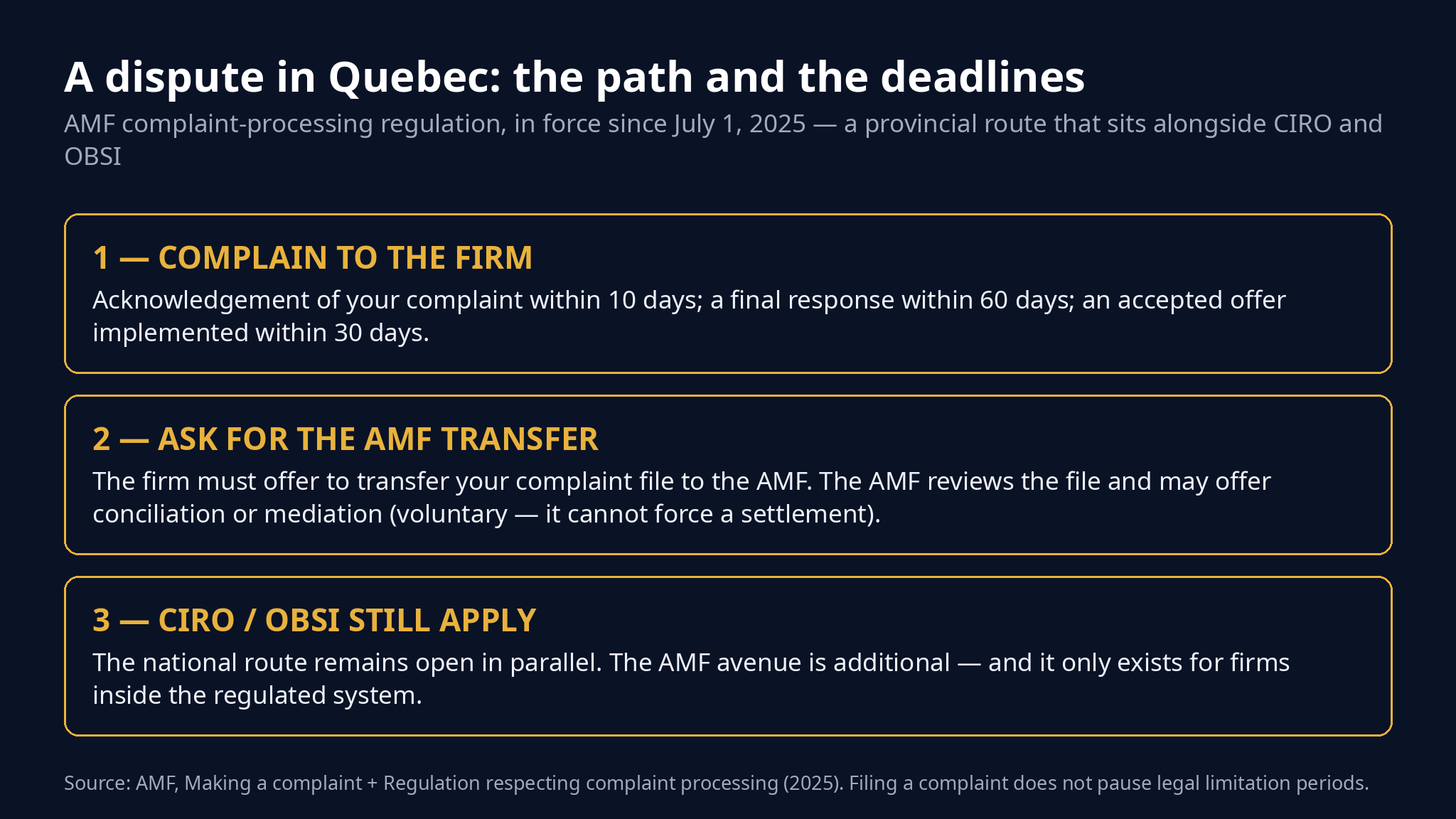
Everywhere in Canada, a CIRO dealer’s client can escalate through the firm’s complaint process and then to the Ombudsman for Banking Services and Investments (OBSI). Quebec residents get an additional, provincial route — and since July 1, 2025 it runs on a strengthened set of rules under the AMF’s complaint-processing regulation:
- Complain to the firm first. Under the 2025 regulation the firm must acknowledge your complaint within 10 days and give you a final response within 60 days. If it makes an offer you accept, it has 30 days to implement it.
- Ask for your file to go to the AMF. A firm must offer you the transfer of your complaint file to the AMF. The AMF reviews the file and can offer conciliation or mediation between you and the firm — a service no other province’s regulator provides in this form. Mediation is voluntary (the AMF cannot force a firm to settle), and the AMF can also take the matter up in its own supervision or open an investigation.
- The CIRO/OBSI route still exists. The AMF avenue sits alongside the national process; it does not replace CIRO membership, CIPF protection or OBSI. Note that filing a complaint does not pause any legal limitation period — if a dispute is serious, get advice early rather than waiting out the process.
This is a genuine Quebec advantage, and it only attaches to firms inside the system: an unregistered offshore platform has no complaint file to transfer and no AMF relationship at all.
What is identical to the rest of Canada
Do not let the Quebec layer obscure how much of this market is national. In Quebec, exactly as in Ontario or Alberta:
- CIRO-only, CIPF-backed. Leveraged forex for retail clients runs through CIRO dealer members, with CIPF cover up to C$1 million for all general accounts combined if the firm fails — against insolvency and missing property, never against trading losses.
- Same margin, same leverage. The AMF sets no separate leverage. CIRO margin is national, set per currency pair and account base currency: EUR/USD is 5% margin in a CAD account (20:1) and 3% in a USD account (about 33:1), with USD/CAD reaching the 50:1 ceiling. Anyone advertising 1:500 to a Quebec resident is unregistered by definition. The full tables are in our guide to forex leverage limits in Canada.
- No registered accounts. Leveraged forex and CFDs cannot be held in a TFSA, RRSP or FHSA in any province, Quebec included.
- Binary options are banned for individuals (terms under 30 days, under CSA Multilateral Instrument 91-102). A site pitching them to you is a fraud red flag in every province.
- Same trading clock. Quebec runs on Eastern Time, so the London–New York overlap — the deepest liquidity of the day — lands around 8 a.m. to noon Montreal time. Our Alberta vs Ontario explainer shows how different that clock looks further west.
Taxes: the two-return province
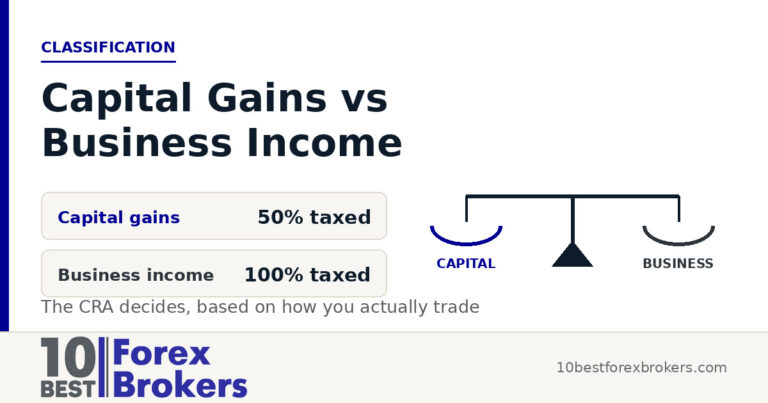
Quebec is the only province where you file two returns: the federal return with the CRA and a separate provincial return with Revenu Québec. Your forex result has to be reported on both, and the classification question — capital gains (generally half taxable) versus business income (fully taxable), decided by how you actually trade — applies at both levels. Frequent leveraged day trading leans toward business income; occasional longer-term positions lean toward capital gains. Keep CAD-denominated records from day one so both filings draw on the same numbers. Our guides to forex trading taxes in Canada and the year-end tax checklist walk through the federal side in detail; this is general information, not tax advice — get an accountant for your own situation.
Moving to or from Quebec? Your account may not move with you
Eligibility follows your residence, not your citizenship or where you opened the account:
- Moving into Quebec is the restrictive direction for two brands: a Plus500CA or Fortrade account that was ordinary in Ontario cannot simply continue from a Montreal or Gatineau address, because neither firm is authorised to serve Quebec residents. Tell your dealer before you move and plan any transition while you still control the timing.
- Moving out of Quebec opens the full national choice set — including the two firms that were closed to you — on the destination province’s terms (and if the destination is Alberta, its accredited-investor gate is waiting for you instead).
- Either way, notify your dealer of a change of residential address promptly. Account agreements require it, and quietly trading from a province your dealer cannot serve risks a frozen or closed account at the worst moment.
How to check a broker from Quebec in five minutes
- Start with the AMF’s qualified-persons list (on the AMF’s derivatives-markets page). If the legal entity behind the brand is not on it, it cannot legally offer you forex or CFDs — full stop.
- Check the AMF register for the firm’s Quebec registration, using the legal entity name, not the marketing brand.
- Confirm CIRO membership in CIRO’s “Dealers We Regulate” directory, or run the name through our CIRO Broker Checker — you need both layers, AMF and CIRO.
- Scan the AMF’s warnings and alerts, where unregistered platforms targeting Quebecers are named regularly.
- Apply with your real Quebec address. A compliant dealer screens province eligibility at signup and will tell you immediately if it cannot serve you. A platform that never asks which province you live in — and never offers you a French contract — is answering the question for you.
Frequently asked questions
Is forex trading legal in Quebec?
Yes. Forex trading is legal for Quebec residents, but the firm offering it must clear two gates: CIRO dealer membership (the national rule) and AMF qualification under Quebec’s Derivatives Act (the Quebec rule). A firm with only one of the two is not authorised to take a Quebec retail account.
Can I open a Plus500 account in Quebec?
No. Plus500CA Ltd. does not serve Quebec residents — the province is excluded in its Canadian terms, and Plus500CA does not appear on the AMF’s list of qualified persons. Quebec traders need a dealer from the AMF list above.
Why is Fortrade not available in Quebec?
Fortrade Canada Limited is registered as an investment dealer in every province and territory except Quebec, and it is not on the AMF’s qualified-persons list. It is also currently barred from opening new accounts anywhere in Canada, so it is unavailable to Quebecers on two independent grounds.
Do brokers have to serve me in French in Quebec?
Yes. Quebec’s language law gives consumers the right to be informed and served in French, and a broker’s standard account agreement — a contract of adhesion — must be presented in French first before you choose another language. Every dealer authorised in Quebec provides French documents and support; offshore platforms generally do not, which is a practical warning sign.
What happens if I have a dispute with my broker in Quebec?
Complain to the firm first: under rules in force since July 1, 2025 it must acknowledge your complaint within 10 days and respond finally within 60 days. If you are not satisfied, you can have your complaint file transferred to the AMF, which reviews it and may offer conciliation or mediation. The CIRO complaint process and OBSI remain available as well — the Quebec route is additional, not a replacement.
Is leverage higher in Quebec than in the rest of Canada?
No. Leverage and margin are set nationally by CIRO and are identical in Quebec: up to 50:1 on USD/CAD, with EUR/USD at 20:1 in a CAD account (about 33:1 in USD). The AMF adds a qualification gate for firms; it does not change the margin math for clients.
Bottom line
Quebec traders: your first filter is the AMF’s qualified-persons list — six dealer entities, seven brands. OANDA, FOREX.com, CMC Markets, Friedberg Direct’s FXCM and AvaTrade, Interactive Brokers and Questrade are authorised; Plus500CA and Fortrade are not available to you at any spread, on any platform. In exchange for the shorter list, you hold rights the rest of Canada does not: a contract in French before you sign anything, a provincial complaint route with 10-day and 60-day deadlines, and an integrated regulator that publishes exactly who may and may not offer you a derivative. Use the list, use the rights, and file both tax returns.
Last reviewed: November 4, 2026. Dealer positions re-verified against the AMF’s qualified-persons list and Derivatives Act pages, the dealers’ Canadian agreements and terms, CIRO/CIPF status, and the AMF complaint-processing regulation in force since July 1, 2025. Authorisations change — confirm current status on the AMF’s and the broker’s official sites before funding an account.
The Quebec position for every name on the national list is summarised in our guide to the best CIRO-regulated forex brokers in Canada.